Komar and Melamid Messages to the Public: We Buy Human Souls
About the Exhibition
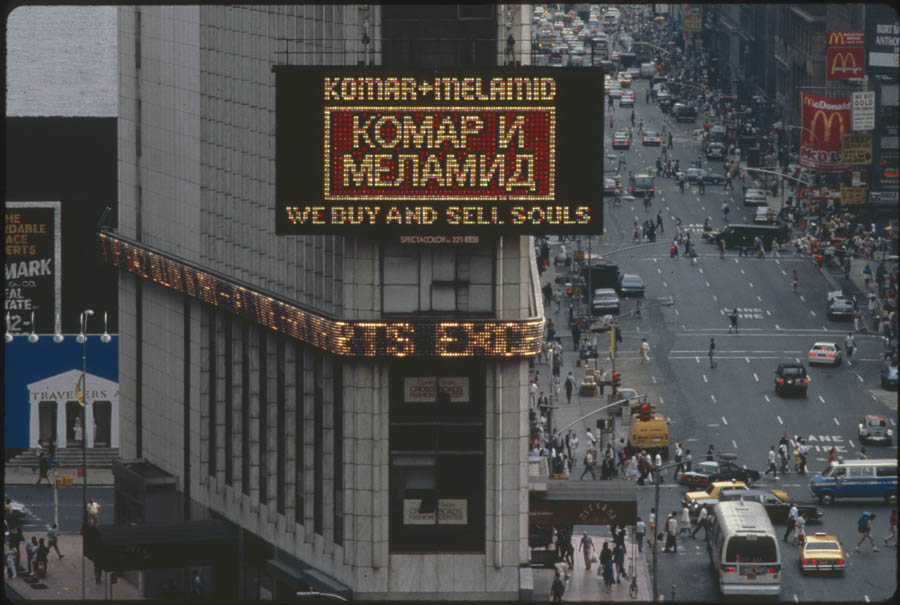
Vitaly Komar (b. 1943, Moscow, USSR) and Aleksandr Melamid (b. 1945, Moscow, USSR) use advertising and media to produce their artworks. This enables them to express their feeling that there isn’t anything in capitalistic countries that cannot be bought or sold, including the human soul.
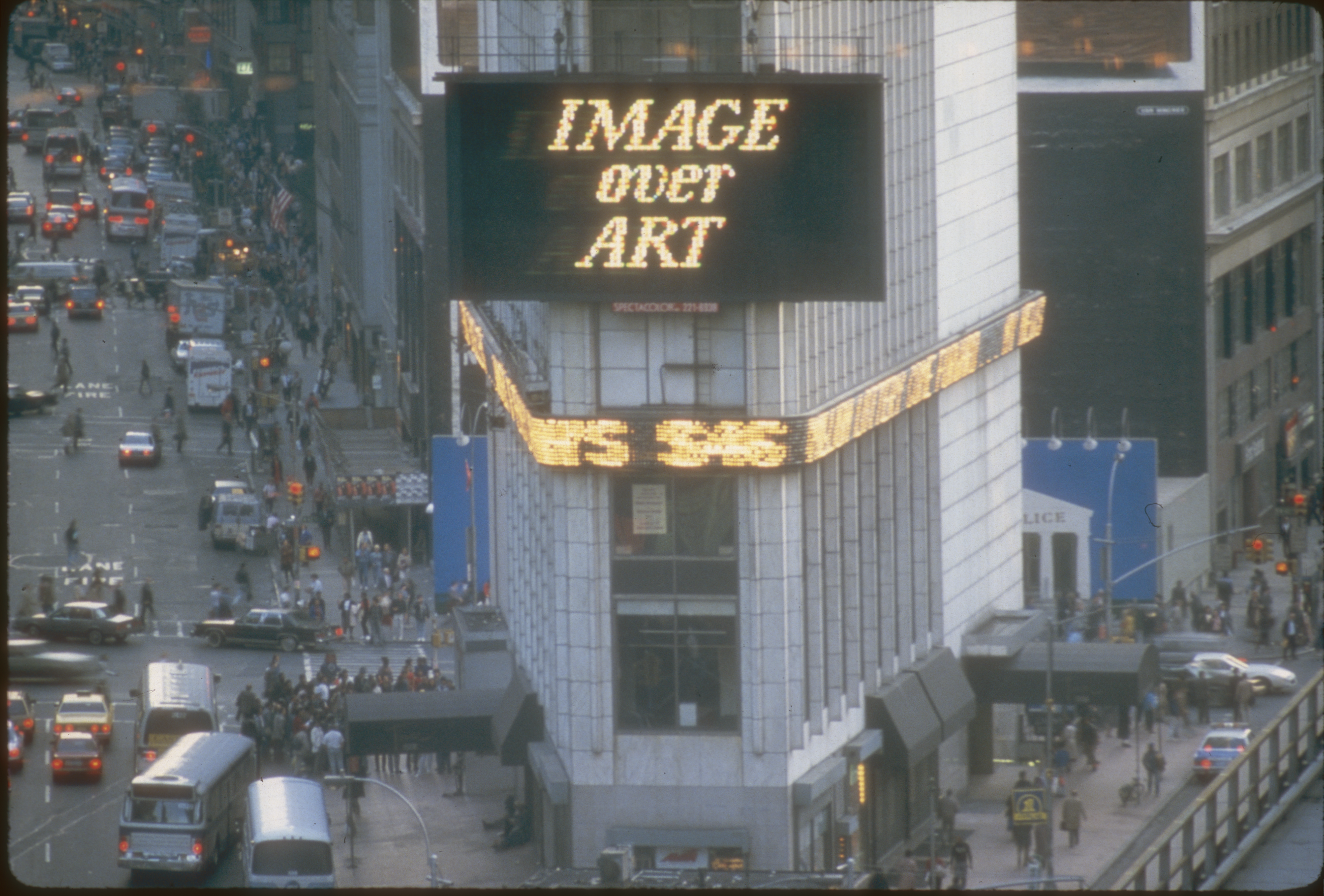
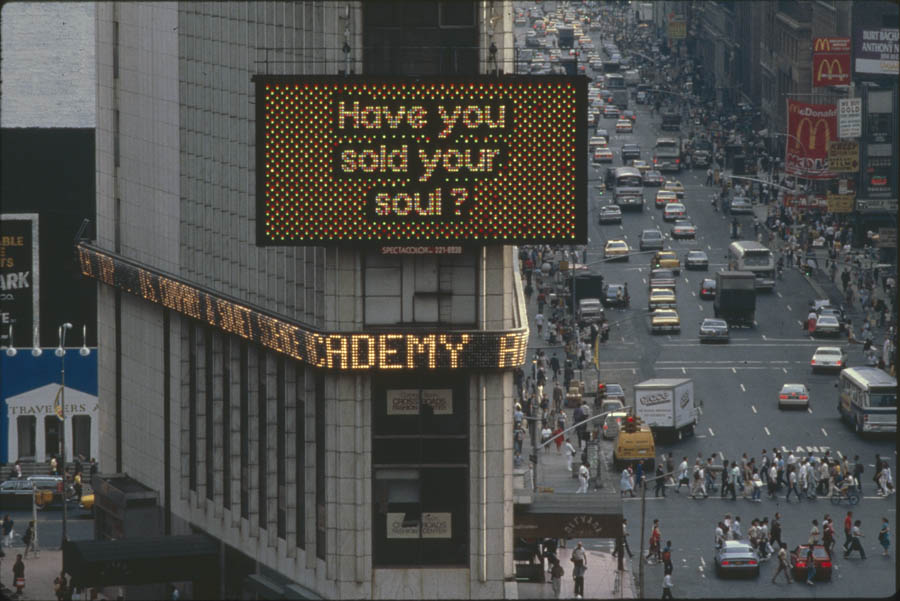
Consisting of 40-foot-wide, brightly colored graphic messages, Komar and Melamid’s piece has to do with the buying and selling of souls. Messages such as “Have you sold your soul yet?” and “A soul is the best investment,” are followed each time by the refrain “Komar and Melamid: We Buy and Sell Human Souls.”
Until 1986, Komar and Melamid were in the business of buying and selling human souls, a business the two of them created. They “sold” over 800 souls through advertisements in periodicals and galleries for the four years the business existed. Among one of the most noteworthy souls sold was that of Andy Warhol, who sold his soul for nothing. Warhol’s soul was bought by a Russian man for 30 rubles.
“Someone actually asked a million dollars for their soul, but no one bought it,” the artist Komar stated. “We are having a difficult time succeeding in this business because everyone wants to sell their soul, no one wants to buy.”
Komar and Melamid came to New York from the Soviet Union in 1978 (by way of Israel) to pursue their dream of putting art in the street; they collaborated from 1974 to 2003. In all their works, Komar and Melamid mix historical events and autobiographical references, some of which are political. According to Komar, their dream of putting art on the street finally come true with “Messages to the Public”.
Photo Gallery
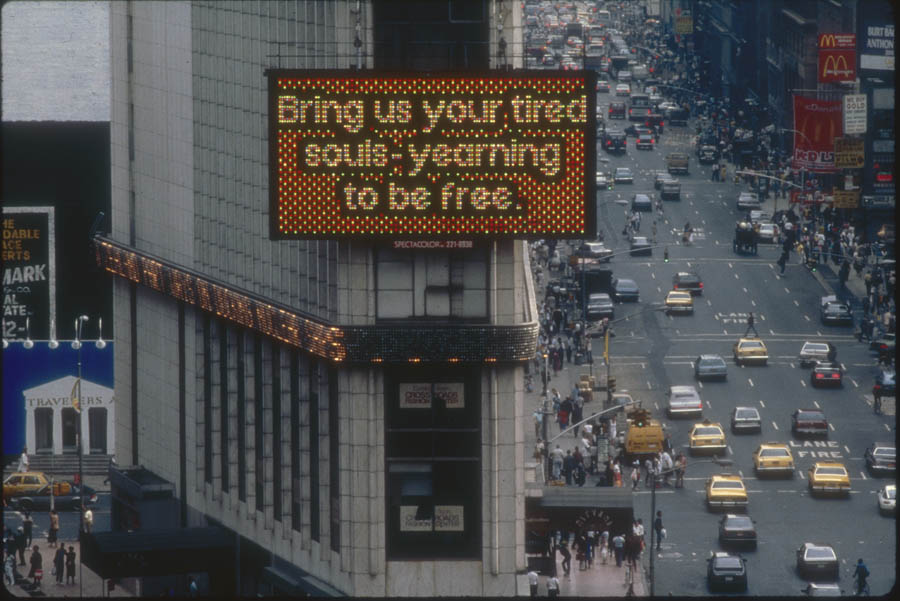
About the Series
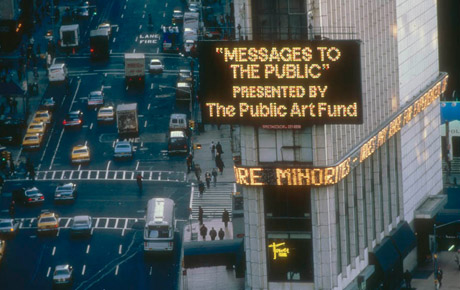
Messages to the Public formed a key part of the Public Art Fund’s long-term commitment to media-based artworks. Running from 1982 to 1990, the show featured a series of artists’ projects created specifically for the Spectacolor board at Times Square.
As Russell Miller from Ohio newspaper The Toledo Blade explained in his article on February 19, 1984, “every month, a different artist presents a 30-second animation on the Spectacolor light board—an 800-square-foot array of 8,000 red, white, blue, and green 60-watt bulbs that dominates the Times Square vista. The spot is repeated more than 50 times a day for two weeks, wedged into a 20-minute loop of computer-animated commercials.
“Jane Dickson, a painter, was working for Spectacolor, Inc. as an ad designer and computer programmer when, three and a half years ago, she first thought to use the light board to display noncommercial art.
“‘I picked that title,’ she said of Messages to the Public, ‘because I thought the propaganda potential from this project was terrific.’ The board, she noted, was regularly used for ‘commercial propaganda.’
“Dickson sought help from the Public Art Fund, an organization based here and dedicated to taking art out of the galleries and placing it in the city’s streets and parks.”
Project Director of the Public Art Fund Jessica Cusick explained, “We’re trying to do art that’s timely, has a message, is visually potent and is trying to deal with the fine line dividing fine art and commercial art.”
Related Exhibitions

Originally on view at Doris C. Freedman Plaza, Central Park