

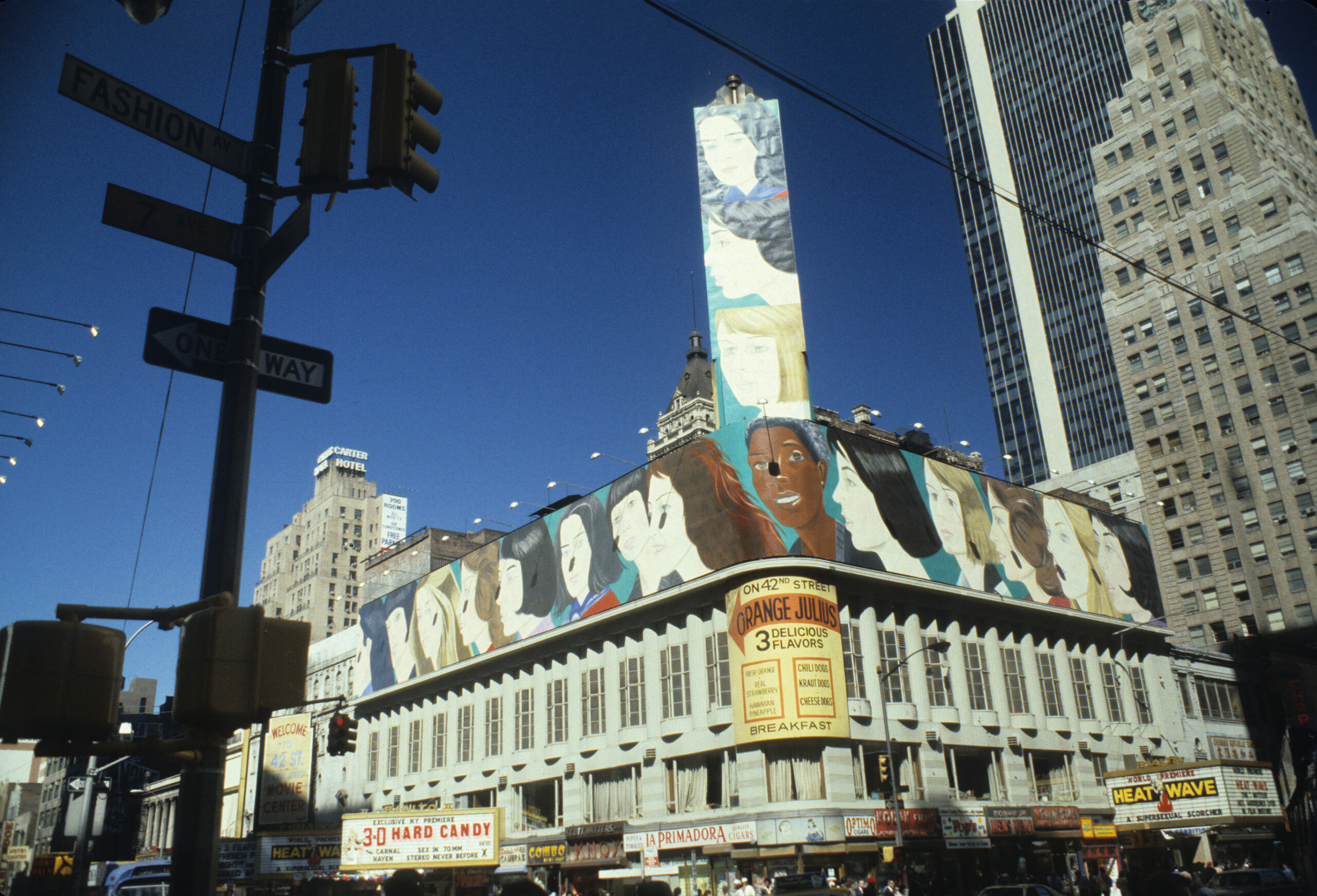
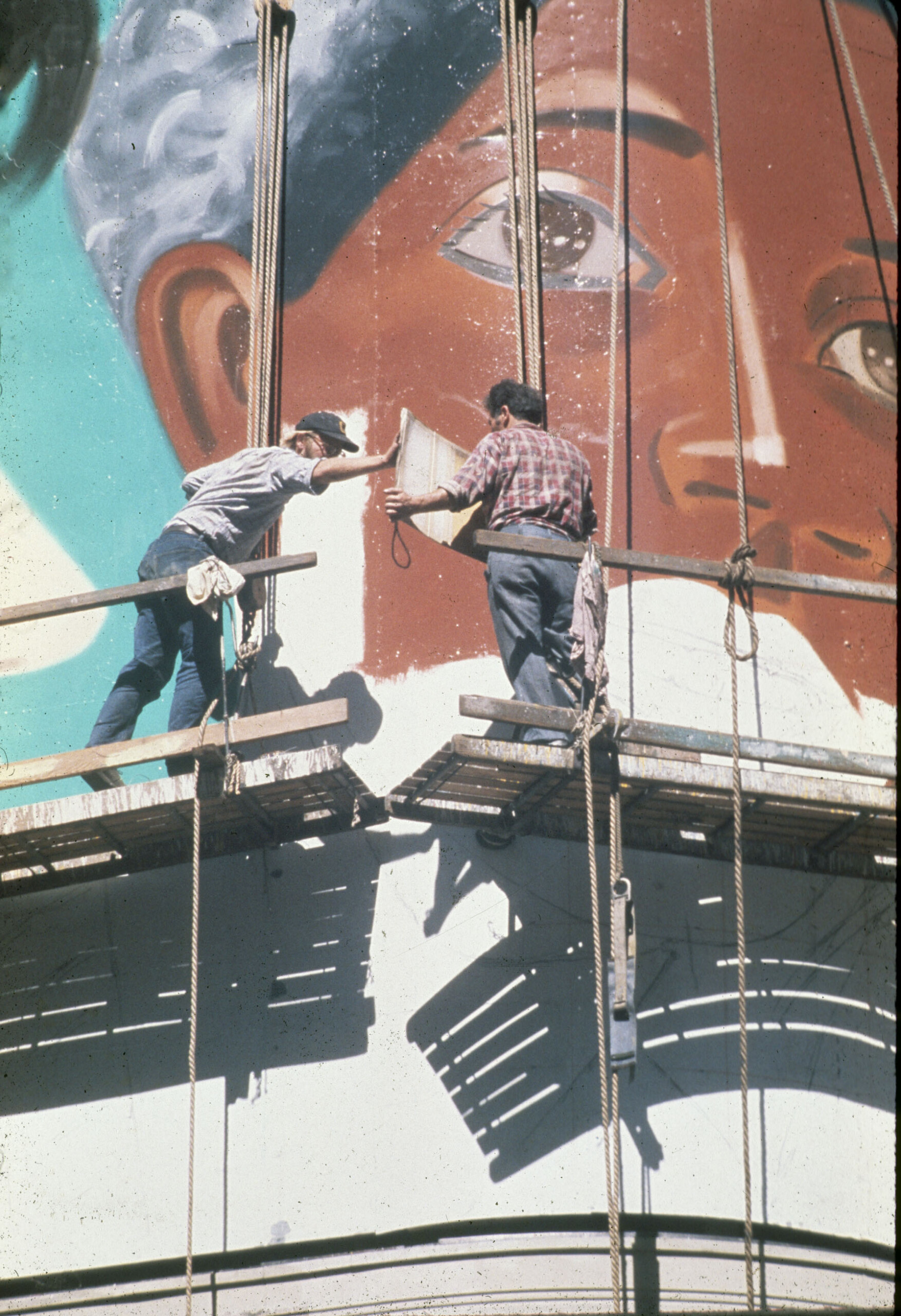
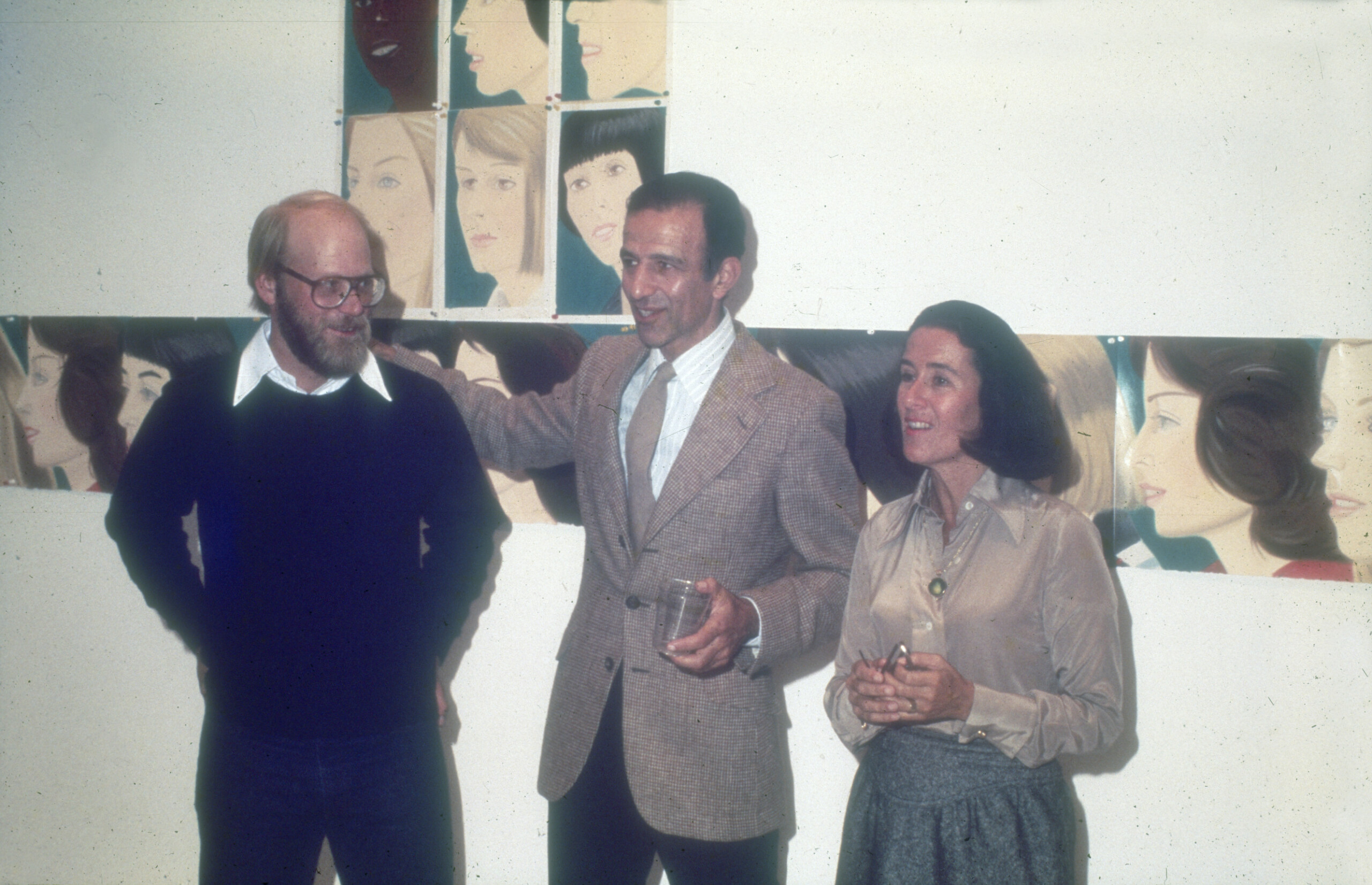
Nine Women by Alex Katz (b. 1927, New York City, NY) is a 240’ billboard painting in the heart of Times Square, the center of New York’s Theater District. Doris C. Freedman, Chairman of the Public Arts Council, commented that Katz’s work “is an excellent example of how public spaces can be enlivened and enhanced through the integration of art into the urban environment. Alex Katz’s design—a procession of 24 women’s faces—adds a flowing, light, and spacious sense to the usually congested environment of 42nd Street and Broadway.” The work consists of 23 female heads—each 20’ high—that perch on the 240’ billboard and the 60’ tower looming behind, lending the distinctive vision of one of the nation’s leading contemporary artists to America’s most commercial thoroughfare.
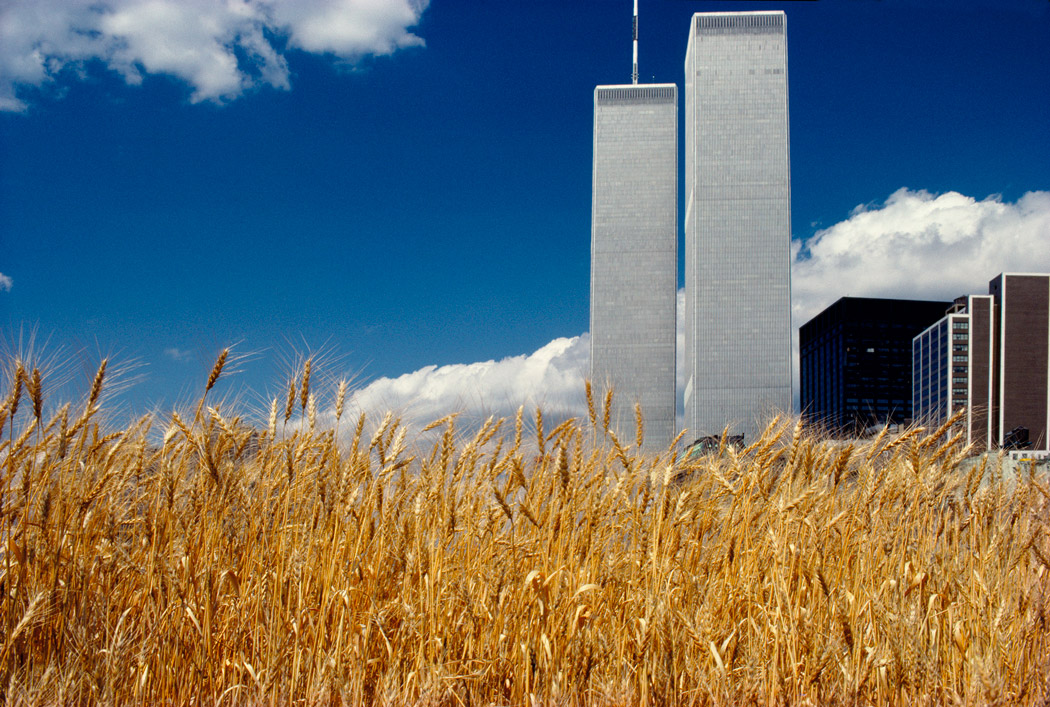
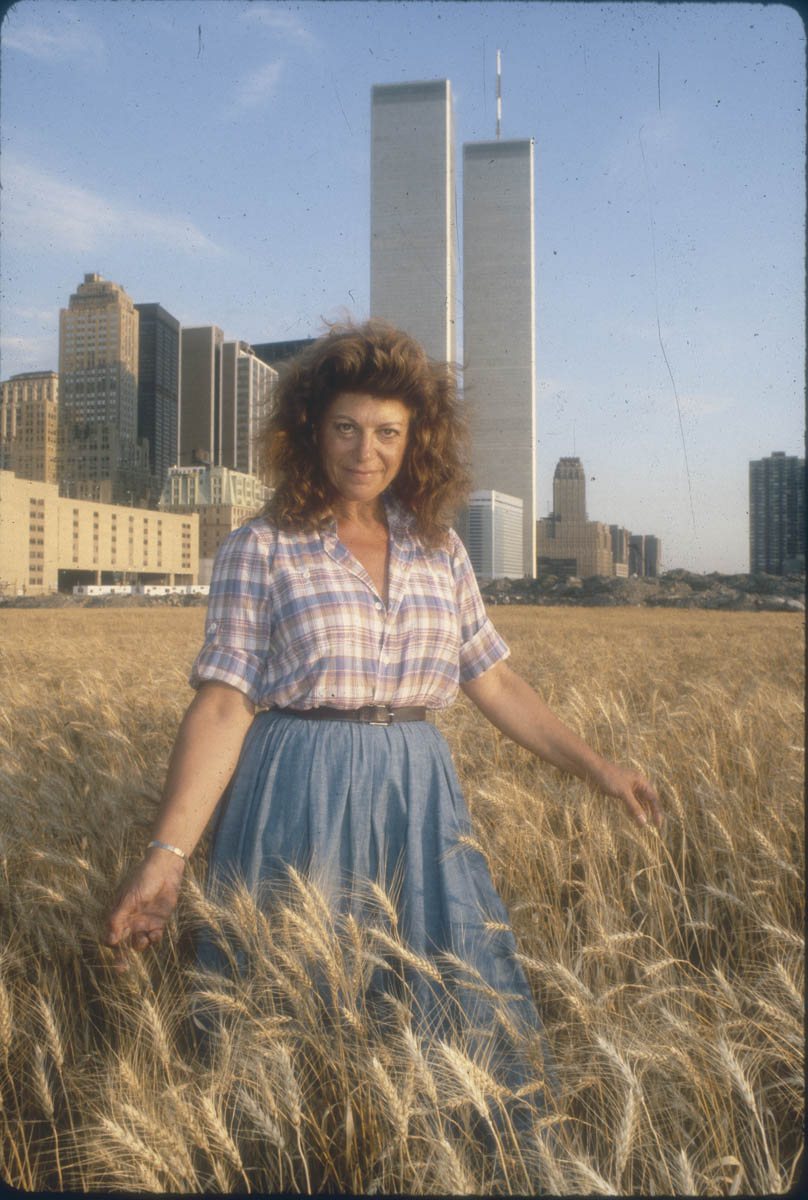
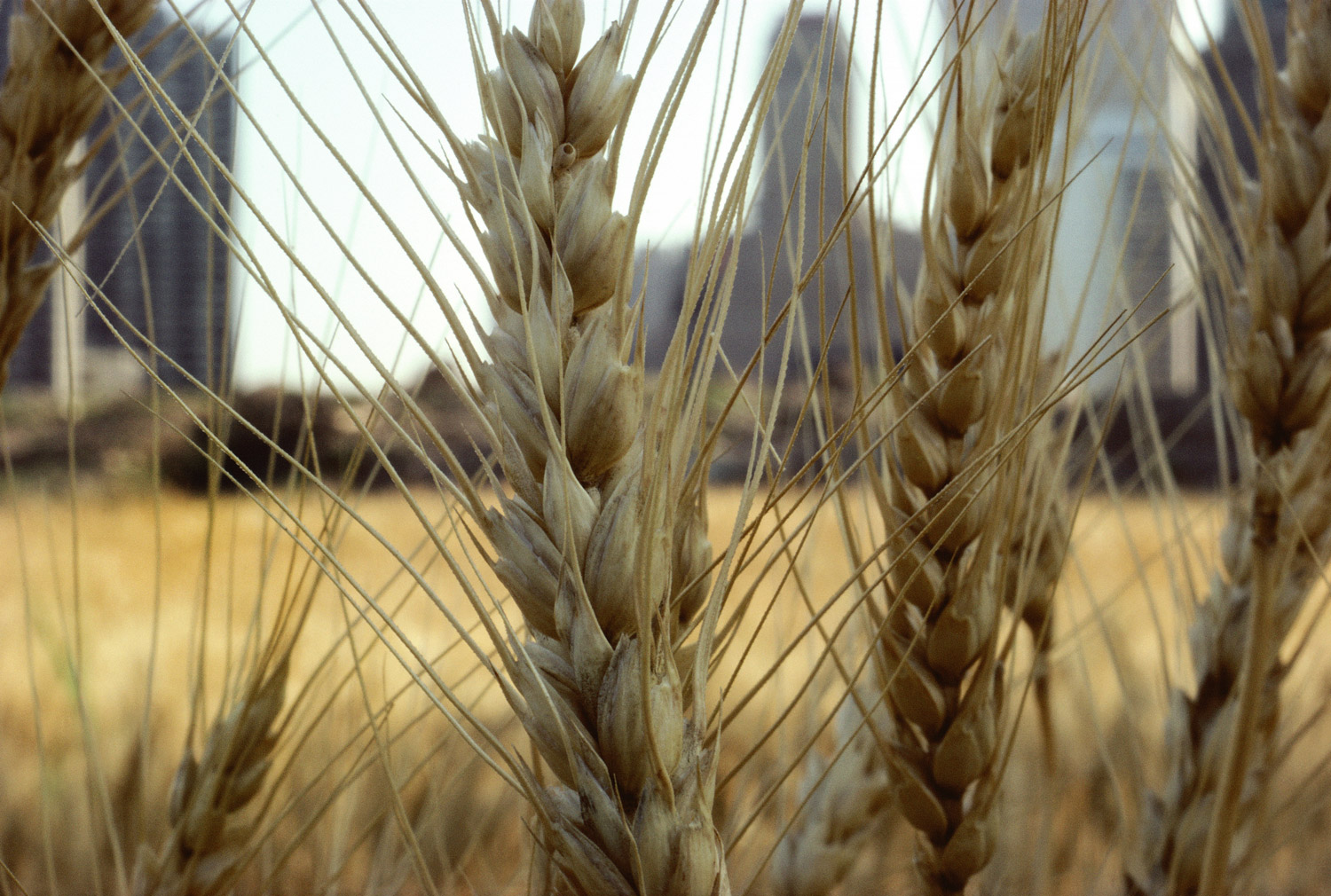
Agnes Denes (b. 1931, Budapest, Hungary) and her assistants planted and harvested 1.5 acres of wheat at the Battery Park City Landfill. The planting consisted of digging 285 furrows by hand, clearing off rocks and garbage, and then placing the seeds by hand and covering the furrows. Each furrow took two to three hours. Denes and her assistants maintained the field for four months, set up an irrigation system, weeded, put down fertilizers, cleared off rocks, boulders, and wires by hand, and sprayed against mildew. On August 16, 1982, Denes harvested the crop, yielding almost 1000 pounds of healthy, golden wheat. Denes describes the project as a “symbol, a universal concept. It represents food, energy, commerce, world trade, economics. It refers to mismanagement and world hunger. It is an intrusion into the Citadel, a confrontation of High Civilization. Then again, it is also Shangri-La, a small paradise, one’s childhood, a hot summer afternoon in the country, peace. Forgotten values, simple pleasures.”

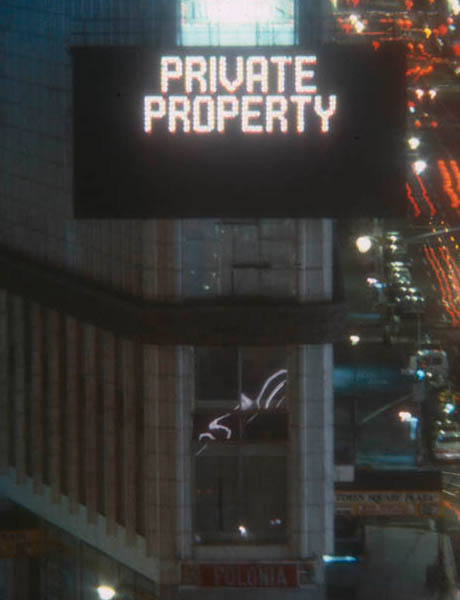
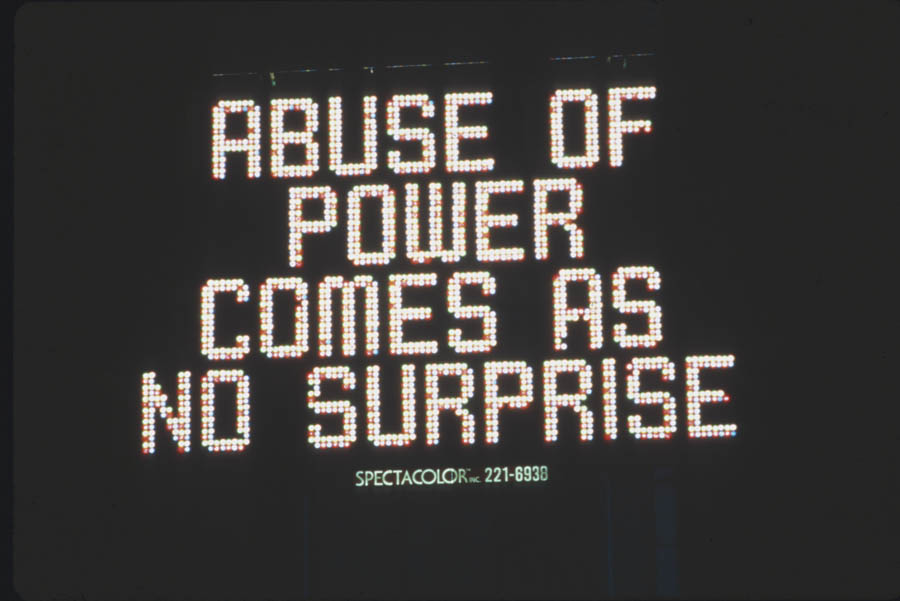
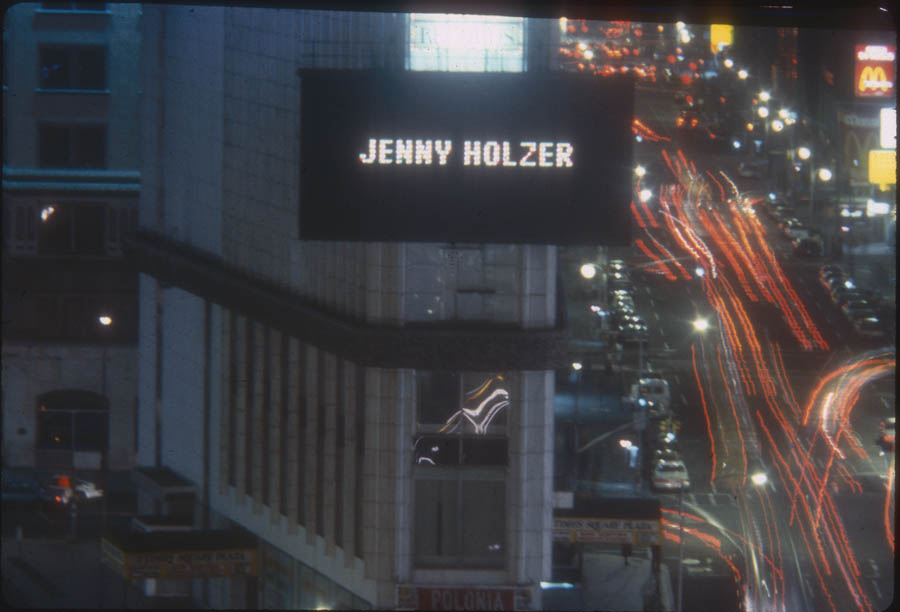
Messages to the Public formed a key part of the Public Art Fund’s long-term commitment to media-based artworks. Running from 1982 to 1990, the show featured a series of artists’ projects created specifically for the Spectacolor board at Times Square.
As Russell Miller from Ohio newspaper The Toledo Blade explained in his article on February 19, 1984, “every month, a different artist presents a 30-second animation on the Spectacolor light board—an 800-square-foot array of 8,000 red, white, blue, and green 60-watt bulbs that dominates the Times Square vista. The spot is repeated more than 50 times a day for two weeks, wedged into a 20-minute loop of computer-animated commercials.
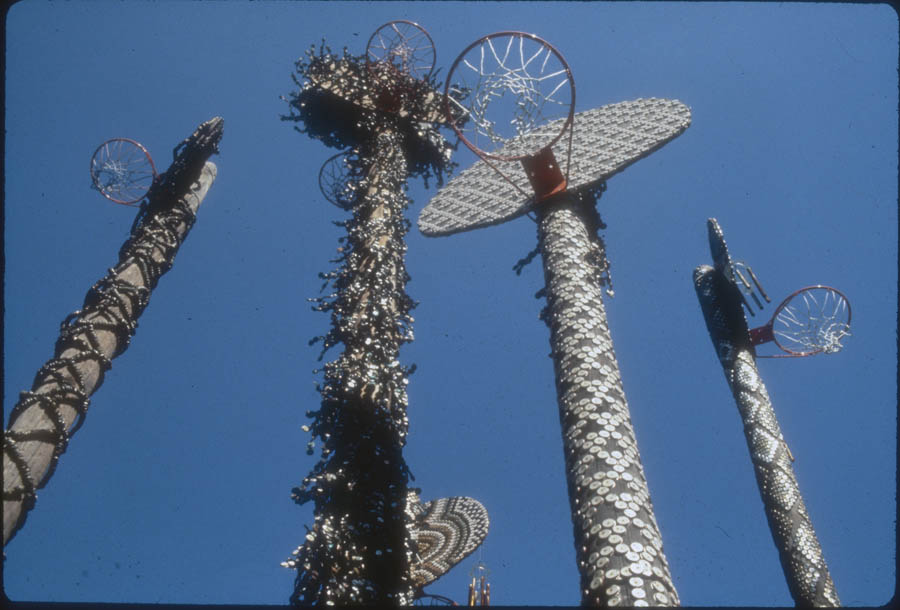
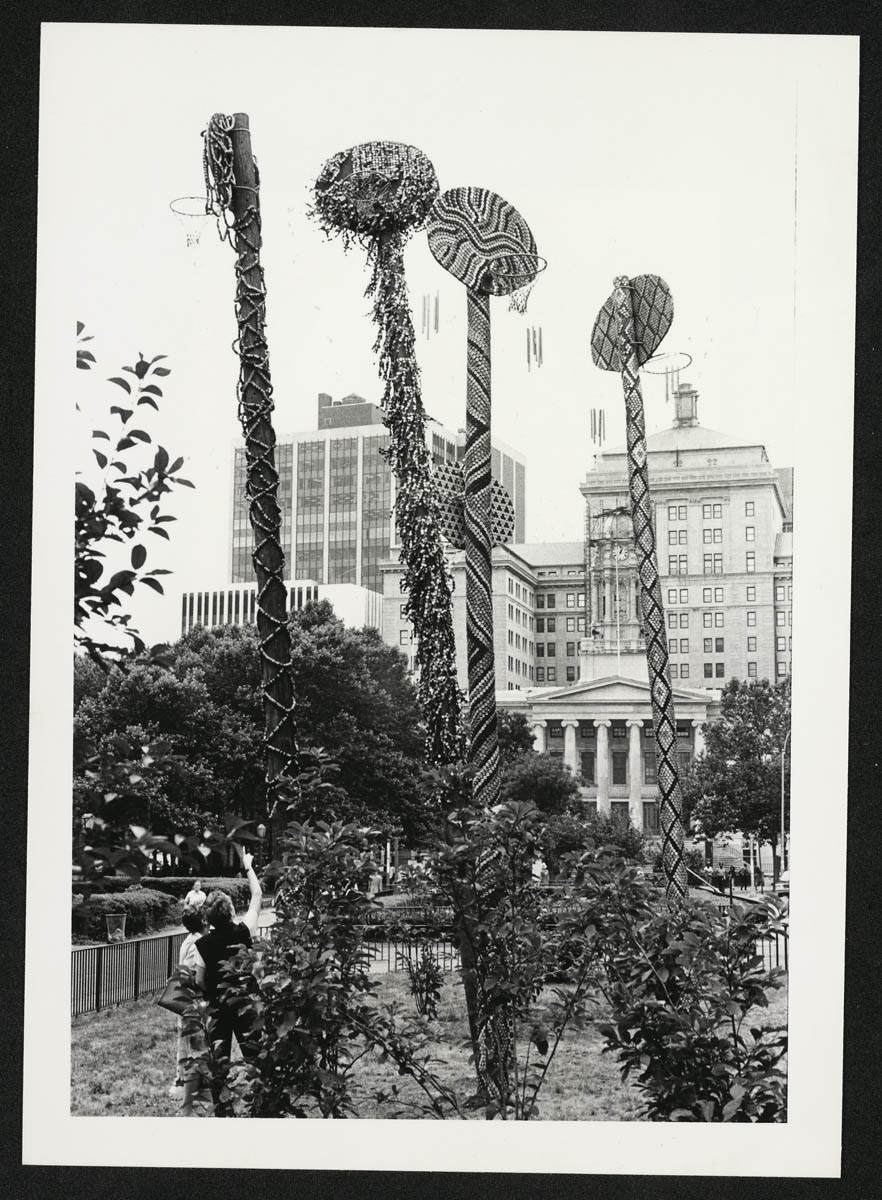
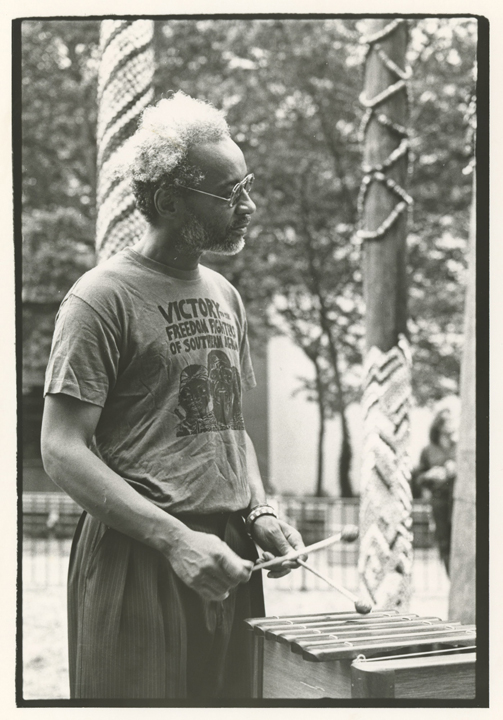
As Artist-in-Residence, David Hammons (b. 1943, Springfield, IL) constructed a temporary sculpture titled Higher Goals. The work was built on site in Brooklyn’s Cadman Plaza Park over a period of eight weeks.
Higher Goals consists of five bottle cap–studded telephone poles ranging in height from 20 to 30 feet. Mounted at the top of each pole is a basketball backboard (also covered with bottle caps), complete with hoop and net. In a labor-intensive process, Hammons nailed more than 10,000 bottle caps onto the surface of each pole to create distinctive diamond, spiral, and mesh patterns. Hammons explained the concept behind Higher Goals with an analogy to professional basketball teams. “It takes five to play on a team, but there are thousands who want to play—not everyone will make it, but even if they don’t, at least they tried.” This statement is indicative of Hammons’ personal belief that aspirations should not be confined to set limits and that individuals should set goals at higher levels (i.e. above the standard 10-foot-high measure of a basketball net).
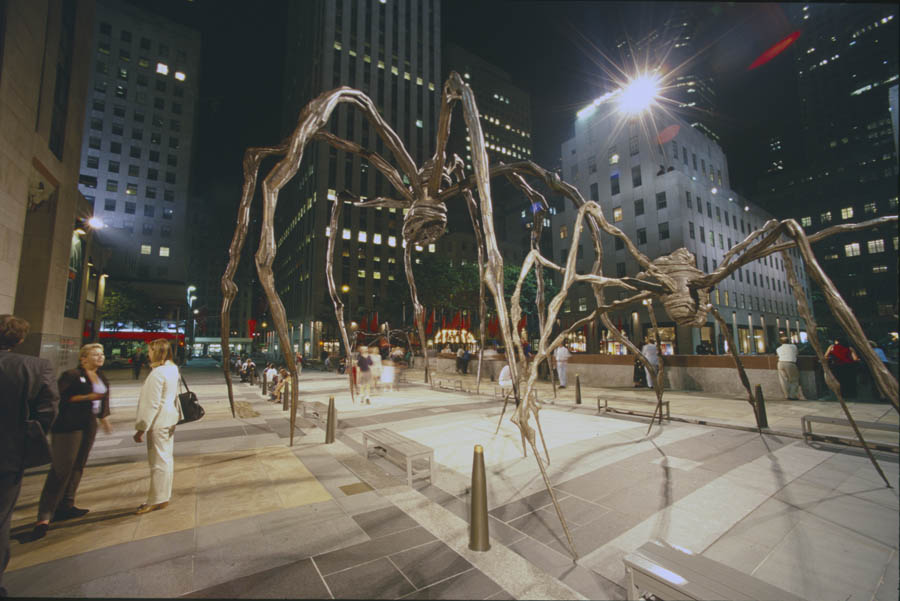
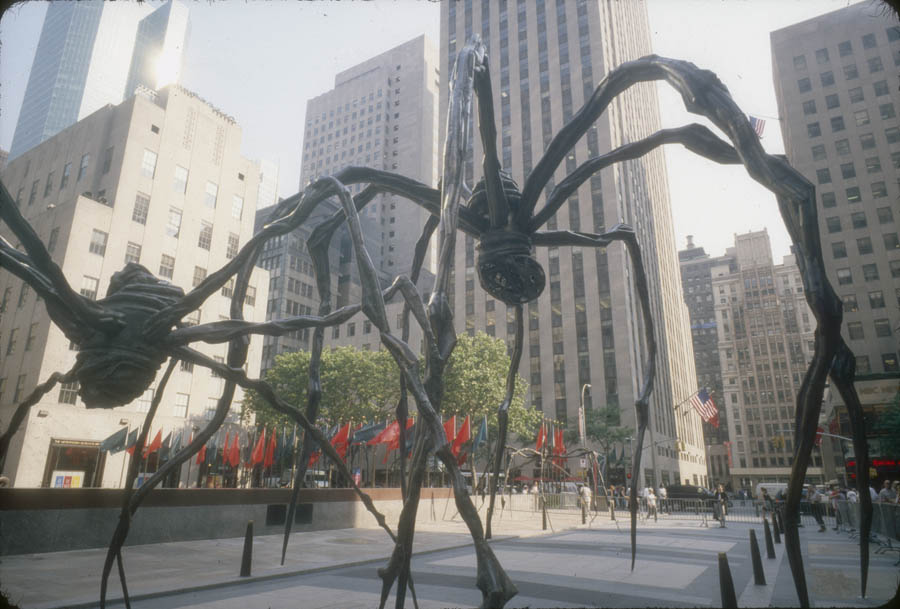
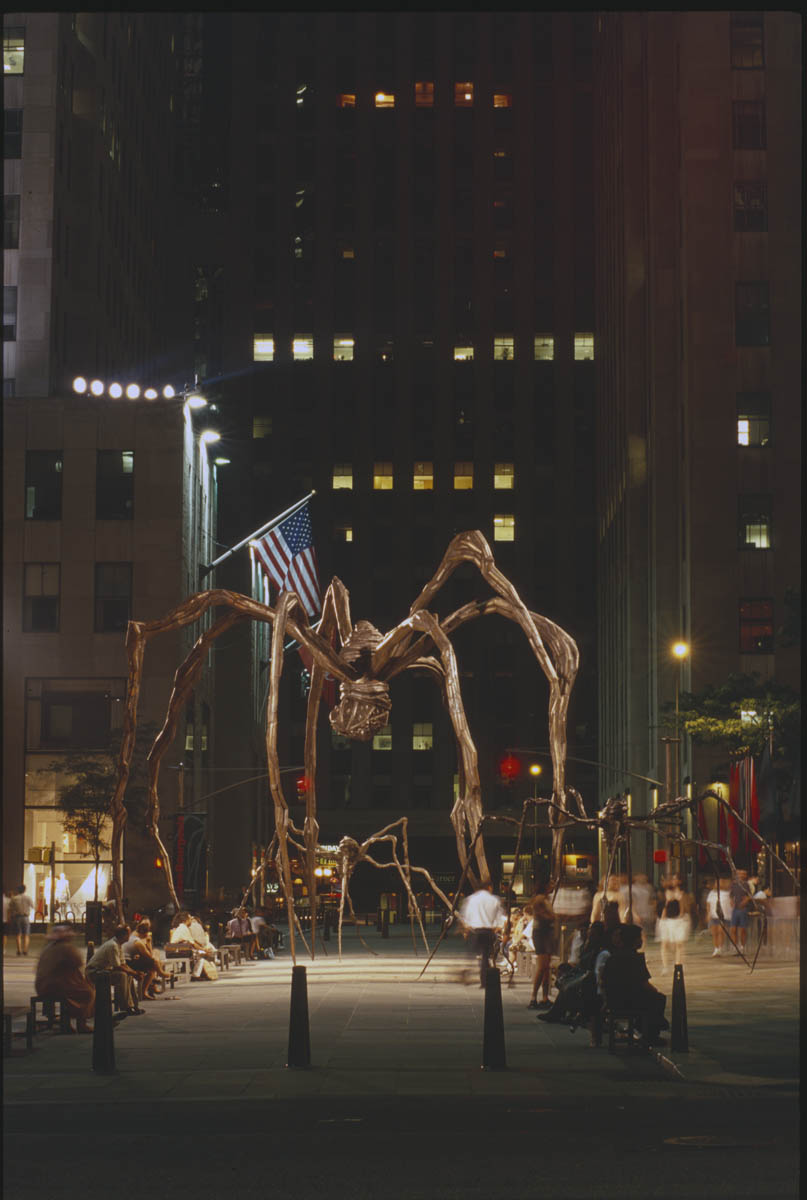
Spiders by Louise Bourgeois (1911-2010, b. Paris, France) was on view in Rockefeller Center during the summer of 2001. The work features a 30-foot-tall spider, Maman—meaning “mama” in Bourgeois’ native French—carrying a basket of eggs and flanked by two smaller spiders. Brian D. Leitch from The New York Times Magazine stated, “Louise Bourgeois, like the giant mother-spider sculpture she created several years ago, has been spinning a web of weirdly magnificent work for more than six decades—and finally, at 90, she’s getting her full due.”

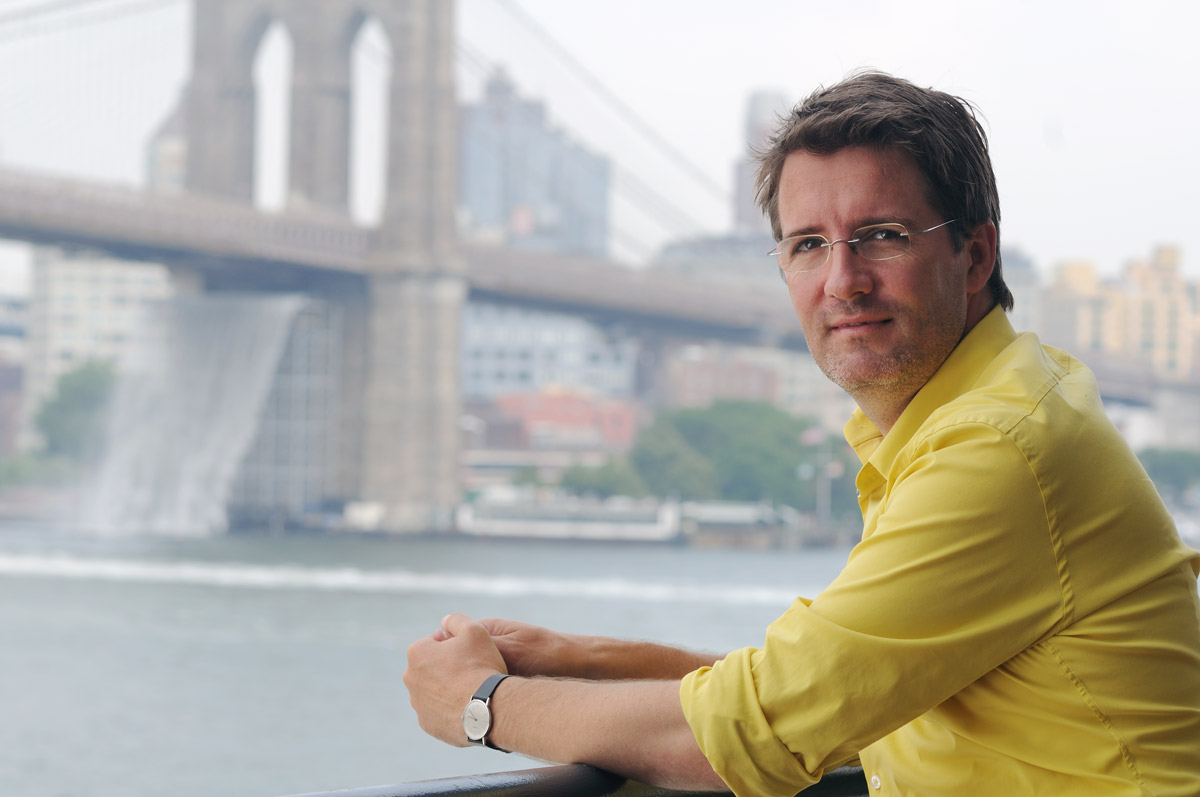
Public Art Fund, in collaboration with the City of New York, presented The New York City Waterfalls, a major new work of public art by internationally acclaimed artist Olafur Eliasson (b. 1967, Copenhagen, Denmark). The exhibition of four man-made waterfalls of monumental scale was on view until October 13, 2008 at four sites on the shores of the New York waterfront: one on the Brooklyn anchorage of the Brooklyn Bridge; one on the Brooklyn Piers, between Piers 4 and 5 near the Brooklyn Heights Promenade; one in Lower Manhattan at Pier 35, north of the Manhattan Bridge; and one on the north shore of Governors Island. The 90-to 120-foot-tall Waterfalls that have been erected on the shoreline operated from 5:30 to 9 pm on Mondays and Wednesdays and from 12:30 to 9 pm on Tuesdays and Thursdays through Sundays. They were lit after sunset.

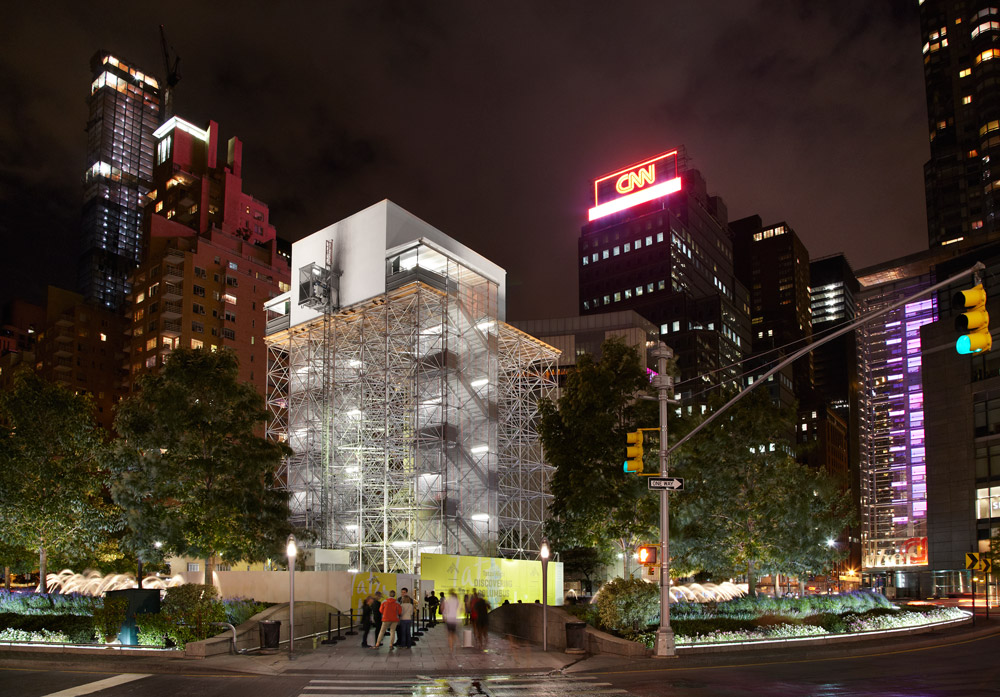
Tatzu Nishi (b. 1960, Nagoya, Japan) is known internationally for his temporary works of art that transform our experience of monuments, statues, and architectural details. His installations give the public intimate access to aspects of our urban environment and at the same time radically alter our perceptions. For his first public project in the United States, Nishi has chosen to focus on the historic statue of Christopher Columbus.
The marble statue, which rises to more than 75 feet atop a granite column, was designed by the Italian sculptor Gaetano Russo. It was unveiled in 1892 to commemorate the 400th anniversary of Columbus’s first voyage to the Americas. Despite its prominent public location, the statue itself is little known, visible only as a silhouette against the sky or at a distance from surrounding buildings.
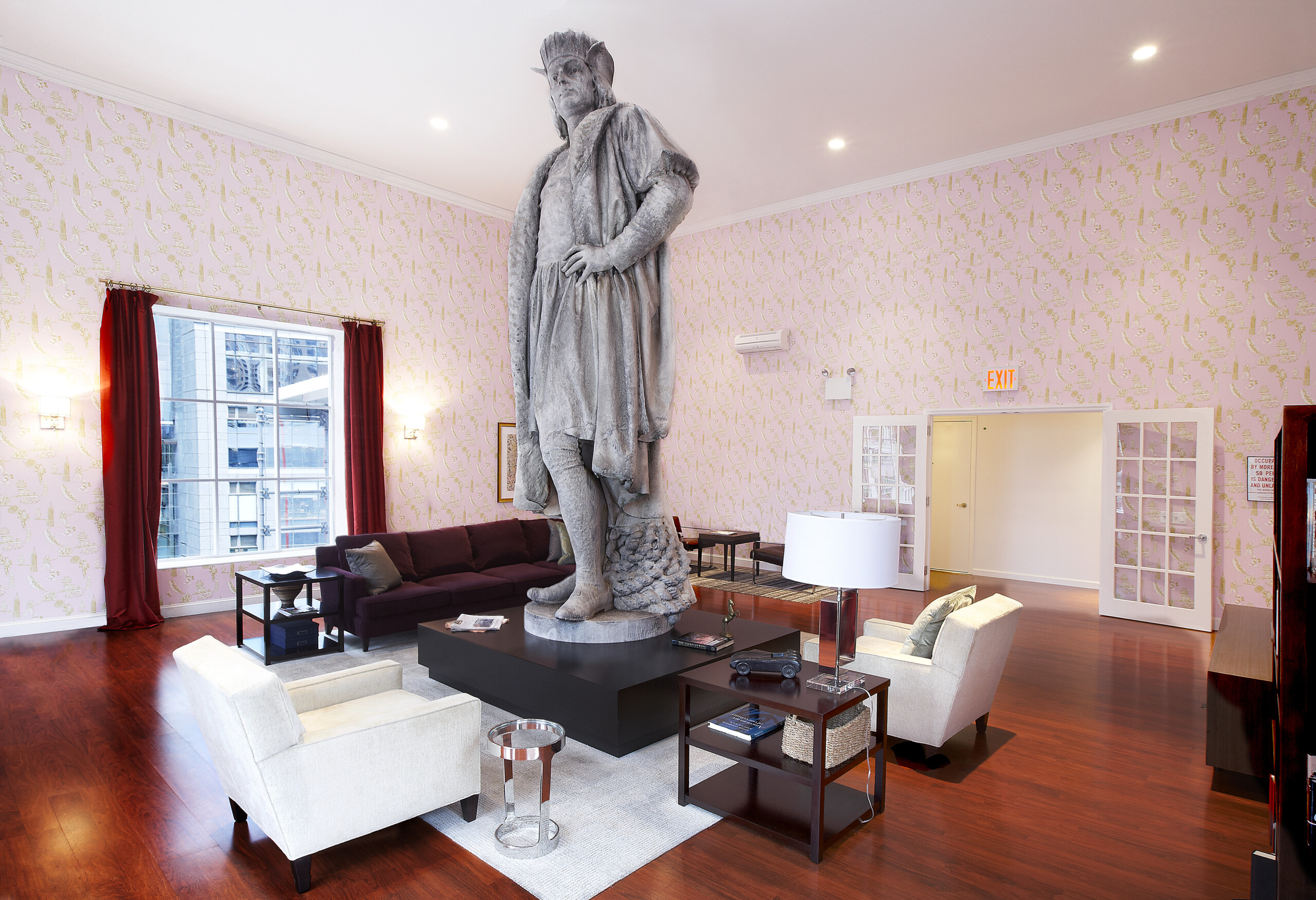
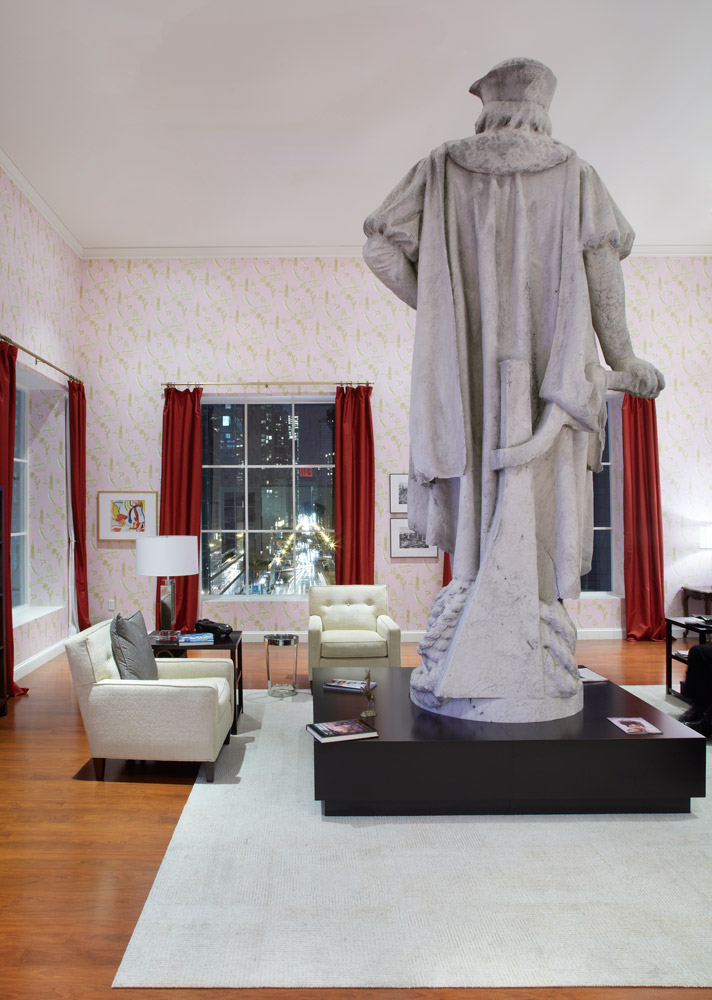
Nishi’s project reimagines the colossal 13-foot-tall statue of Columbus standing in a fully furnished, modern living room. Featuring tables, chairs, couch, rug, and flat-screen television, the decor reflects the artist’s interpretation of contemporary New York style. He even designed wallpaper inspired by memories of American popular culture, having watched Hollywood movies and television as a child in Japan. Discovering Columbus offers both a unique perspective on a historical monument and a surreal experience of the sculpture in a new context. Allowing us to take a journey up six flights of stairs to a fictional living room, Tatzu Nishi invites us to discover for ourselves where the imagination may lead.

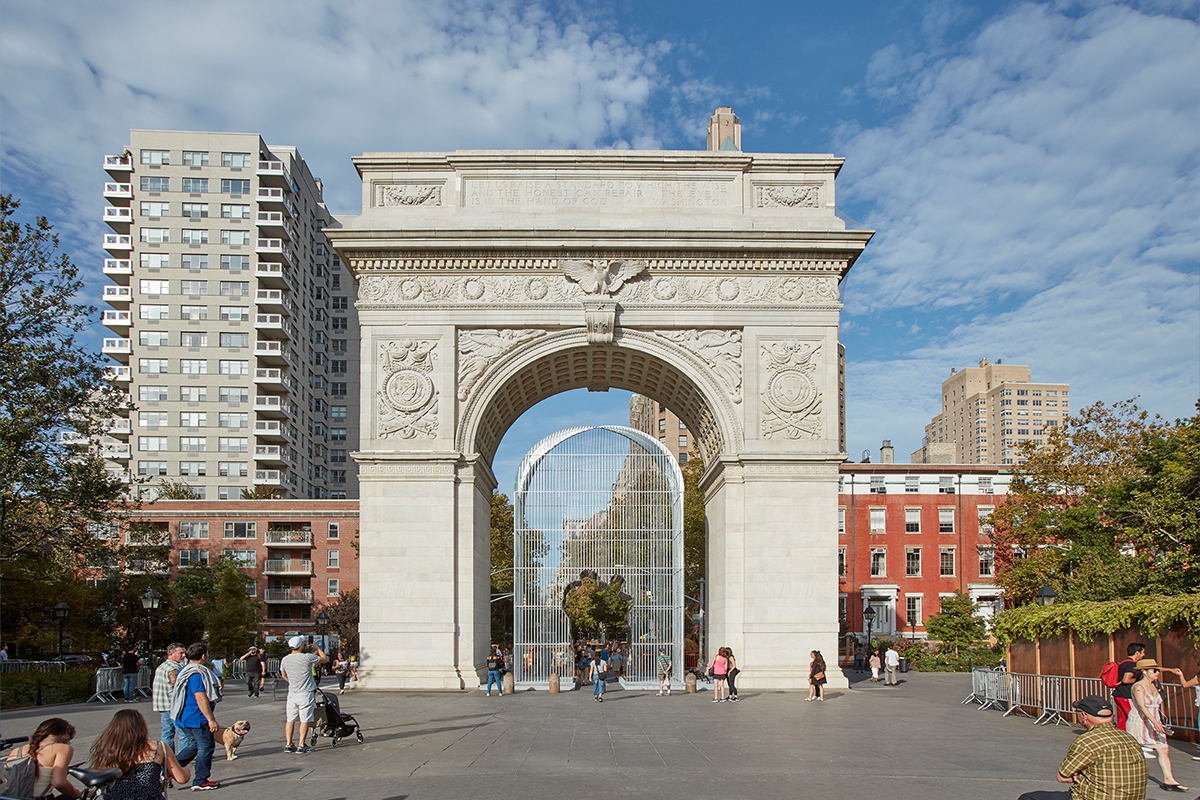
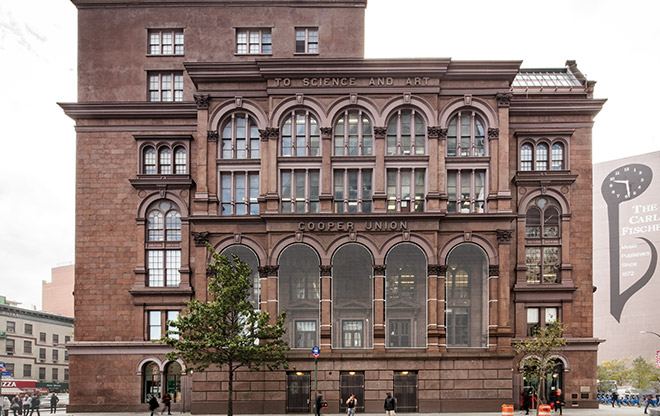
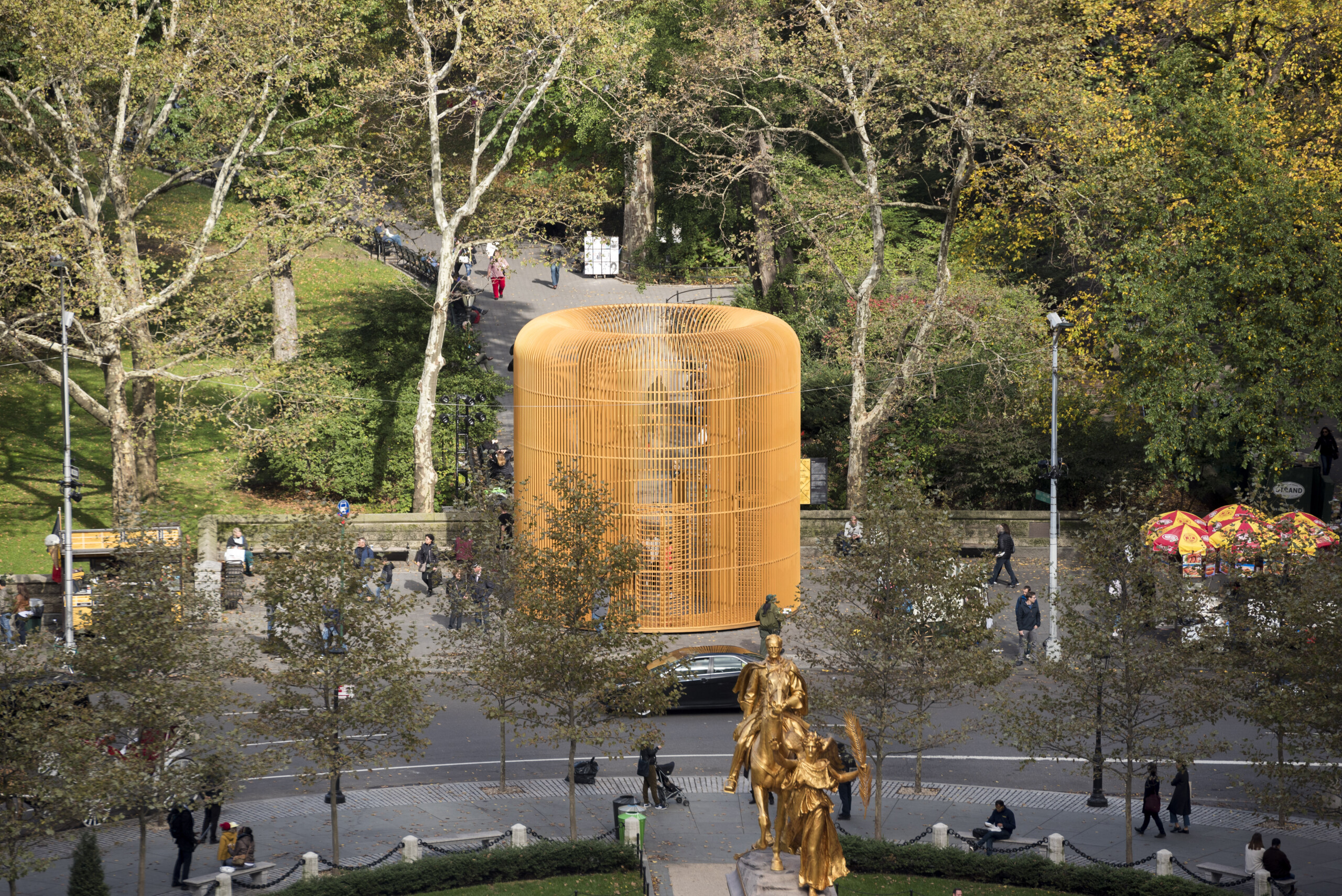
Ai Weiwei conceived this multi-site, multi-media exhibition for public spaces, monuments, buildings, transportation sites, and advertising platforms throughout New York City. Collectively, these elements comprise a passionate response to the global migration crisis and a reflection on the profound social and political impulse to divide people from each other. For Ai, these themes have deep roots. He experienced exile with his family as a child, life as an immigrant and art student in New York, and more recently, brutal repression as an artist and activist in China. The exhibition draws on many aspects of Ai’s career as a visual artist and architect, and is informed by both his own life experience and the plight of displaced people. In 2016, Ai and his team traveled to 23 countries and more than 40 refugee camps while filming his documentary, Human Flow.
“Good fences make good neighbors” is a folksy proverb cited in American poet Robert Frost’s Mending Wall, where the need for a boundary wall is being questioned. Ai chose this title with an ironic smile and a keen sense of how populist notions often stir up fear and prejudice. Visitors to the exhibition will discover that Ai’s “good fences” are not impenetrable barriers but powerful, immersive, and resonant additions to the fabric of the city.

Multiple Locations

Flow Separation is a commission by New York–based artist Tauba Auerbach (b. 1981, San Francisco, CA), which transforms the historic Fireboat John J. Harvey into a contemporary “dazzle ship.” Invented by British painter Norman Wilkinson during World War I, the original dazzle patterns were painted onto ships to optically distort their forms, confusing enemy submarines tracking their distance, direction, and speed. With their geometric shapes, the dazzle designs were heavily indebted to both animal camouflage and avant-garde movements like Cubism, Futurism, and Vorticism. Thousands of vessels were dazzled in the UK and US, including in New York City at the Brooklyn Navy Yards.


Estructuras Monumentales is the first major exhibition of outdoor sculptures by New York City–based artist Carmen Herrera (1915–2022, b. Havana, Cuba). She has created vibrant, abstract paintings for more than 70 years, but has only recently received her well-deserved art historical recognition. Herrera’s radiant compositions simplify dynamically juxtaposed forms to their purest elements of color and geometry, creating a distinctive and iconic clarity by emphasizing what she sees as “the beauty of the straight line.”
Herrera’s Estructuras series of sculptures are even less well known. Informed by her architectural training, Herrera began the series in the 1960s with a group of diagrammatic sketches. She envisioned large-scale monochromatic sculptures that would extend the experience of her luminous paintings into three dimensions. Until recently, these historic proposals have remained unrealized. With Estructuras Monumentales, this remarkable artist is now able to share her powerful structures with public audiences for the first time.


Conquest is a compelling new collective performance conceived by acclaimed artist Pope.L (1955–2023, b. Newark, NJ). It is inspired by his iconic solo crawls, where the artist dragged himself across a number of different urban landscapes. Navigating the streets and parks of Downtown Manhattan, Conquest extends this irreverent and provocative 40-year tradition of public performance with an ambitious group crawl involving over 140 volunteers.
The artist selected participants who reflect the cultural and demographic diversity of New York City to crawl in relay a 1.5 mile-long route from the West Village’s John A. Seravalli Playground to Union Square via Washington Square Park’s triumphal arch. Crawling together, strangers experience the struggle and vulnerability of giving up their physical privilege, satirizing their own social and political advantage. As the course of Pope.L’s Conquest unfolded, we are all offered an insight into the power and contradictions of collective action.


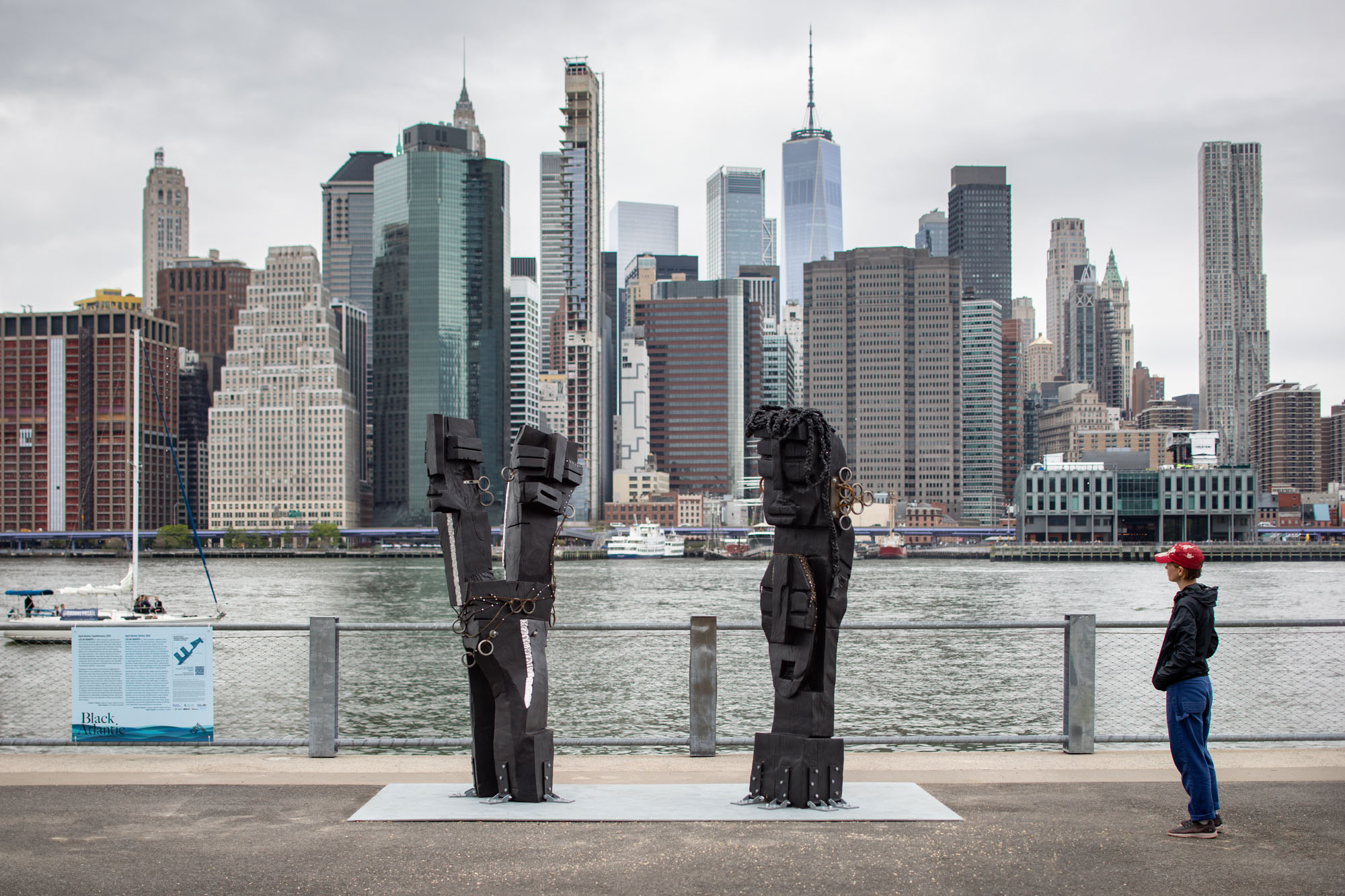
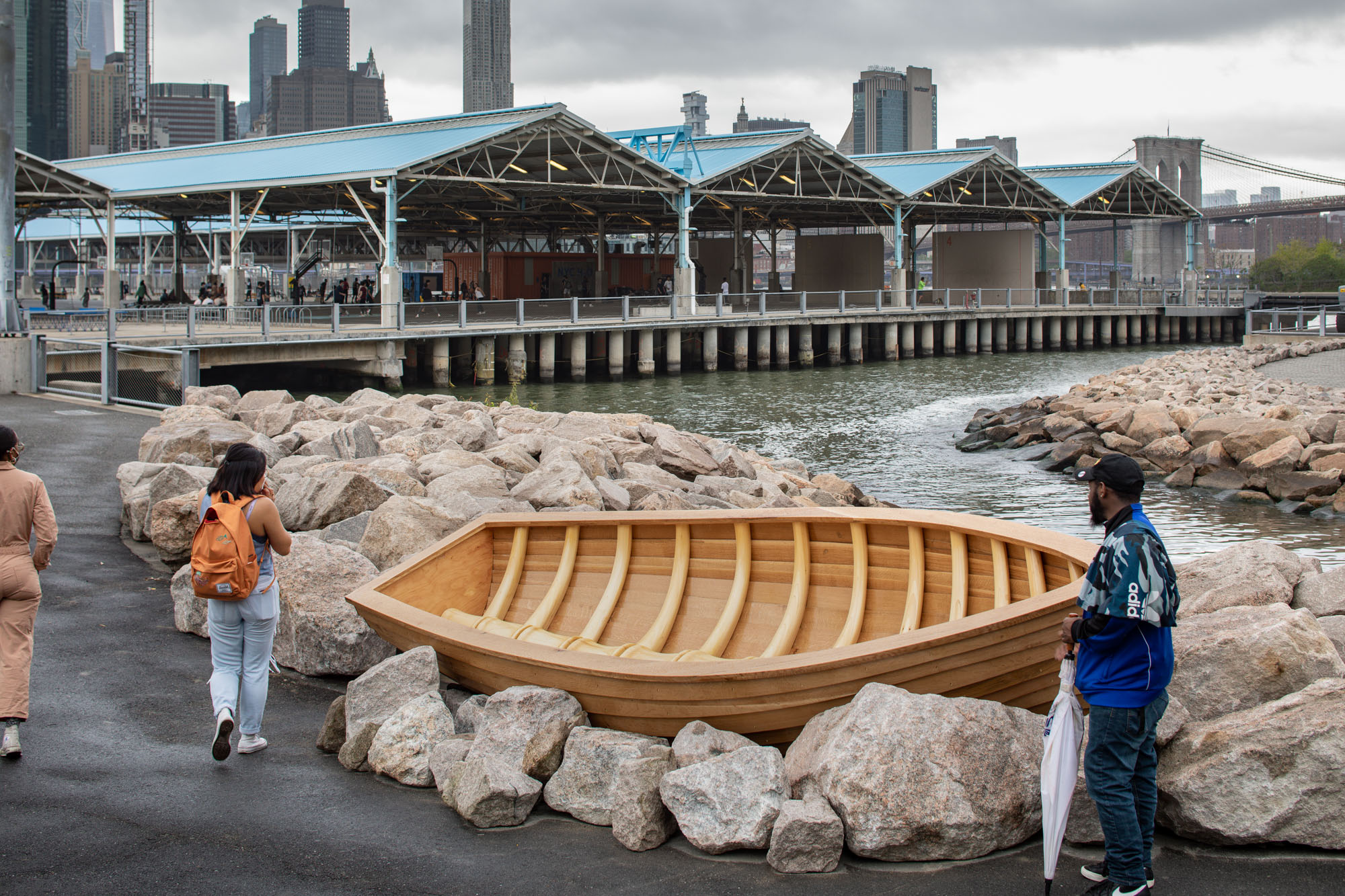
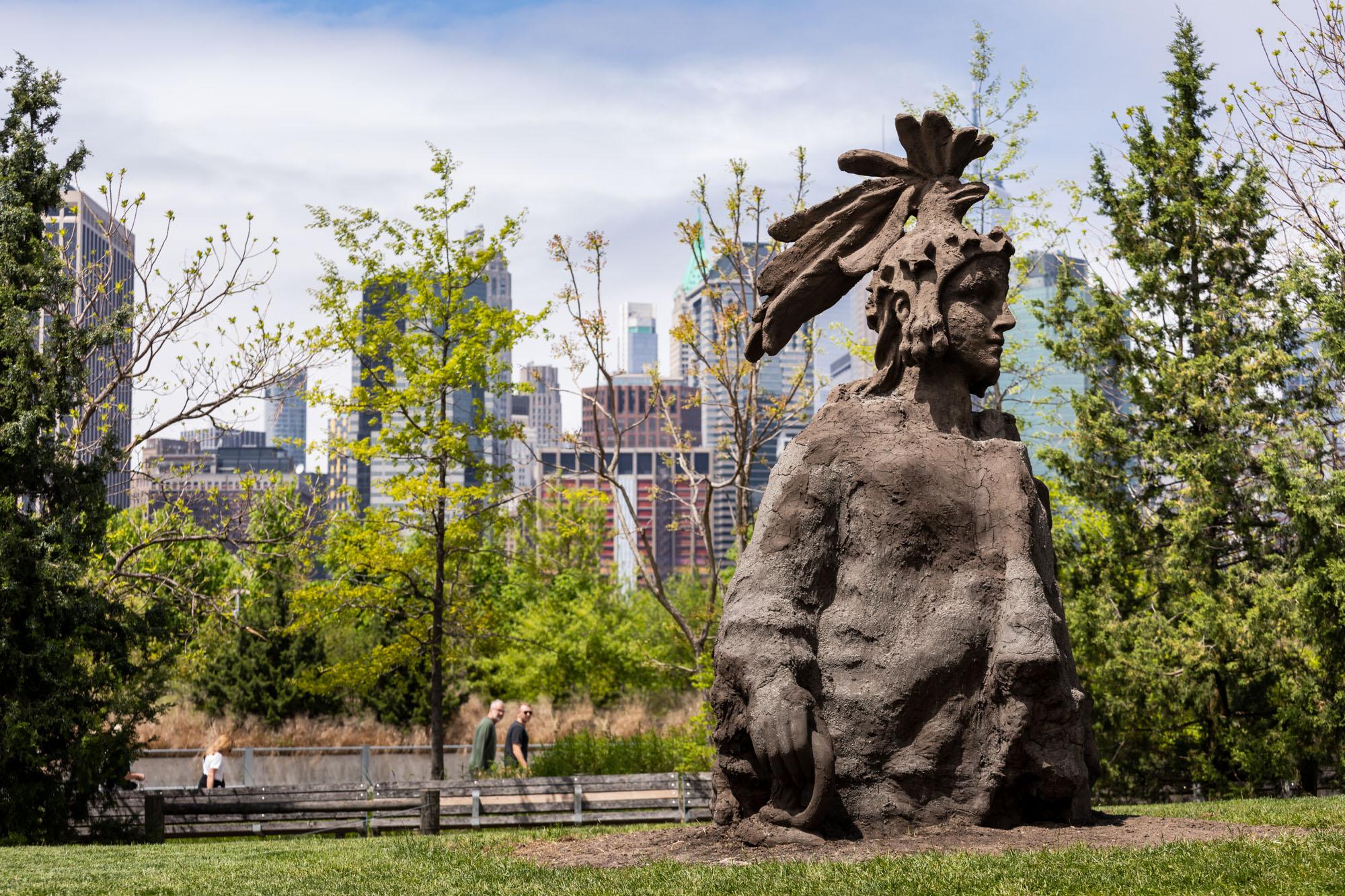
Displayed on the shores of this former shipping port, Black Atlantic is an exhibition inspired by the diaspora across the ocean that connects Africa with the Americas and Europe. Over the centuries, these transatlantic networks have led to complex hybrid cultures and identities like those of the five artists featured in Black Atlantic. Each commission suggests a unique creative approach towards crafting new identities and futures through the personal gestures of hand-made work, often in dialogue with the processes of large-scale fabrication. The artists have mined both global histories and personal experiences to create these compelling works, which are as inventive in form and materials as they are powerful in their themes.
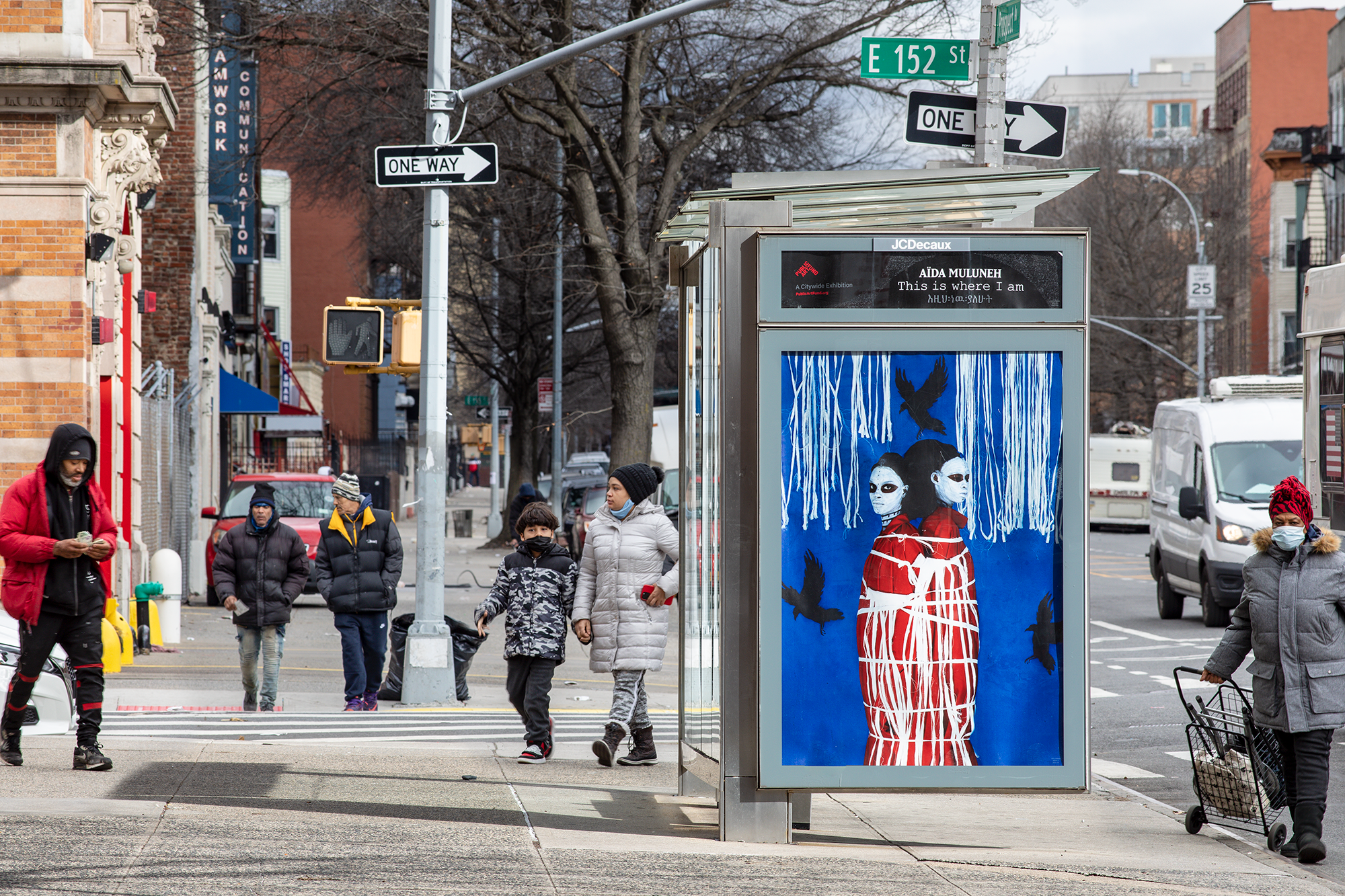
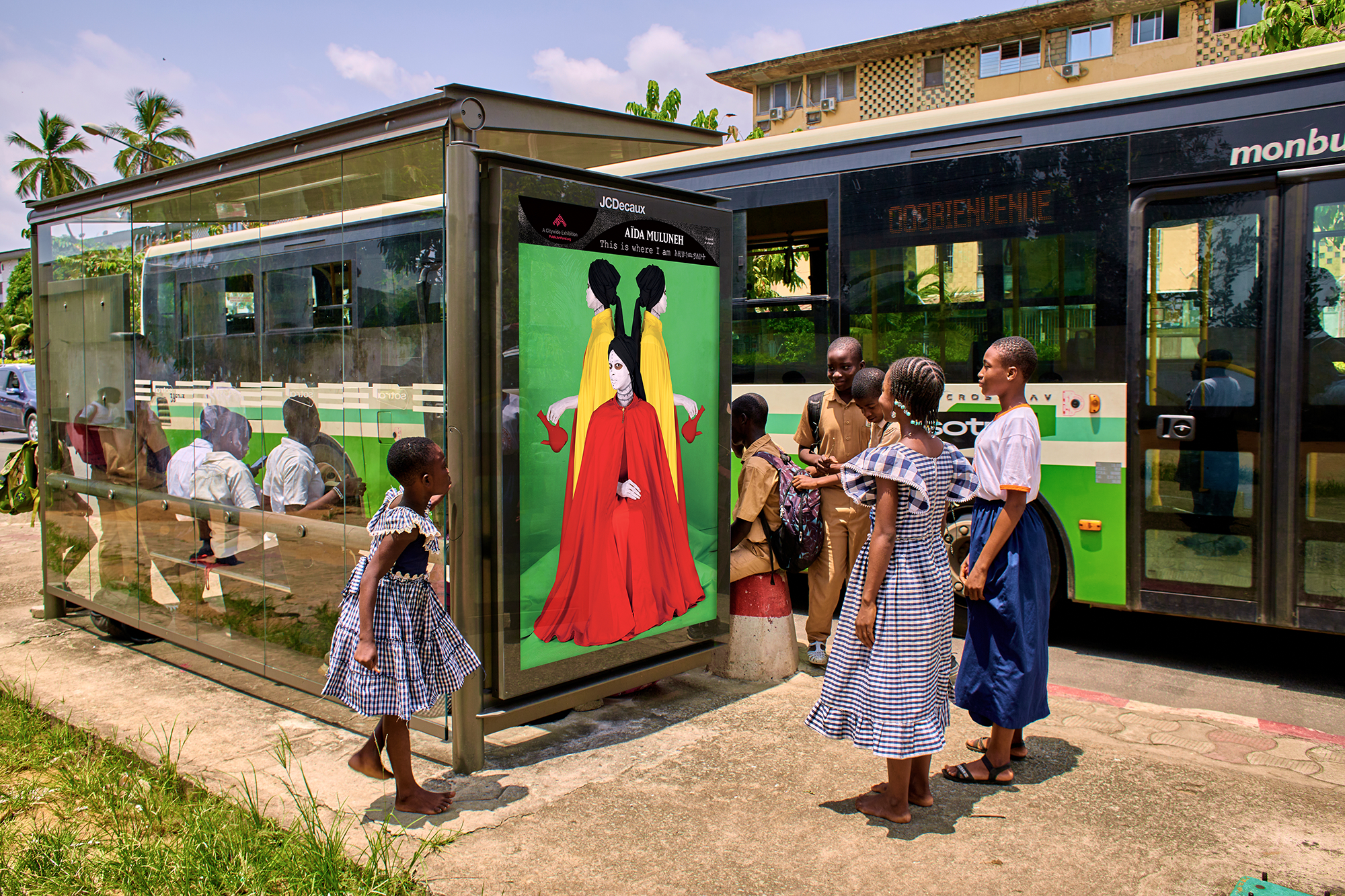
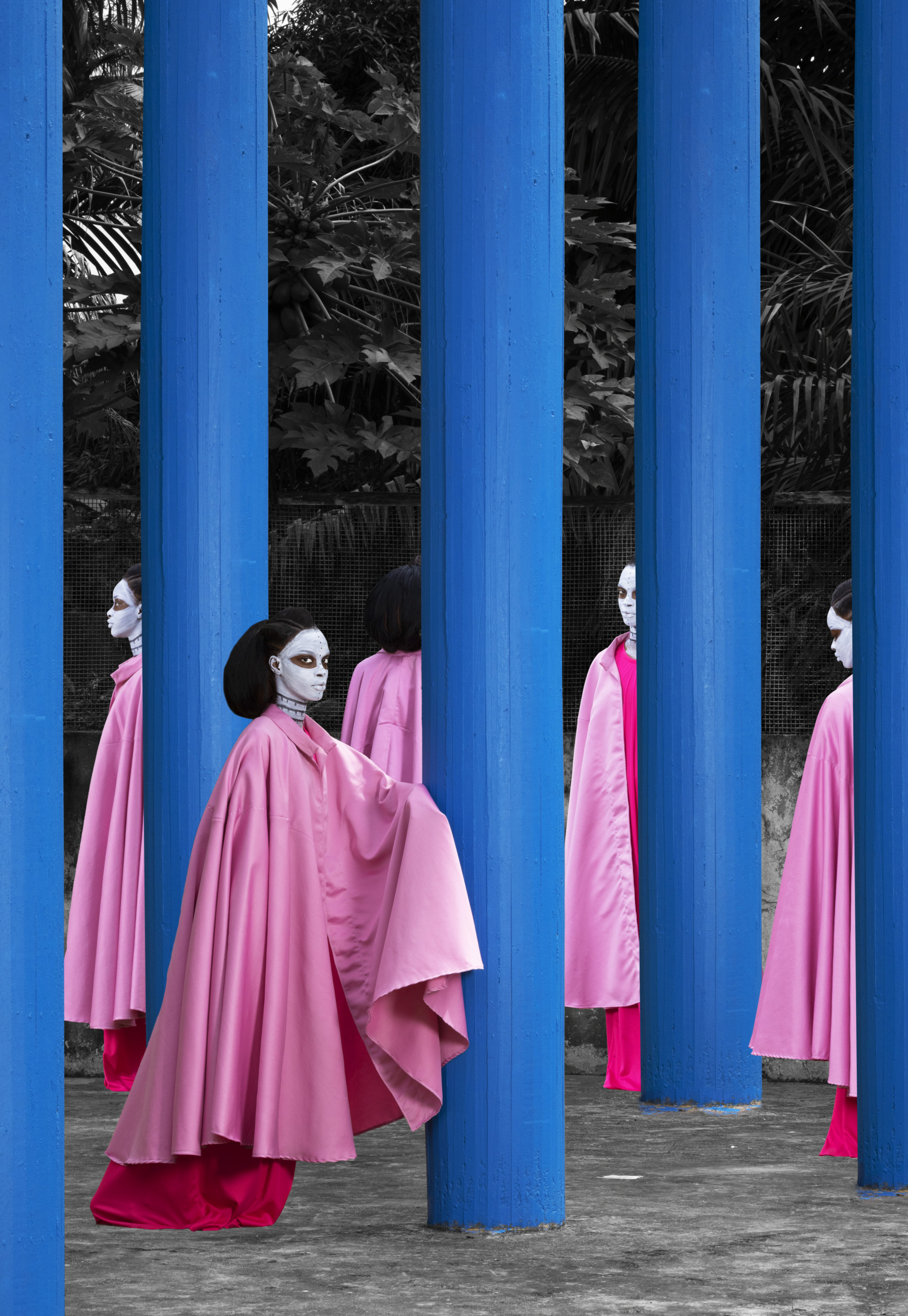
Born in Ethiopia and currently based in Côte d’Ivoire, Aïda Muluneh creates vibrant photographs that highlight her national, political, and cultural identity. Through the use of metaphor, she creates vignettes that poetically portray facets of her experiences as an Ethiopian woman and immigrant. Muluneh left Ethiopia at a young age and grew up between Yemen and England, later spending time in Cyprus and Canada before attending college in the United States. Her work reflects her investment in sharing complex, distinctly African perspectives, as well as her own journeys across the globe. This is where I am is an exhibition of 12 new artworks by Muluneh (b. 1974, Addis Ababa, Ethiopia) presented in over 330 JCDecaux bus shelters across New York, Boston, and Chicago in the United States, and Abidjan in Côte d’Ivoire.