Louis Hock Messages to the Public: 800 BUY With ART
About the Exhibition
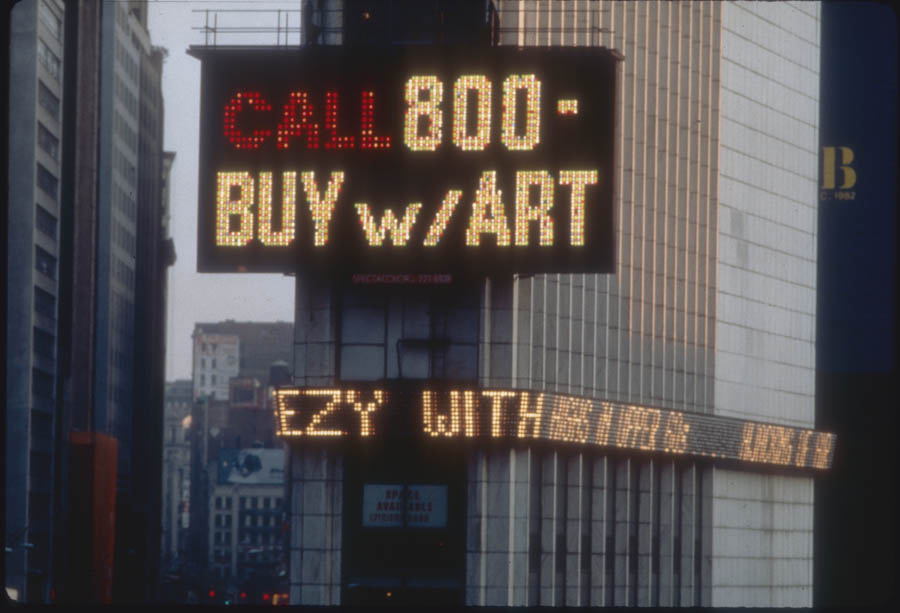
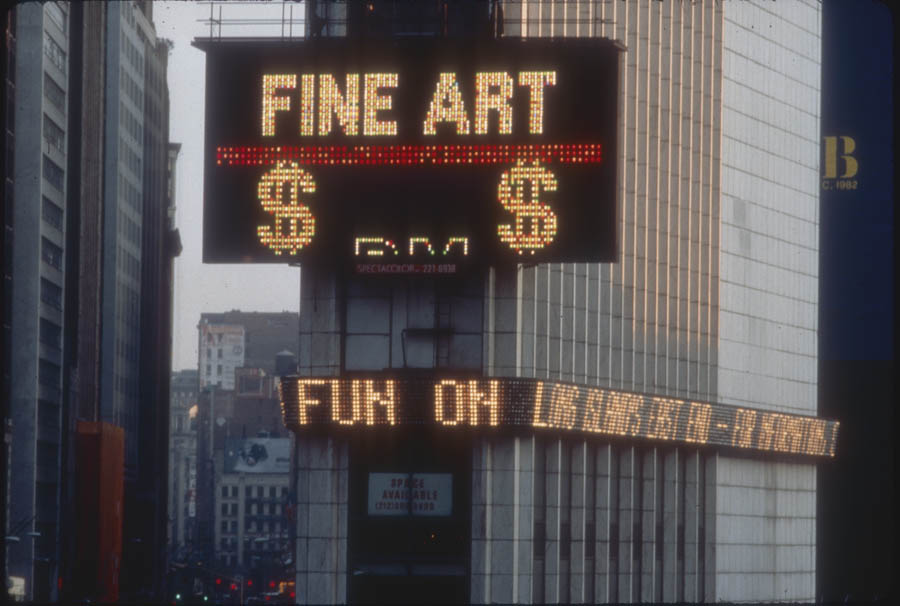
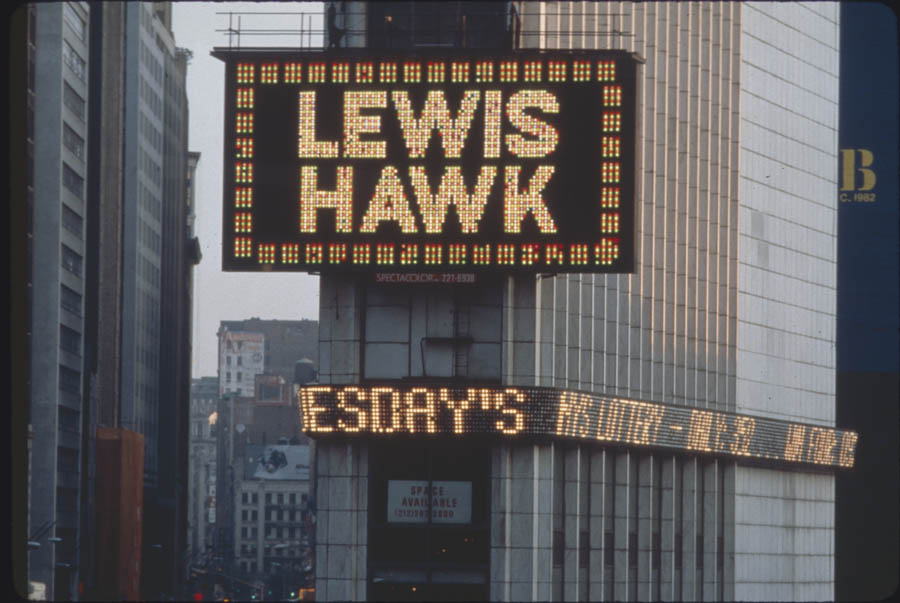
Louis Hock (b. 1948, Los Angeles, CA) created 800-BUY With ART as a mock advertisement for Lewis Hawk Fine Art. This phantom promotion mimics traditional media techniques and tactics to market its artist-product, the fictitious Lewis Hawk, and even goes so far as to include a working 800 number. Callers to 800 BUY W/ ART could take an “art quiz” administered by Lewis Hawk, who offers the challenge, “Listen closely and be ready to think.”
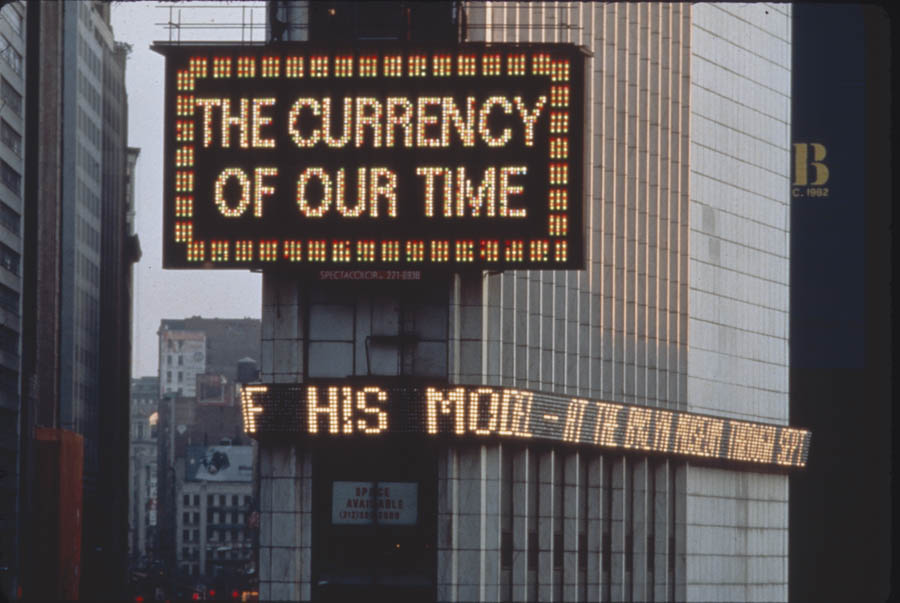
Hock’s 30-second animation opens with a clockwise rotation of lights surrounding an otherwise blank marquee. The name “Lewis Hawk” briefly fills the screen, then is pushed upward by two Greek columns rising from below to mid-screen. The text, occupying the top half of the screen, continues to scroll upward until a new text, “Fine Art,” is revealed. Dollar signs soon supplant the columns as varicolored international monetary symbols rise and fill the screen with characters denoting the deutsch mark, the British pound, the Japanese yen, and the US dollar. Black, diagonal brushstrokes lettered with the words “Promotion” and “Brokerage” appear, and are followed by a final horizontal stroke imprinted with the word “Investment.” The words “The Currency of Our Time” are then revealed from within an expanding circle that balloons outward and are followed by a repeat of the words “Promotion Brokerage Investment.” The message concludes with “800 BUY W/ ART.”
Both the 30-second animation and the companion telephone message aim to reveal the language through which art has been represented by the popular media. The billboard reflects art “as the currency of our time,” stocks and bond-like commodities divorced from the artist’s intention. The 800 number’s text uses that same market language, coupled with the language the media has used to describe the recent battle over government funding for the arts. Hock claims, “In the past few years, art has become public in a way no one anticipated. Just what this new public art means and how it is discussed is framed by the language of media, the good art of commerce, and the bad art of controversy.”
Photo Gallery
About the Series
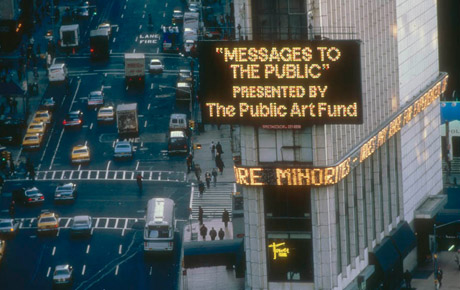
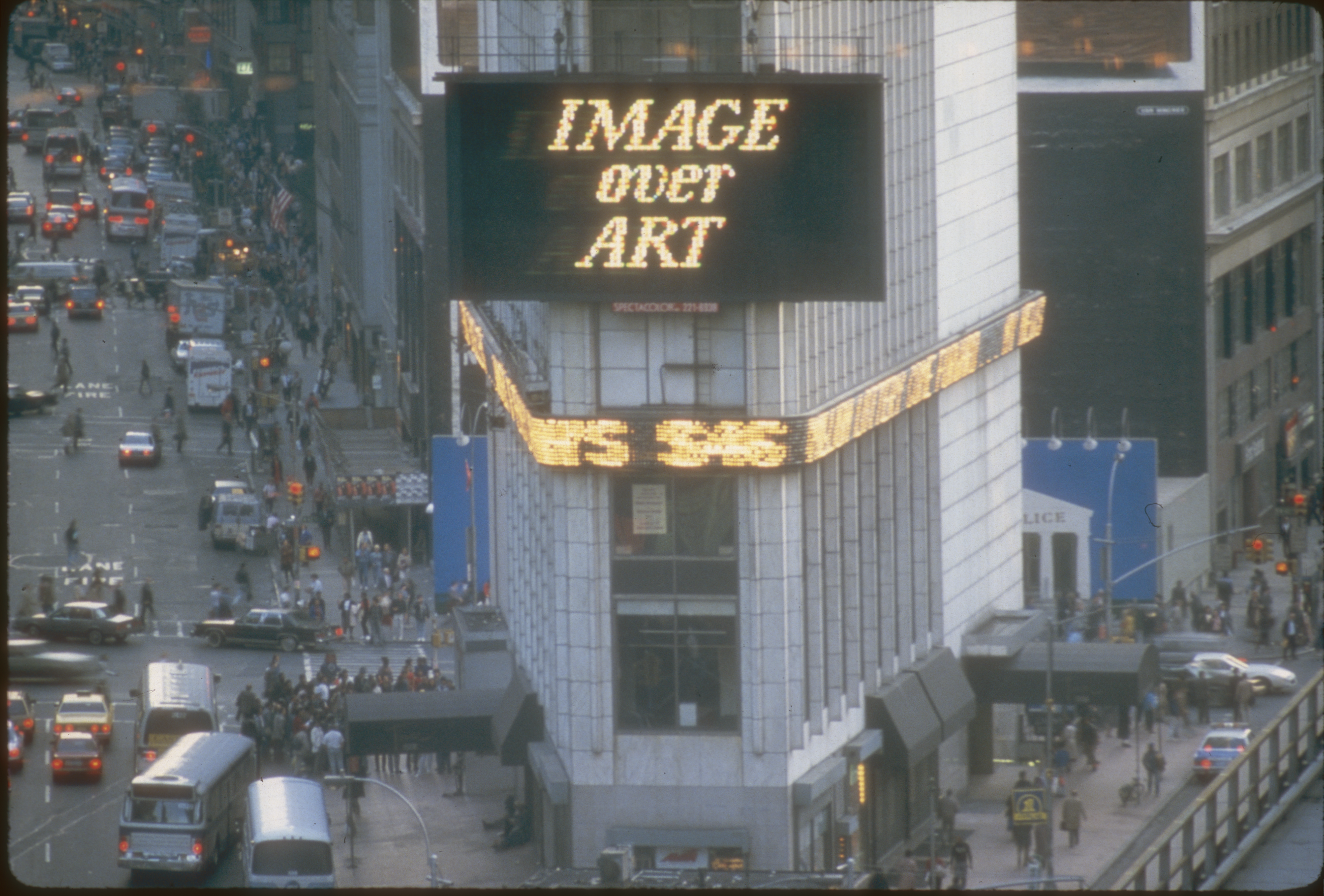
Messages to the Public formed a key part of the Public Art Fund’s long-term commitment to media-based artworks. Running from 1982 to 1990, the show featured a series of artists’ projects created specifically for the Spectacolor board at Times Square.
As Russell Miller from Ohio newspaper The Toledo Blade explained in his article on February 19, 1984, “every month, a different artist presents a 30-second animation on the Spectacolor light board—an 800-square-foot array of 8,000 red, white, blue, and green 60-watt bulbs that dominates the Times Square vista. The spot is repeated more than 50 times a day for two weeks, wedged into a 20-minute loop of computer-animated commercials.
“Jane Dickson, a painter, was working for Spectacolor, Inc. as an ad designer and computer programmer when, three and a half years ago, she first thought to use the light board to display noncommercial art.
“‘I picked that title,’ she said of Messages to the Public, ‘because I thought the propaganda potential from this project was terrific.’ The board, she noted, was regularly used for ‘commercial propaganda.’
“Dickson sought help from the Public Art Fund, an organization based here and dedicated to taking art out of the galleries and placing it in the city’s streets and parks.”
Project Director of the Public Art Fund Jessica Cusick explained, “We’re trying to do art that’s timely, has a message, is visually potent and is trying to deal with the fine line dividing fine art and commercial art.”
Related Exhibitions