Paula Crawford Messages to the Public: The Story of Actaeon
About the Exhibition
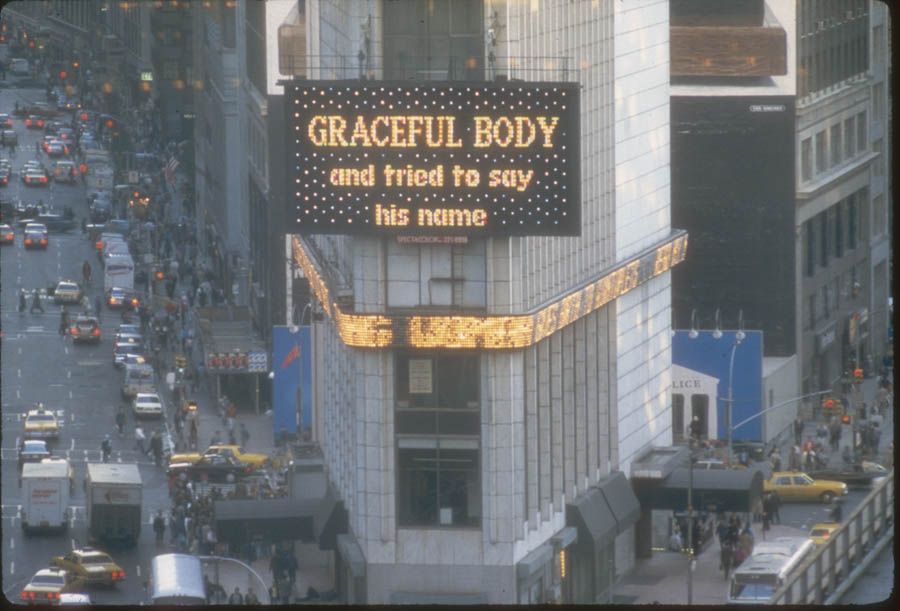
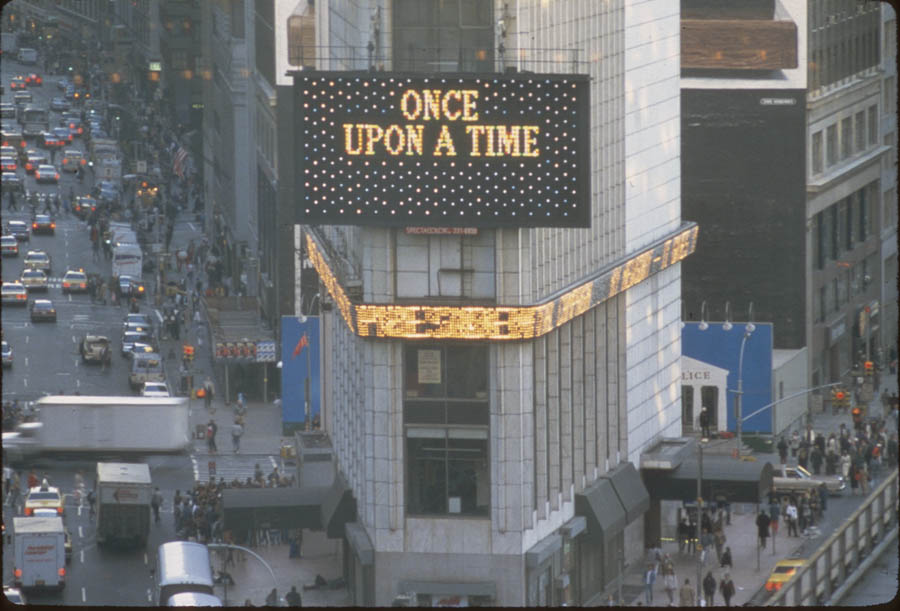
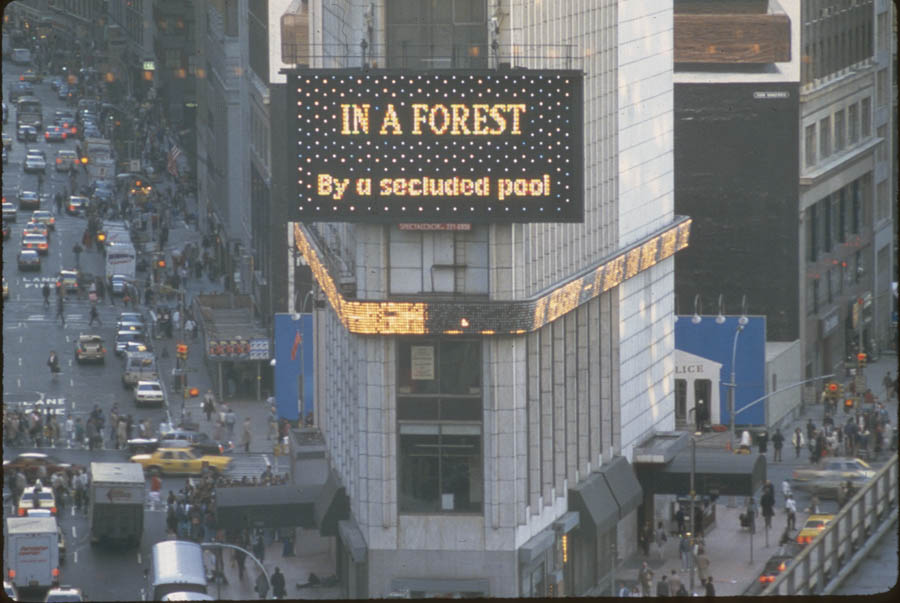
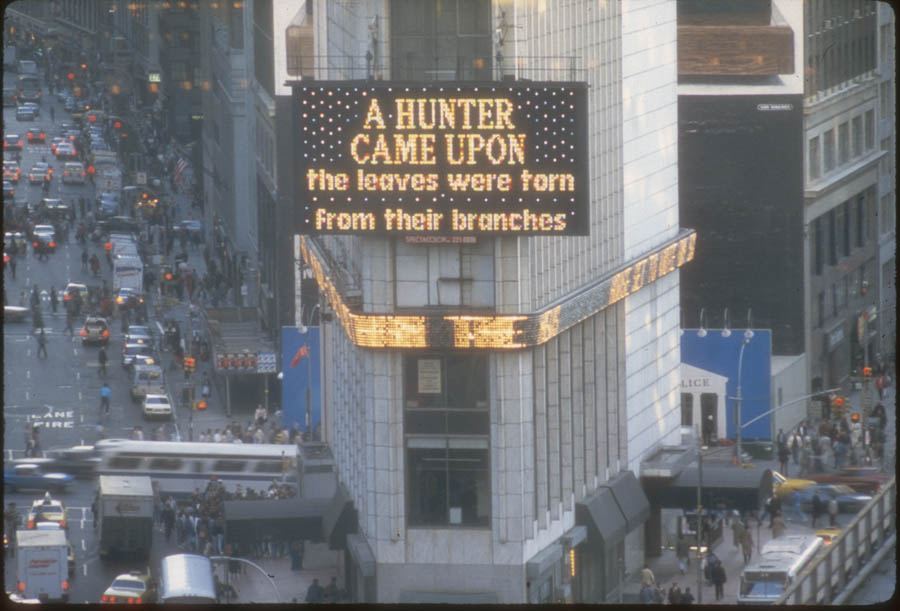
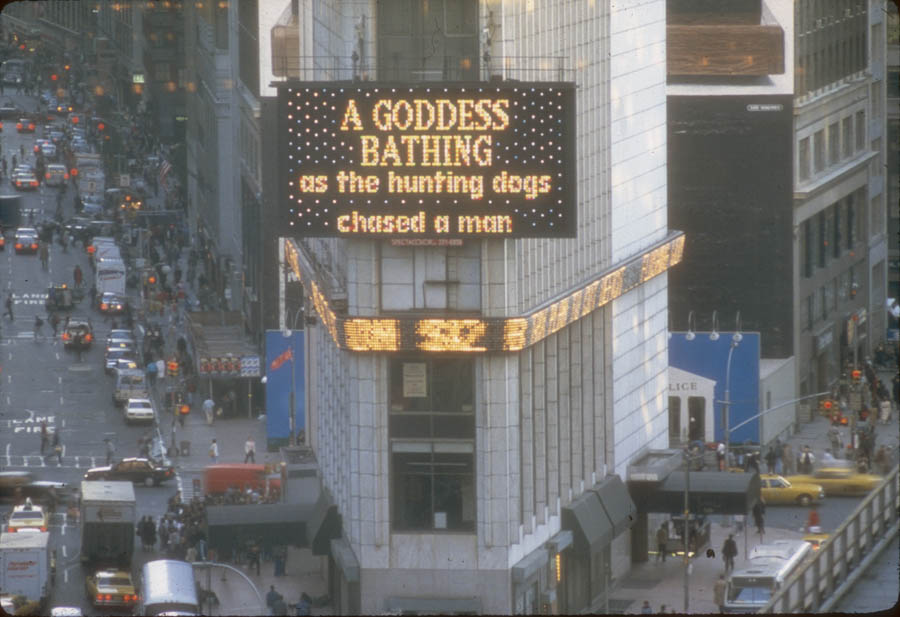
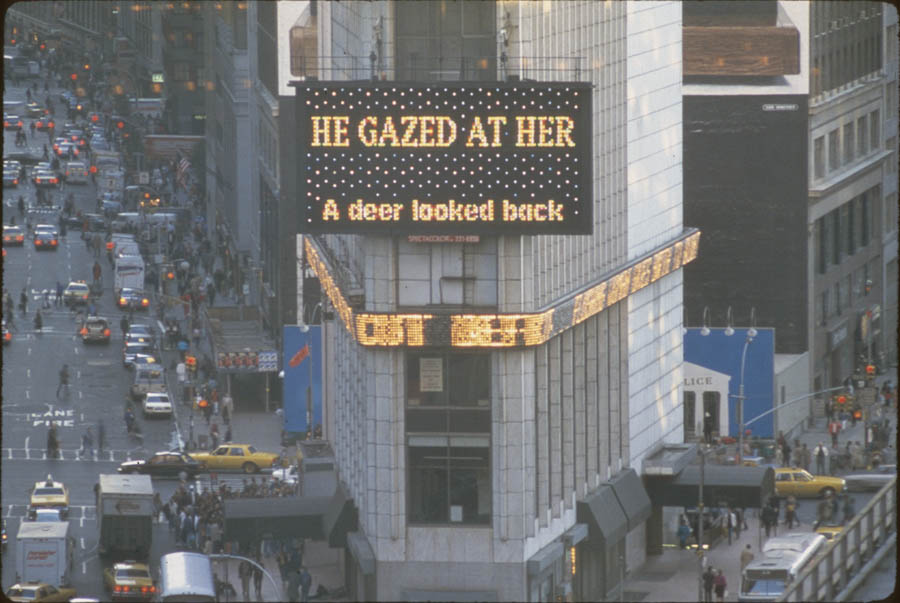
Artist Paula Crawford (b. Berkeley, CA) uses her message to tell the story of Actaeon, taking its narrative from a tale in Greek mythology about an encounter between the goddess Artemis and the hunter Actaeon. According to the most popular version of this myth, Actaeon came upon Artemis as she bathed in the forest with her nymphs. Outraged by this violation of her privacy, Artemis turned Actaeon into a stag. He was immediately chased and killed by his own hounds.
Crawford recounts Actaeon’s story through the juxtaposition and interfacing of two distinct texts. The primary text—concerning a bathing goddess and the curious hunter who happens upon her—appears a few words at a time, in bold uppercase letters, centered on the screen. A few seconds into the message, a subtext rolls up from the bottom of the screen—in smaller, lowercase letters—and passes behind the primary text, disappearing at the top of the screen. This sub-narrative recounts Actaeon’s metamorphosis, the chase, and his futile attempt to speak in order to save himself.
Crawford frequently combines her passions for language and myths in sculptures that invite the viewer to participate. These sculptures, which Crawford has called “three-dimensional graphic poems,” explore the abstracted roles of space, time, and movement involved in the act of reading (and/or existence).
The “Messages to the Public” format seems a particularly appropriate arena for Crawford’s work. She said, “As the texts for my sculptures have had to be edited and simplified to meet formal concerns, verbal ideas have developed in their own directions. A ‘Message to the Public’ is an interesting problem within the framework of what I have done. But here, at Times Square, it’s appropriate to tell a simple story. I’m retelling an ancient myth that, as I see it, describes the fragile symmetry with which a small window separated the hunter from the hunted, the one who looks from the one who is seen, and the one with a voice from a voiceless one.”
Photo Gallery
About the Series
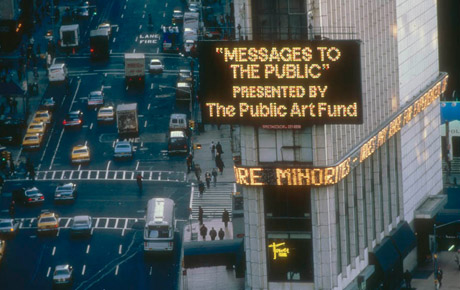
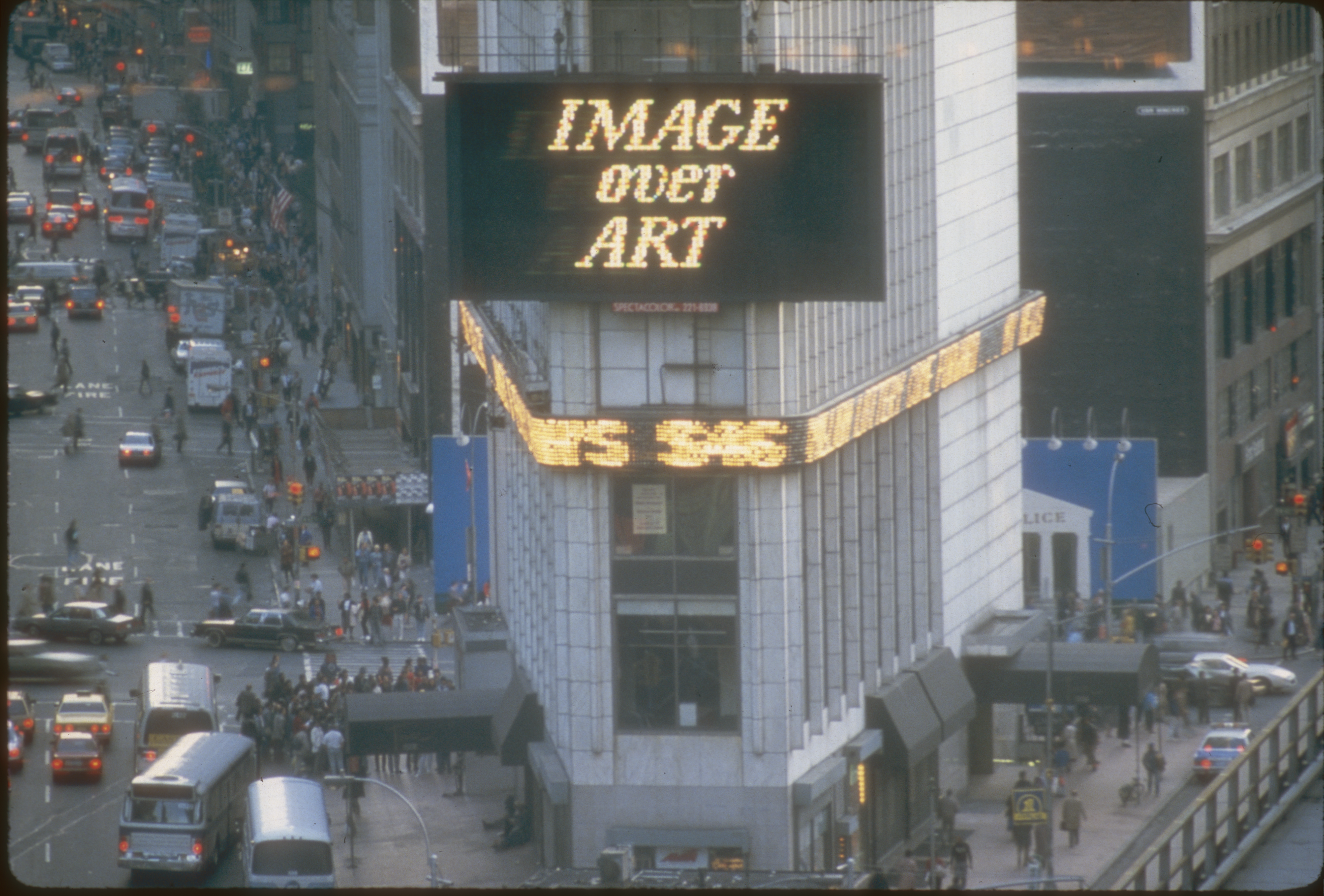
Messages to the Public formed a key part of the Public Art Fund’s long-term commitment to media-based artworks. Running from 1982 to 1990, the show featured a series of artists’ projects created specifically for the Spectacolor board at Times Square.
As Russell Miller from Ohio newspaper The Toledo Blade explained in his article on February 19, 1984, “every month, a different artist presents a 30-second animation on the Spectacolor light board—an 800-square-foot array of 8,000 red, white, blue, and green 60-watt bulbs that dominates the Times Square vista. The spot is repeated more than 50 times a day for two weeks, wedged into a 20-minute loop of computer-animated commercials.
“Jane Dickson, a painter, was working for Spectacolor, Inc. as an ad designer and computer programmer when, three and a half years ago, she first thought to use the light board to display noncommercial art.
“‘I picked that title,’ she said of Messages to the Public, ‘because I thought the propaganda potential from this project was terrific.’ The board, she noted, was regularly used for ‘commercial propaganda.’
“Dickson sought help from the Public Art Fund, an organization based here and dedicated to taking art out of the galleries and placing it in the city’s streets and parks.”
Project Director of the Public Art Fund Jessica Cusick explained, “We’re trying to do art that’s timely, has a message, is visually potent and is trying to deal with the fine line dividing fine art and commercial art.”
Related Exhibitions