Moynihan Train Hall - Public Art Fund
বাংলা (Bengali) 简体中文 (Chinese Simplified) 繁體中文 (Chinese Traditional) Nederlands (Dutch) English Français (French) Deutsch (German) Italiano (Italian) 日本語 (Japanese) 한국어 (Korean) Português (Portuguese - Brazil) Español (Spanish) Tiếng Việt (Vietnamese)
I am looking for…
Suggested searches:
Ai Weiwei
Talks
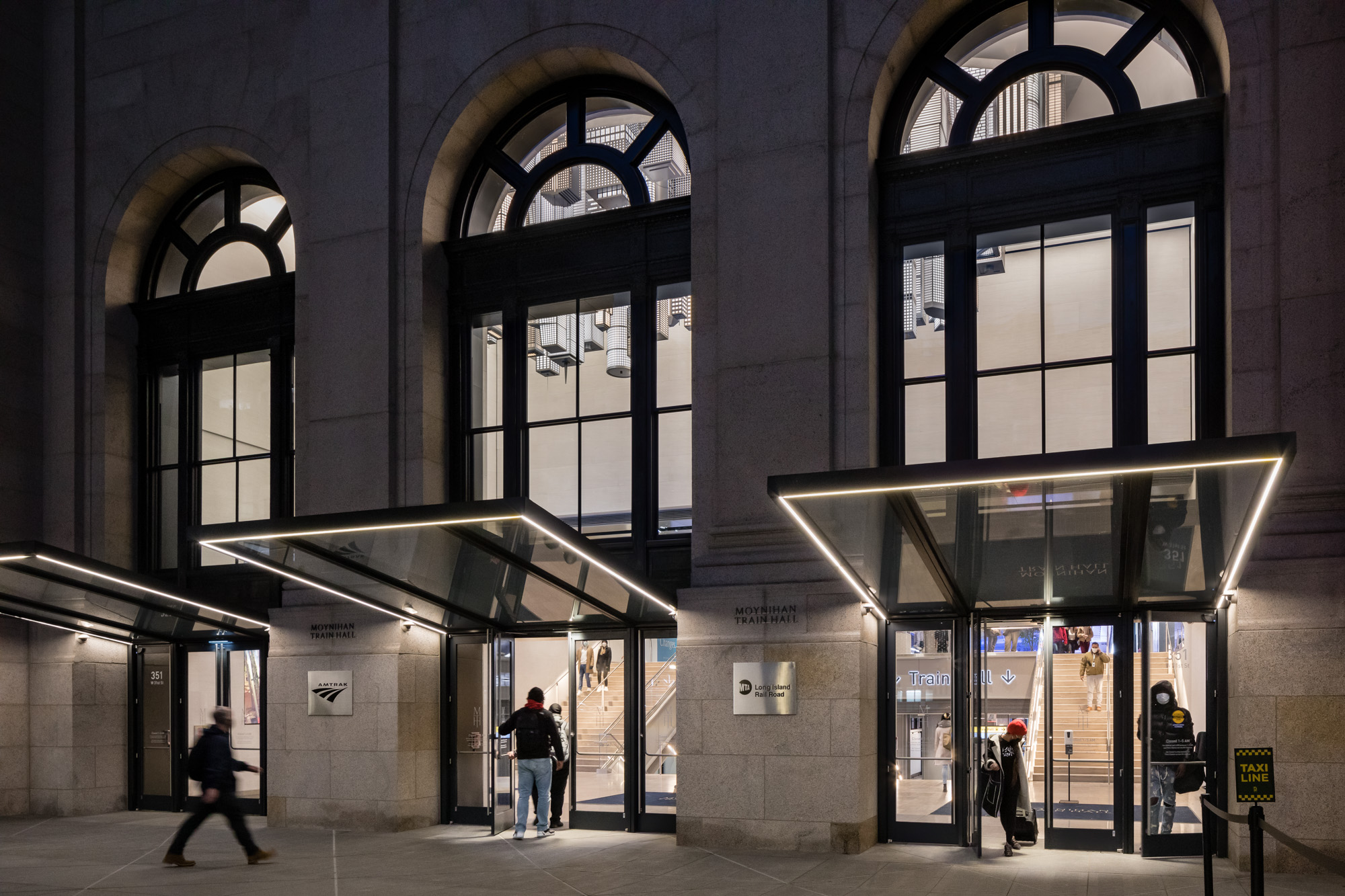
An exterior of a train station with three large arched windows and doors, with the artwork peeking through the window.

Moynihan Train Hall

Moynihan Train Hall
On Permanent View

About

What makes a public building a truly civic space, able to evoke a sense of shared ownership and collective pride? In the new Moynihan Train Hall, a series of remarkable public artworks capture and express the spirit of democratic purpose, historical memory, and innovative design that characterize this new centerpiece of New York City’s essential urban infrastructure.

The historic Pennsylvania Station, a Beaux Arts masterpiece designed by McKim, Mead & White, opened in 1910. Its demolition in 1963 marked the loss of a beloved architectural and civic landmark in the heart of the City. The state-of-the-art Moynihan Train Hall, completed in December of 2020 under the leadership of Governor Andrew M. Cuomo, is a sensitive yet visionary renovation of the 1912 James A. Farley Post Office, the distinguished sister building to the original Pennsylvania Station.

Public Art Fund was invited by Empire State Development to develop and direct a program of ambitious art installations for three prominent sites within the Train Hall. In keeping with the redesigned building’s architectural integration of old and new, the art program commissioned three of the world’s leading artists to create large-scale, site-specific artworks that reflect broadly on notions of past, present, and future. These very different commissions, by Stan Douglas, Elmgreen & Dragset, and Kehinde Wiley, demonstrate each artist’s ingenuity and vision.

Stan Douglas has mined the history of the original Penn Station, giving heroic pictorial life to narratives from different moments in time using today’s most advanced digital technologies. Elmgreen & Dragset have dreamed an imaginary global metropolis into sculptural being, upside down, radiating the city’s irresistible urban energy. Using illuminated stained glass and inspired by classical frescoed ceilings, Kehinde Wiley has adapted the movements of breakdance—a form originated on the streets of the Bronx—into a lyrical allegory of dynamic human expression. Characterized by daring juxtapositions of old and new, these commissions are emblematic of the constant states of innovation and transformation which are quintessentially New York. They are captivating and powerful in different ways, each inspired by New York’s rich heritage, its diverse and talented people, and its creative spirit. Together, they give dazzling artistic definition to the generous, civic character of Moynihan Train Hall.


Stan Douglas, Penn Station’s Half Century

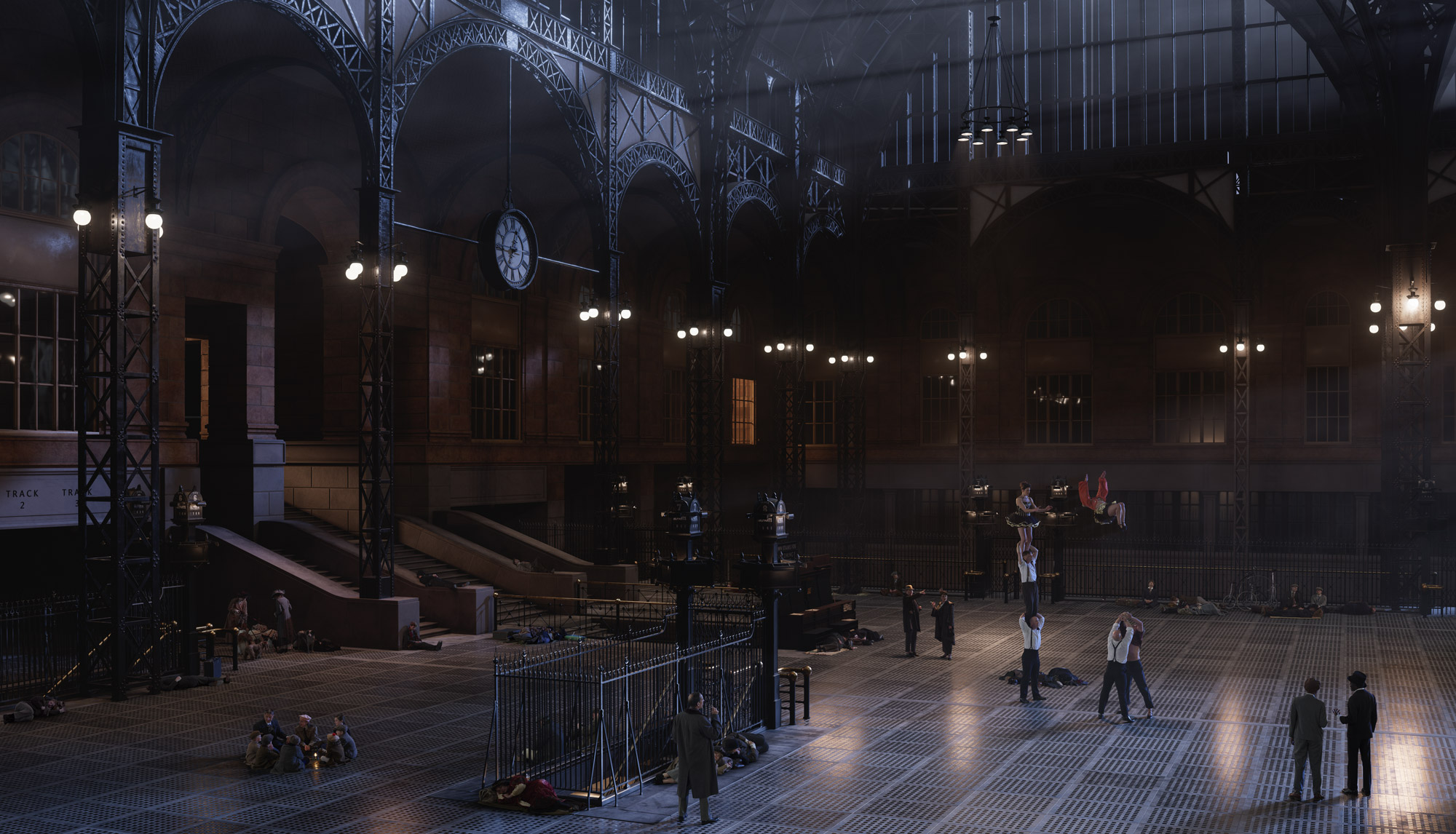
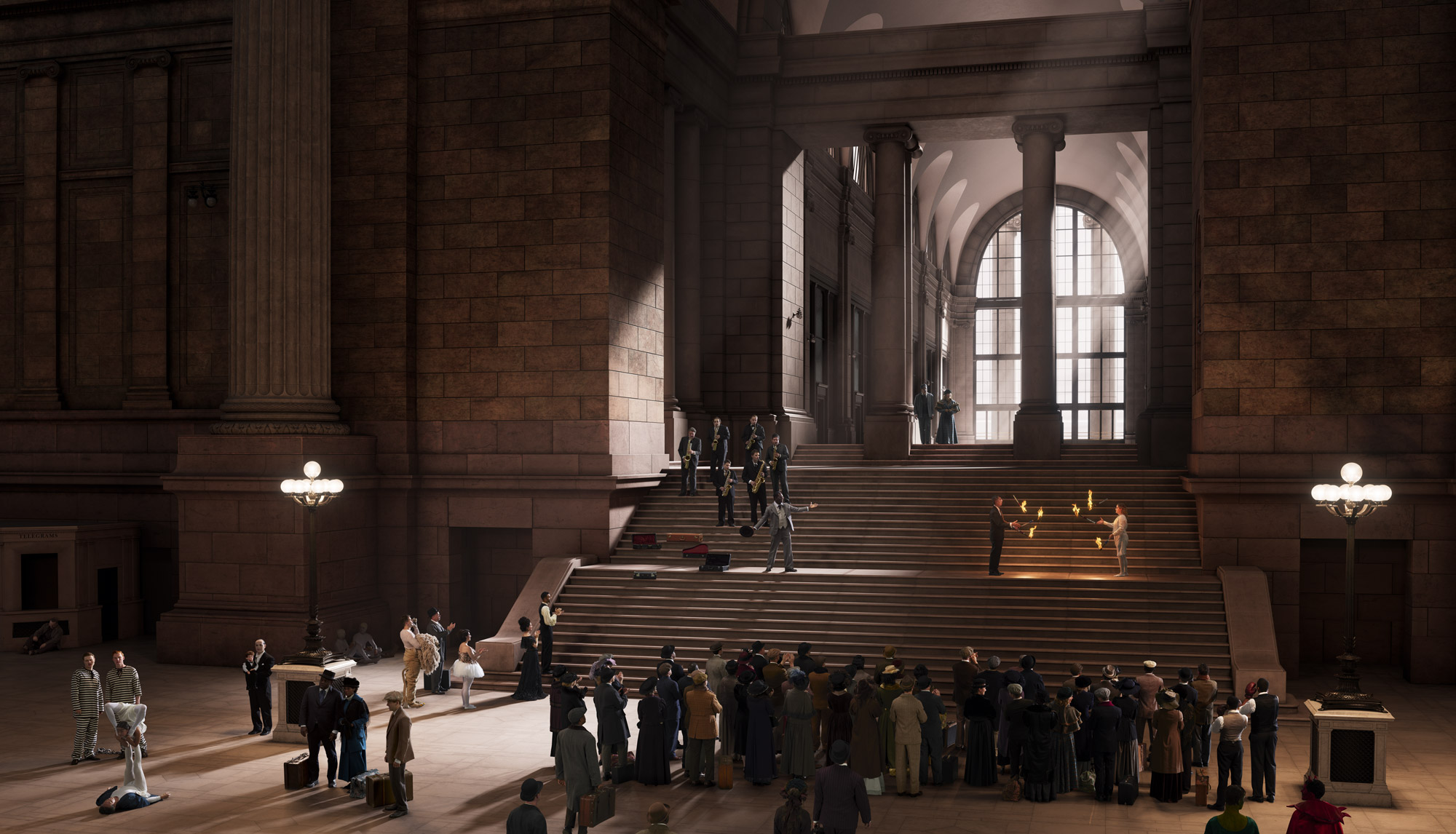
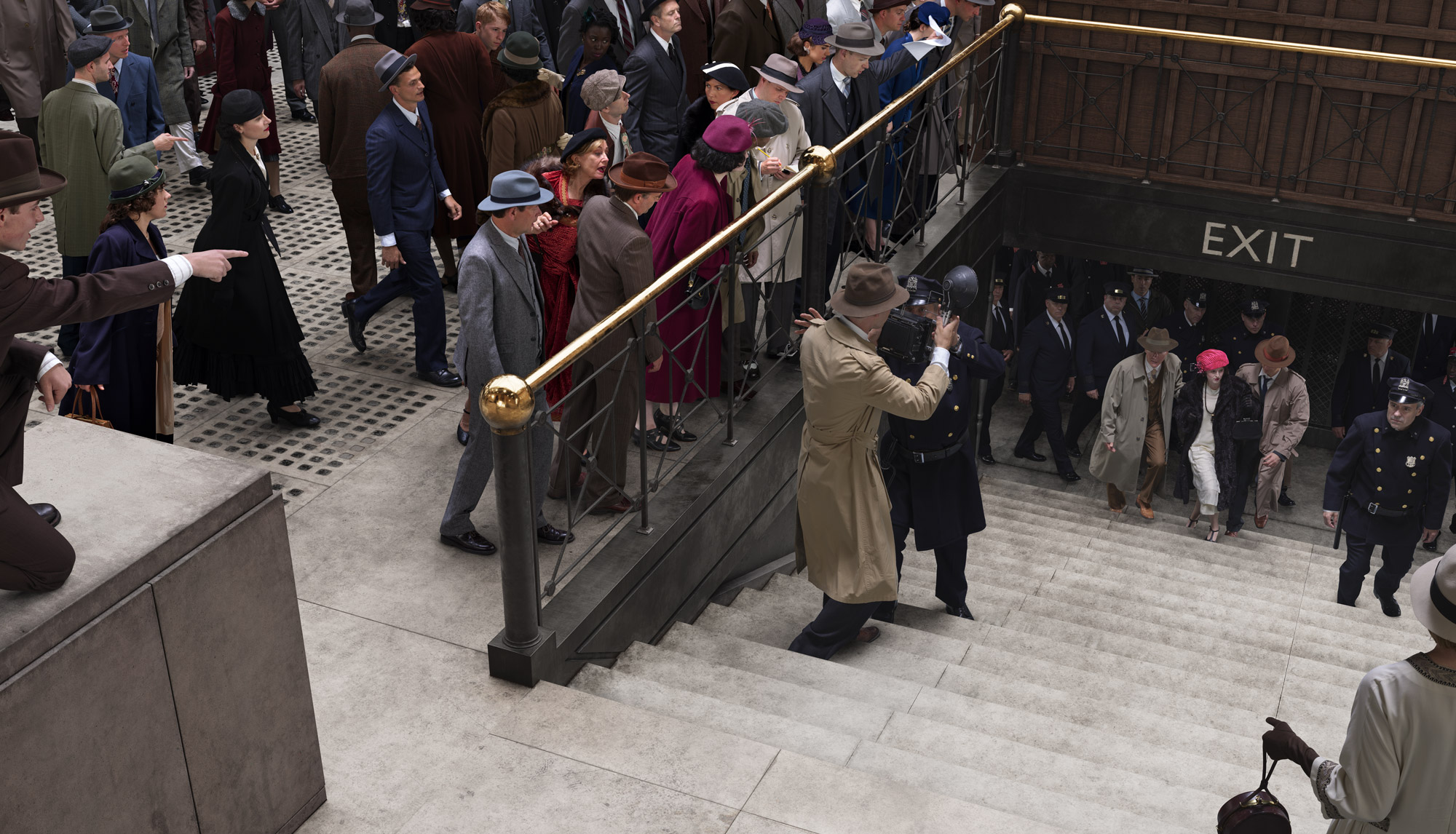
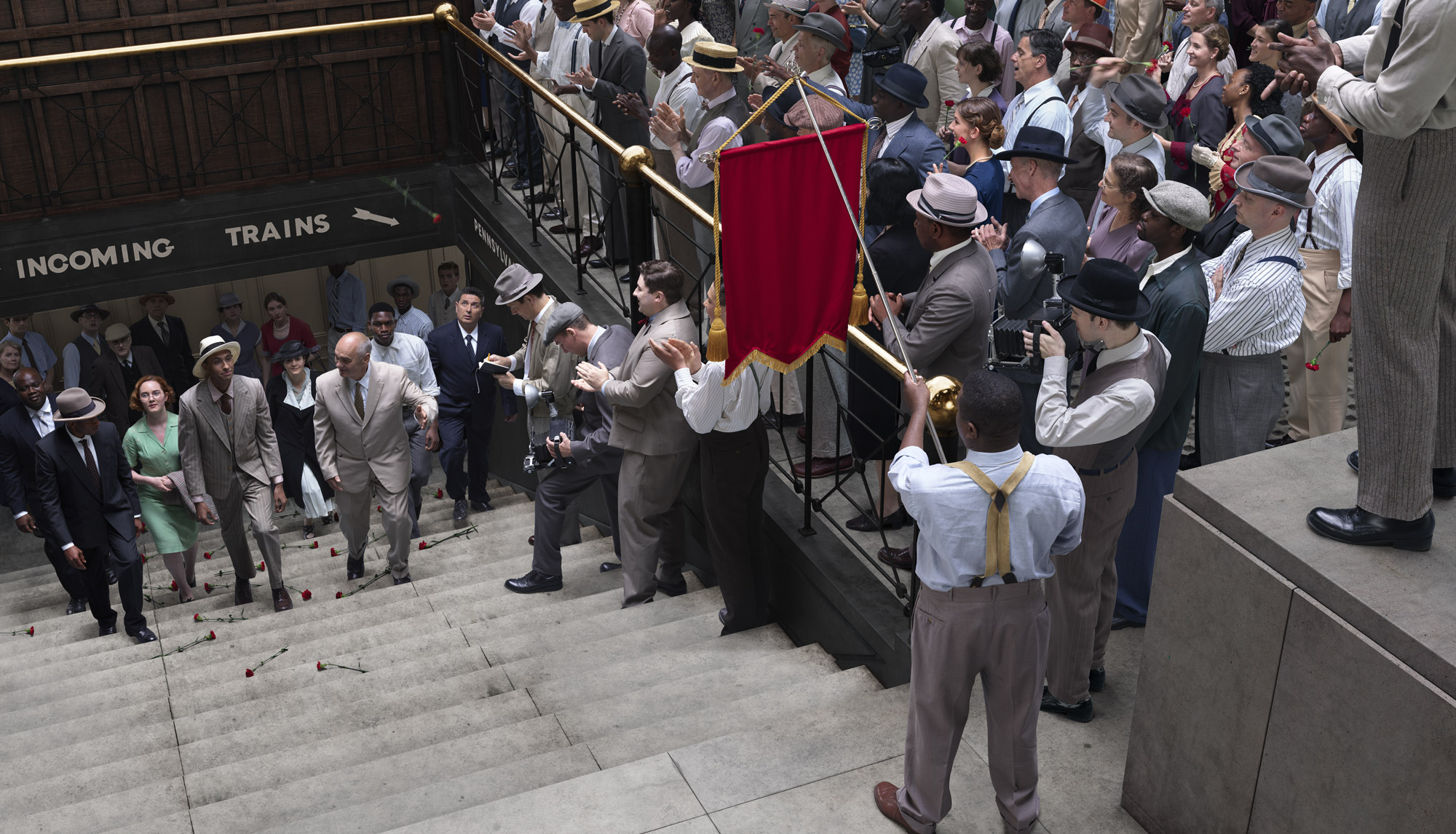
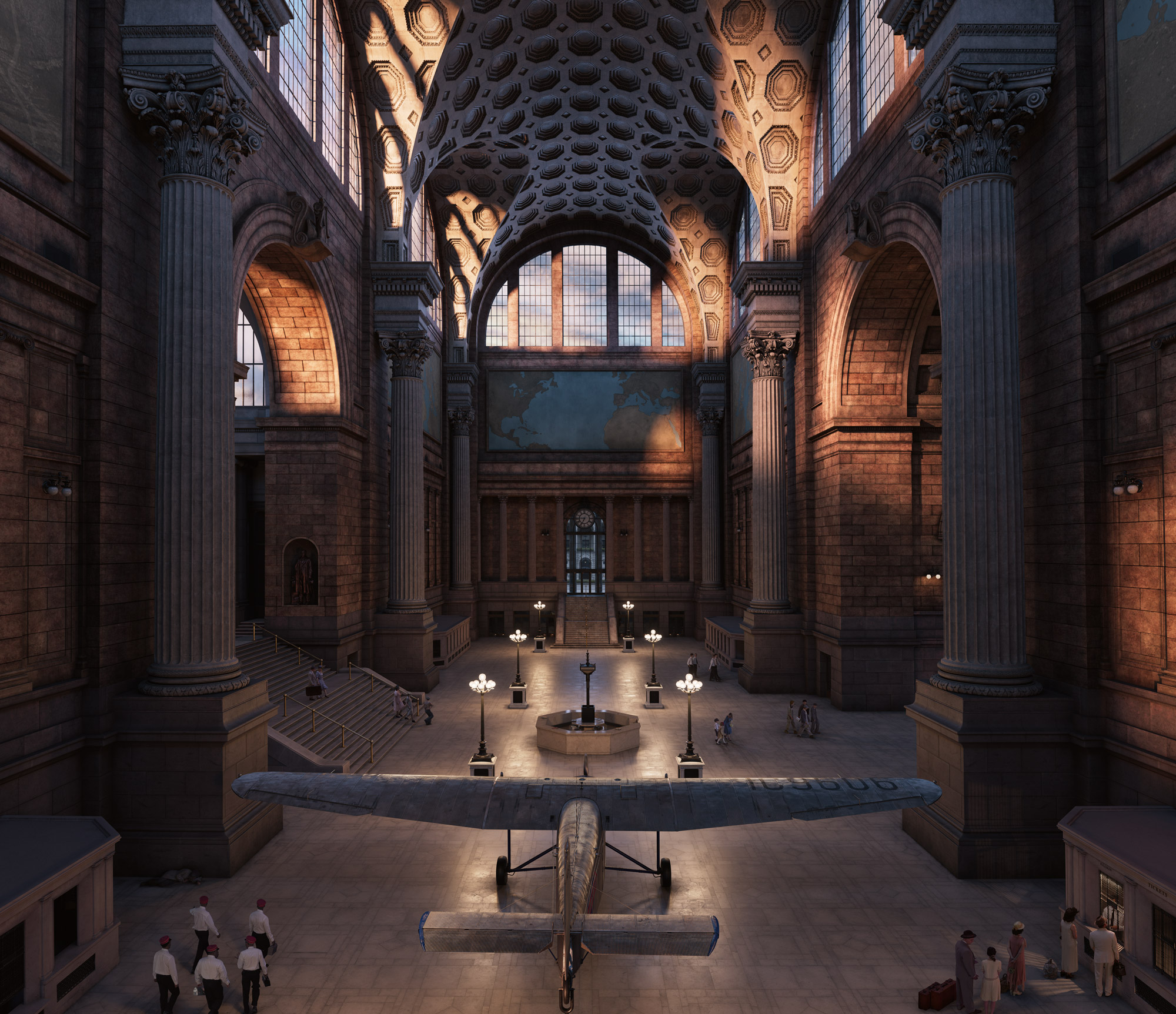
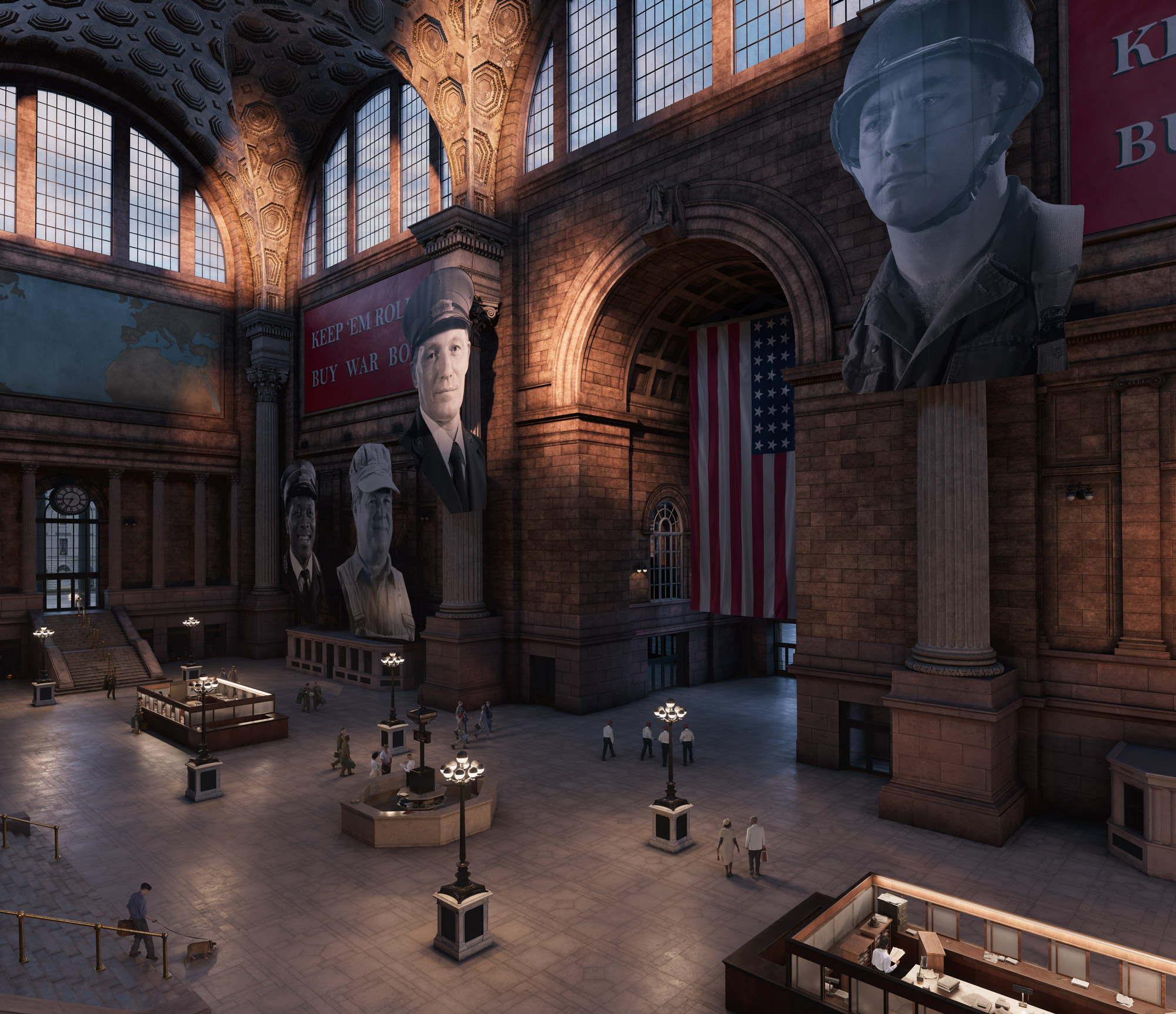
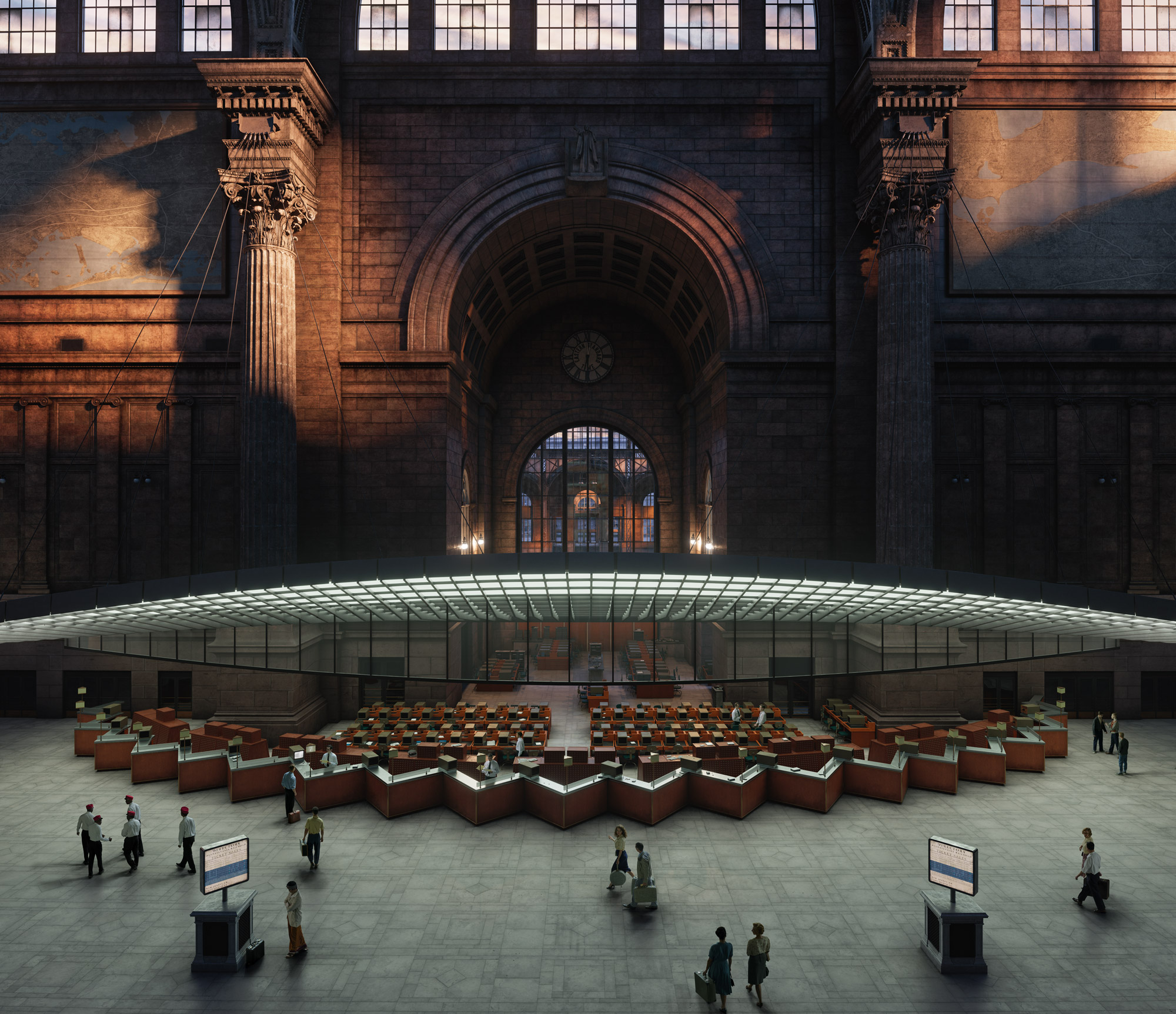
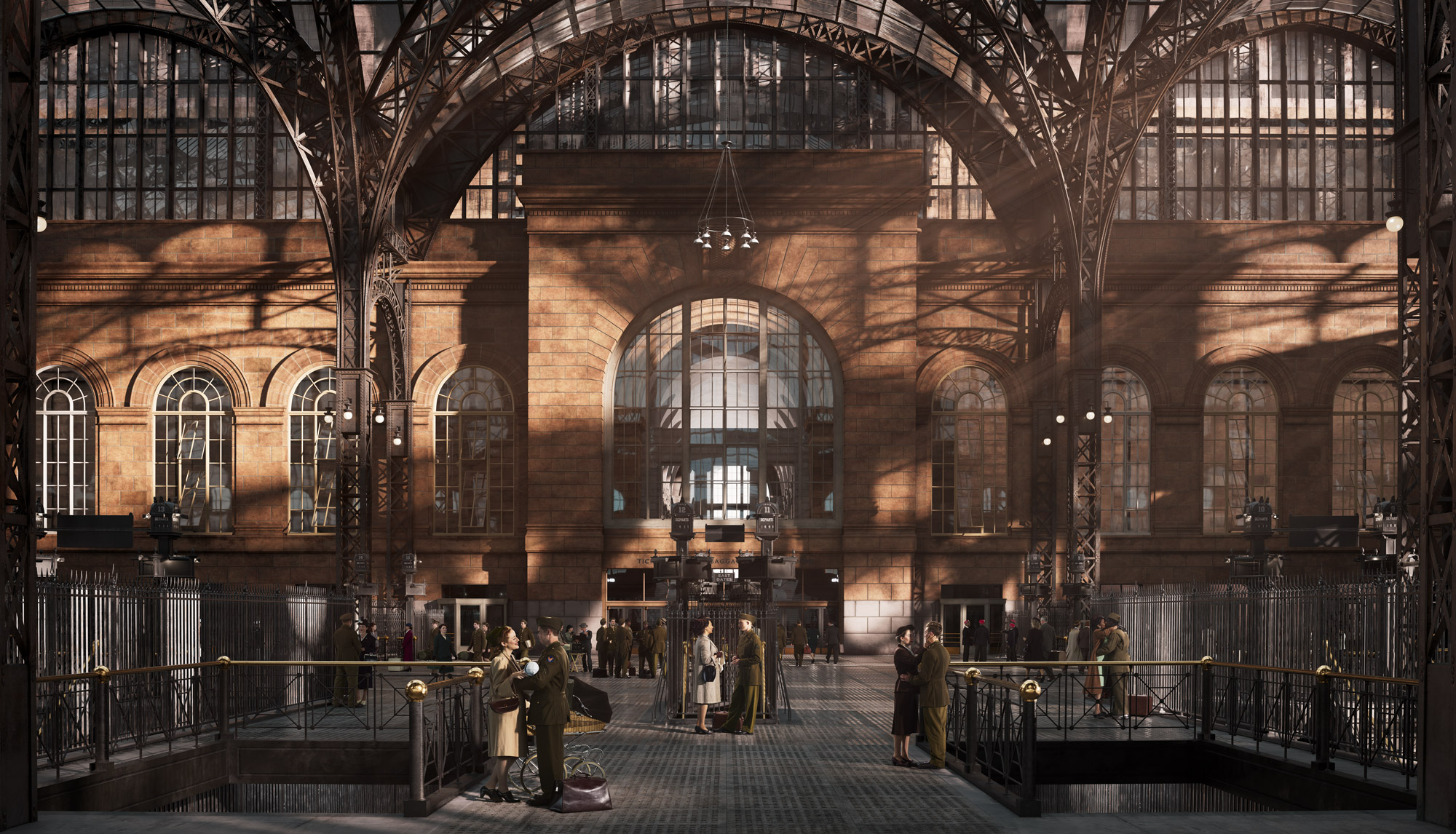
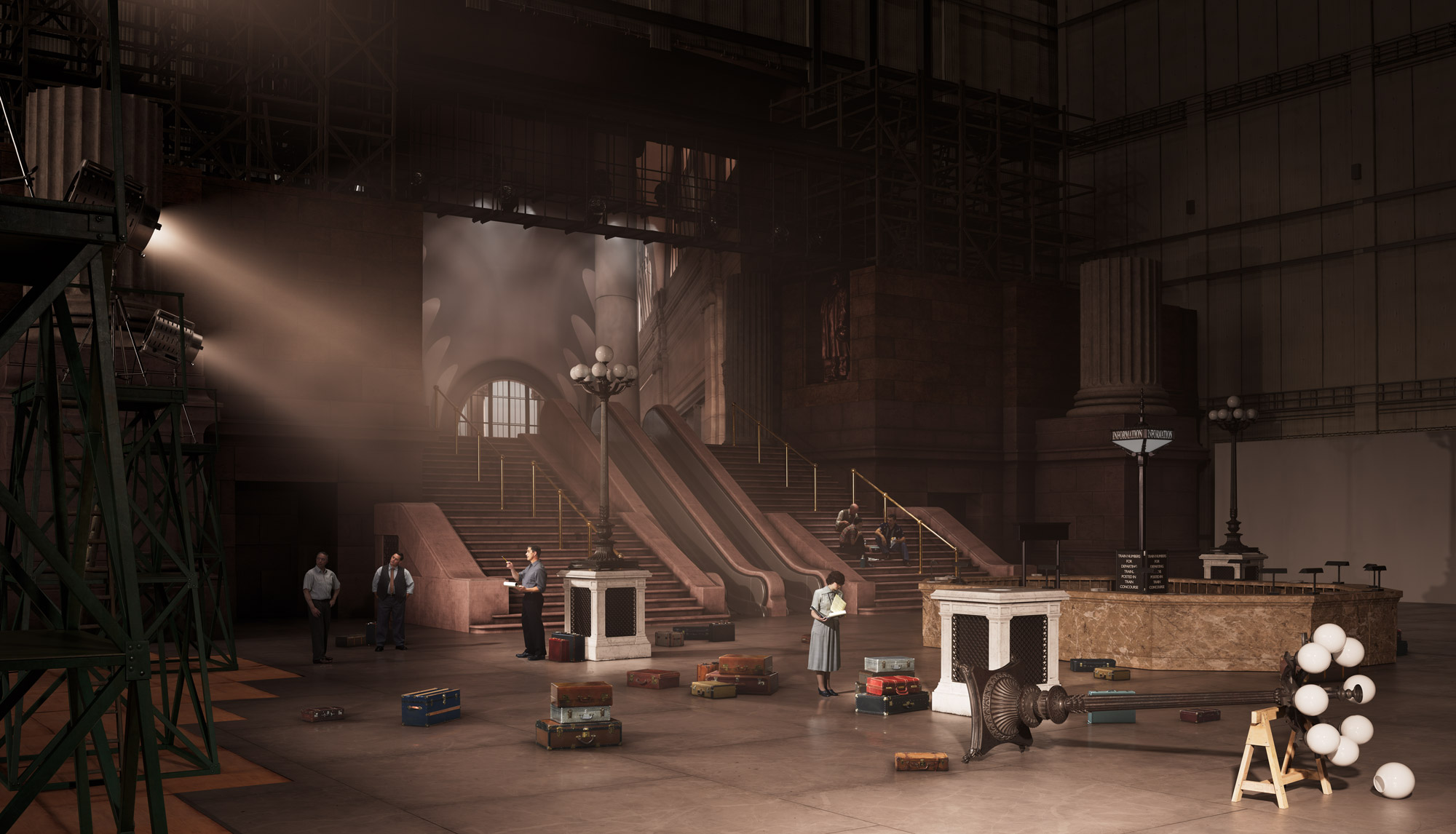
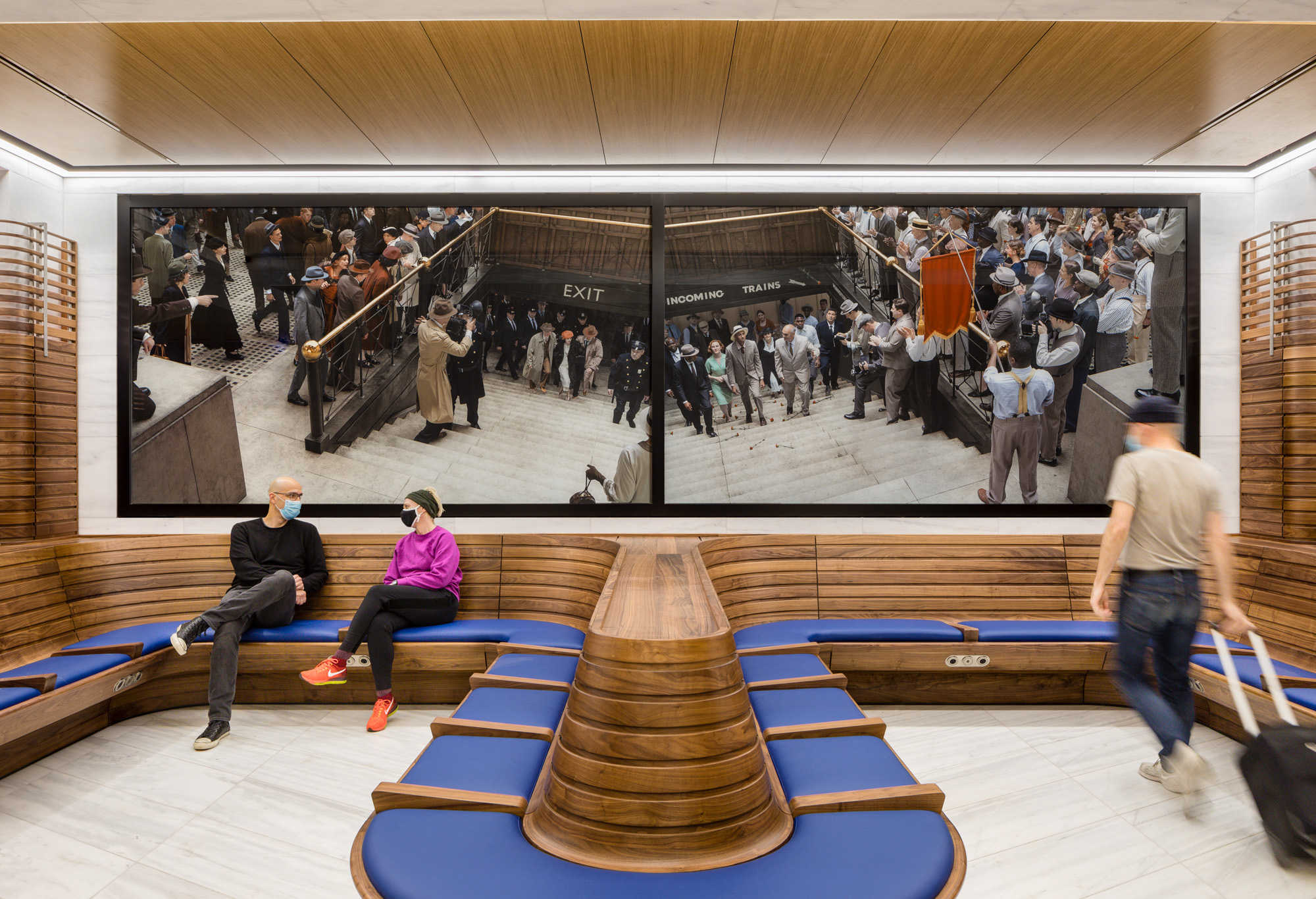
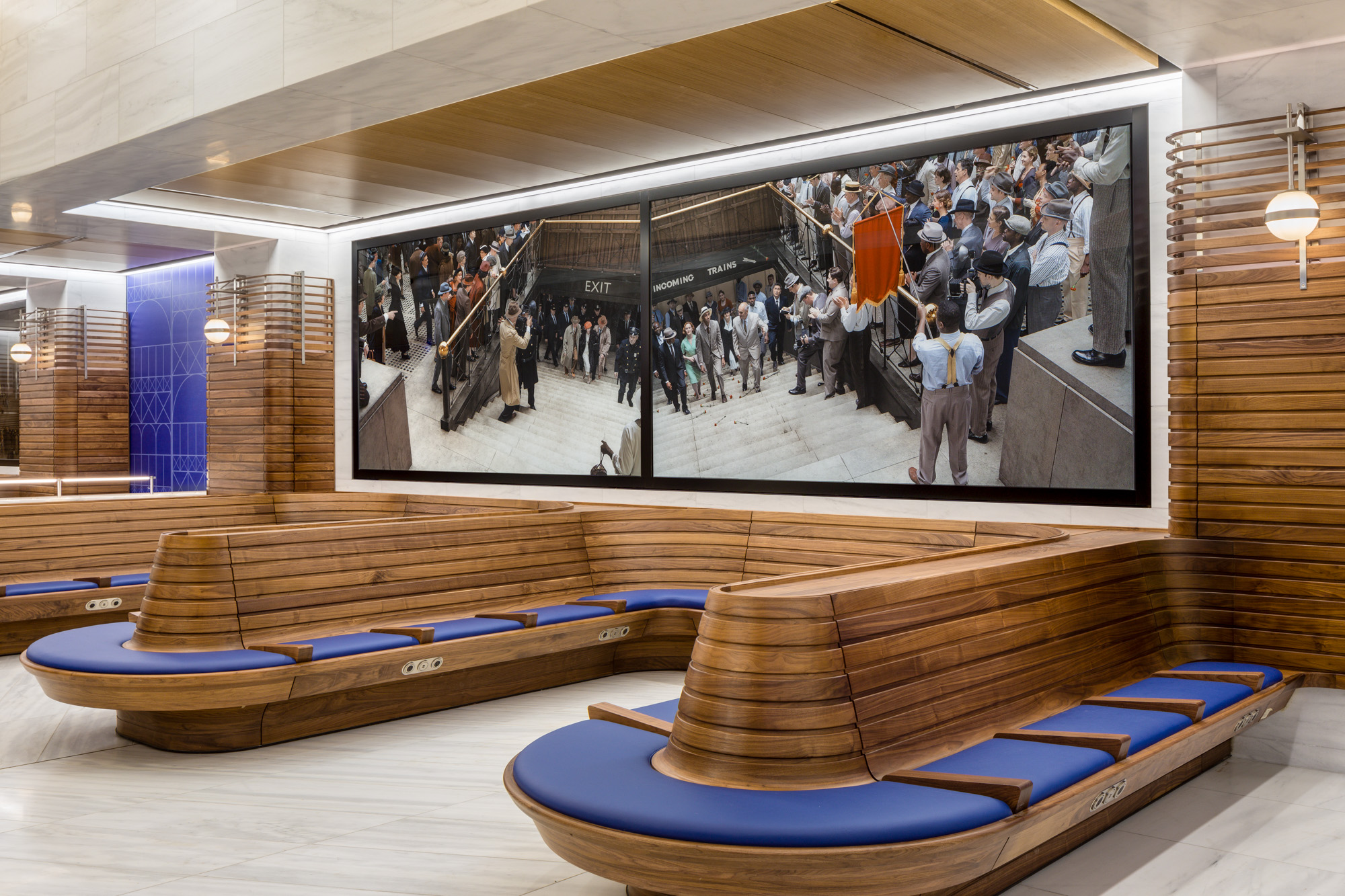
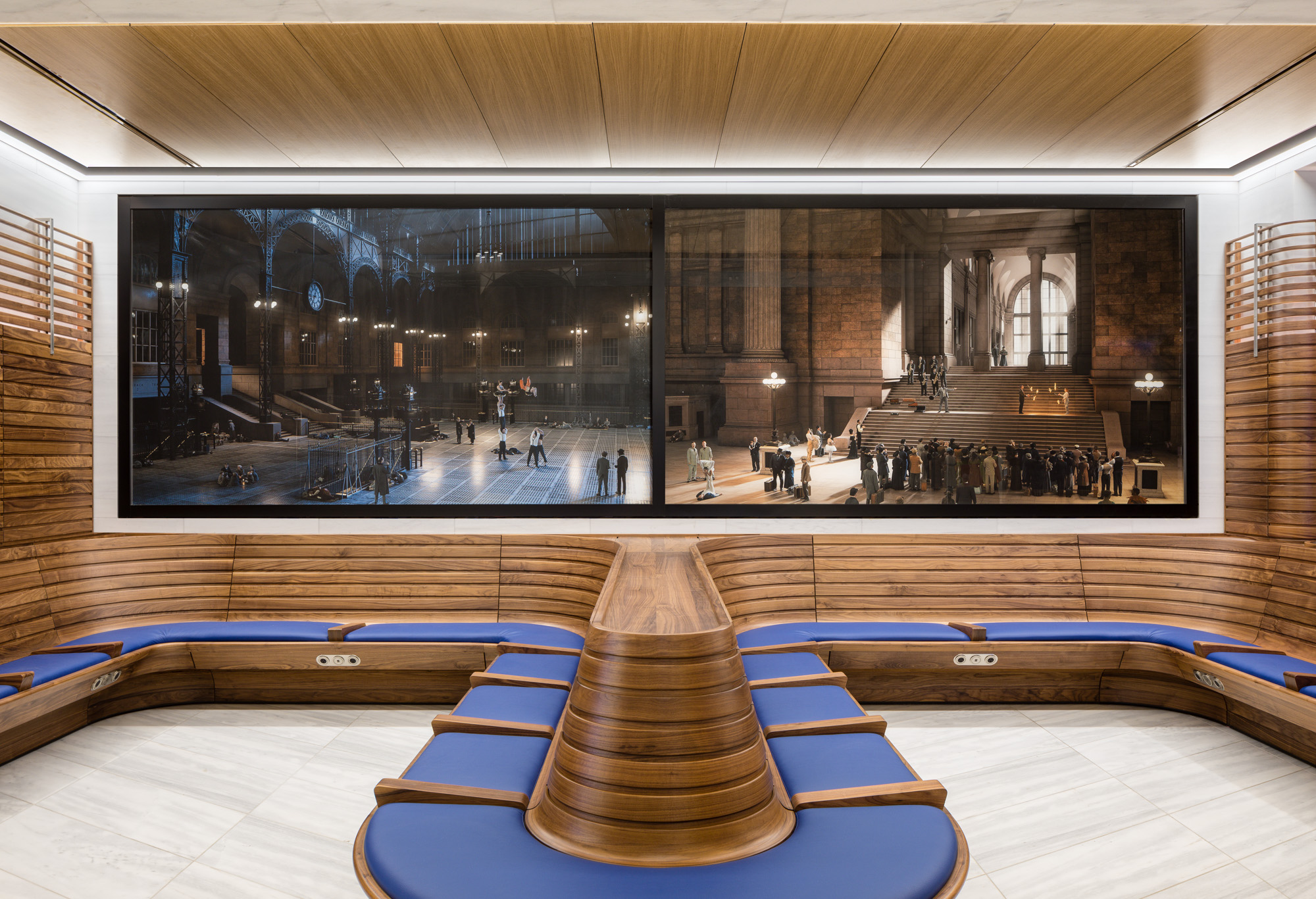
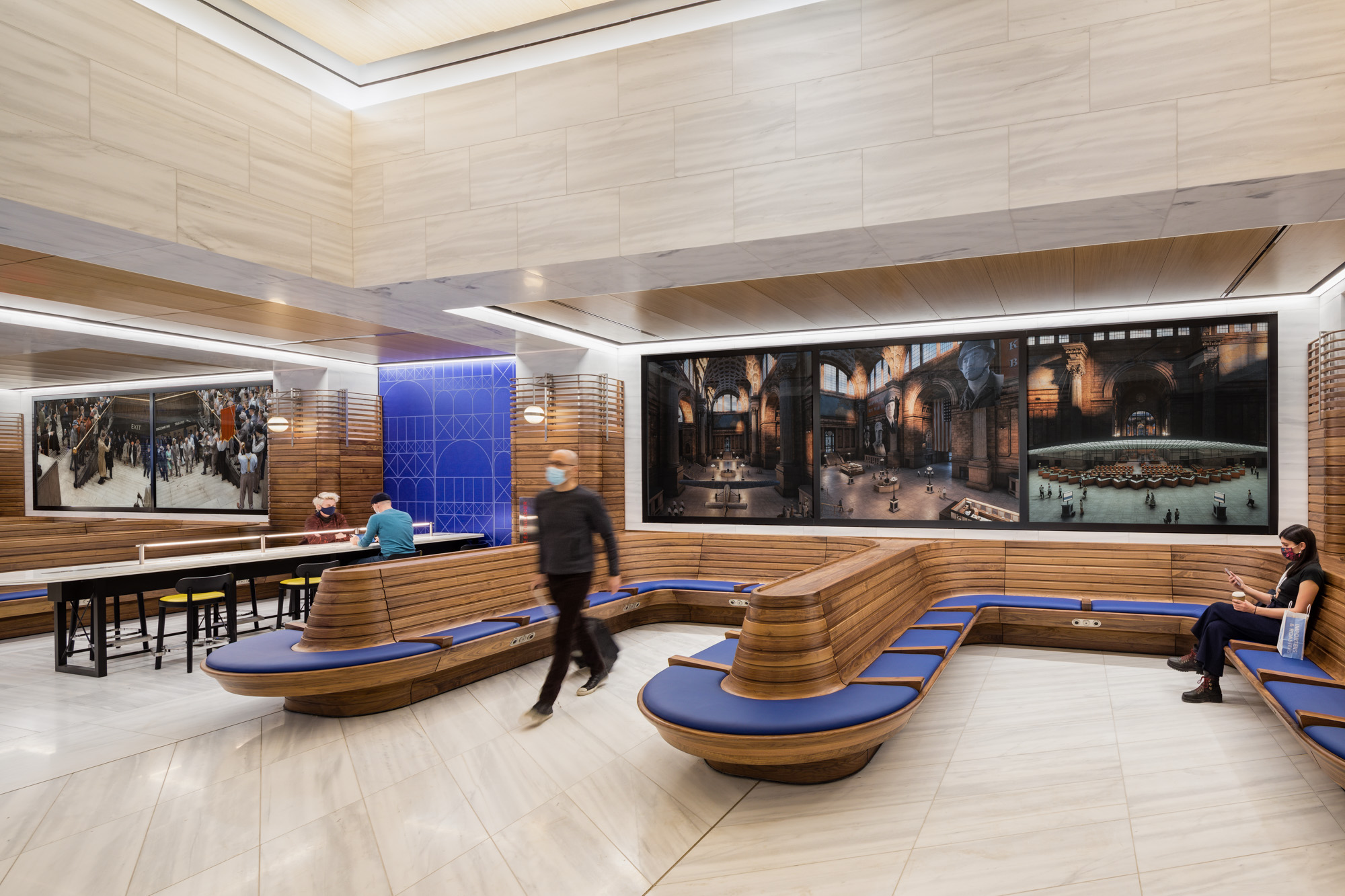
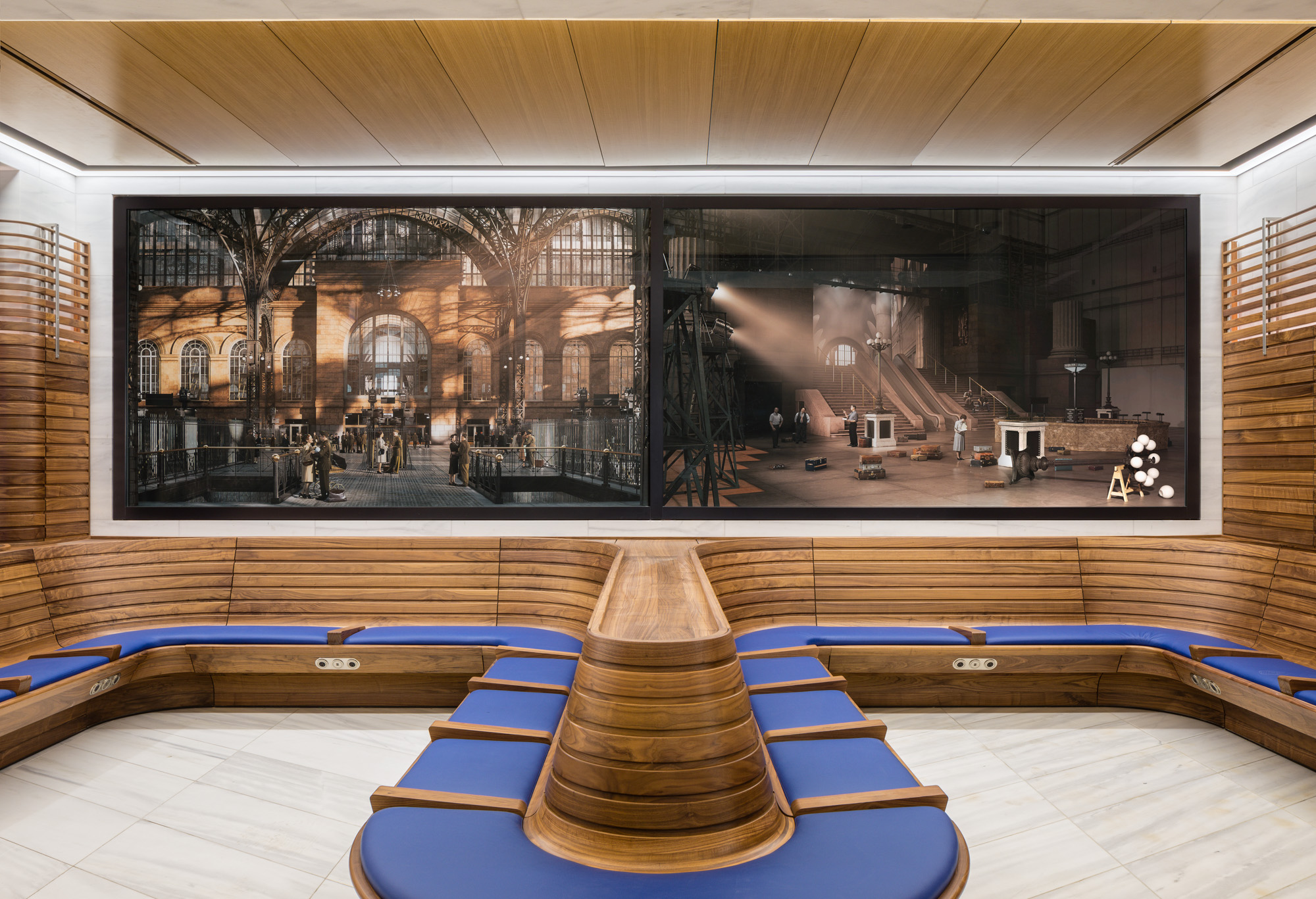
From 1910 to 1963 the original Pennsylvania Station stood one block east of Moynihan Train Hall, on the footprint of today’s Madison Square Garden. The demolition of the grand, Beaux Arts building, designed by eminent American architects McKim, Mead & White, is now considered an incomparable loss to the history of Gilded Age architecture and to the urban landscape of New York City. In the Ticketed Waiting Room at Moynihan Train Hall, artist Stan Douglas’ nine photographic panels, arranged in three pairs and one triptych, reconstruct significant but little-known moments spanning the Station’s half-century lifespan, standing as vivid evocations of the city’s forgotten history. In order to re-create both the demolished building and these moments, Douglas undertook extensive archival research. Extrapolating from photographs, newspaper articles, and architectural plans, he restaged historical events by posing and photographing live performers in period costume. Douglas stitched together dozens of exposures to create each tableau, which he then set within exactingly rendered CGI (computer-generated imagery) backgrounds that faithfully reproduce the soaring ceilings and stately concourses of the original Station. Douglas selected events that chronicle the breadth of collective experience for which Penn Station served as a stage. With a cinematic quality, each scene revives history in uncanny detail, revealing this architectural landmark as a grand theater for the millions of human dramas that animate civic spaces and endow them with meaning.

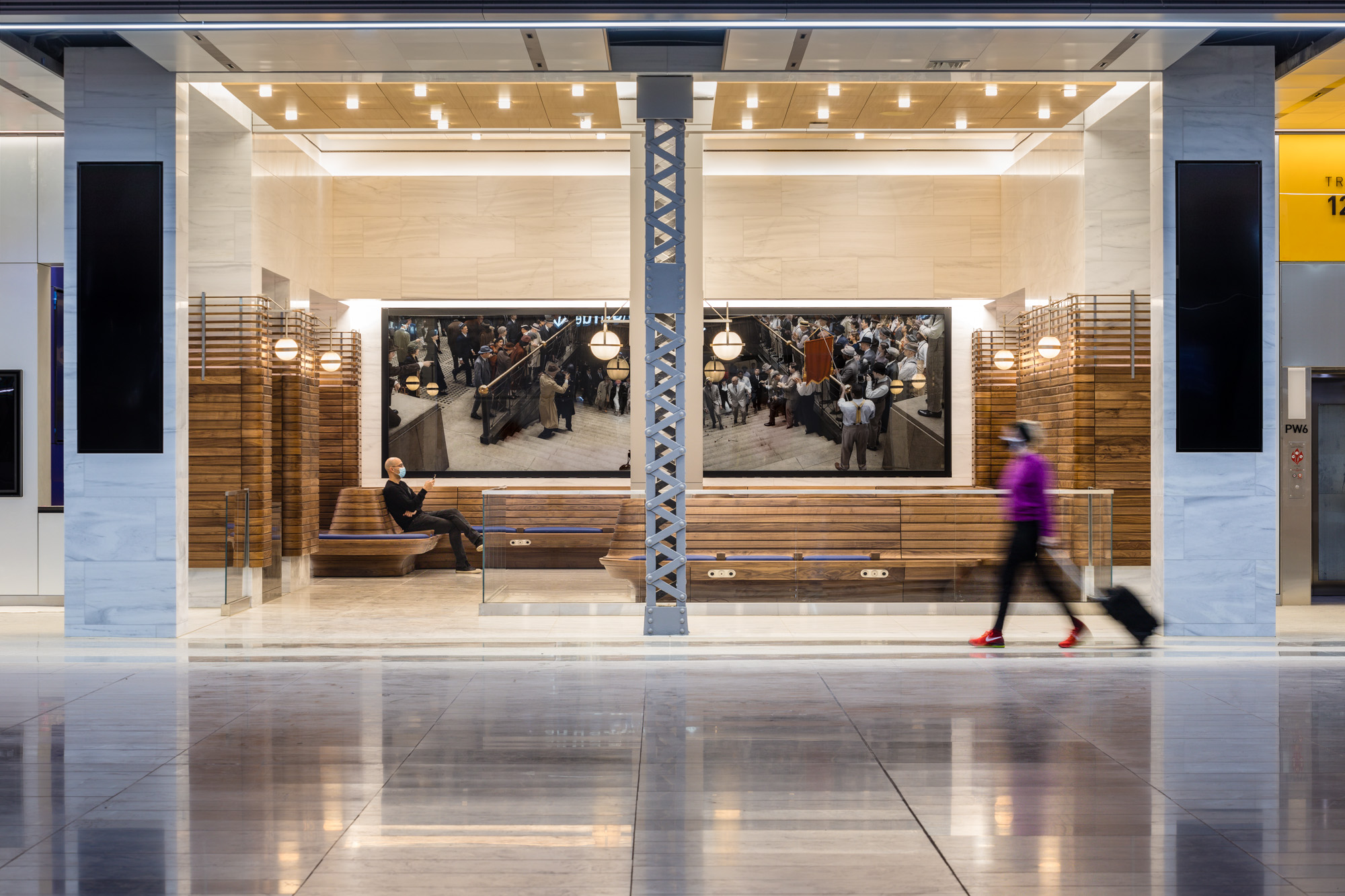
Since the late 1980s, Douglas has used photography, film, and theater to reconsider history and the means of its documentation, which define its shape in our collective memory. Born of exhaustive historical research, Douglas’ artworks bring new focus to overlooked events specific to a particular location. He frequently hones in on intimate, localized moments of spectacle and poignancy that speak to broader societal shifts. In restaging these events, Douglas consciously references the technologies he employs to bring them to life. In Penn Station’s Half Century, depictions of vaudeville performers, Hollywood set designs, and photo mural ad campaigns echo Douglas’s own artistic process, suggesting that photographic documentation has the potential to be a medium of fantasy as much as one of verisimilitude. Conceived specifically for the series of four architectural niches that anchor the rear wall of the Ticketed Waiting Room, the nine individual scenes are connected by multiple narrative threads and introduce subtle details that reveal themselves upon close examination. Penn Station’s Half Century is the artist’s first permanent public commission in the United States.


Stan Douglas (b. 1960, Vancouver, Canada; lives and works in Vancouver)
Penn Station’s Half Century, 2020
Ceramic ink on glass
Nine photographic panels installed in four niches: each niche 6′ 7 5/8” H x 22′ 2 ½” W x ½” D
Commissioned by Empire State Development in partnership with Public Art Fund

Installation Photos

Two horizontal panels of photographs, with blue upholstery and wood seating below the panels. The two photographs depict reenactments of significant but little-known...
A wall of a train lobby houses two horizontal panels of photographs, with blue upholstery and wood seating below the panels. The two photographs depict reenactments...
Two horizontal panels of photographs, with blue upholstery and wood seating below the panels. The two photographs depict reenactments of significant but little-known...

About the Artist

Stan Douglas    View Profile

Since the late 1980s, Stan Douglas (b. 1960, Vancouver, Canada) has used photography, film, and theater to reconsider history and the means of its documentation, which define its shape in our collective memory. Born of exhaustive historical research, Douglas’ artworks bring new focus to overlooked events specific to a particular location. He frequently hones in on intimate, localized moments of spectacle and poignancy that speak to broader societal shifts. In restaging these events, Douglas consciously references the technologies he employs to bring them to life.

Douglas’ work has been the subject of solo exhibitions at prominent institutions such as the Hessel Museum of Art, Bard College, Annandale-on-Hudson, N (2025); DAS MINSK Kunsthaus, Potsdam, Germany (2022); Phi Foundation, Montreal (2022); Art Gallery of Nova Scotia, Halifax (2022); Toledo Museum of Art, OH (2021); Musée d’Art Moderne Grand-Duc Jean (MUDAM), Luxembourg (2018); Pérez Art Museum, Miami (2016); Salzburger Kunstverein, Salzburg, Austria (2016); Hasselblad Center, Gothenburg, Sweden (2016); and WIELS Centre d’Art Contemporain, Brussels (2015). His work has been featured in the Venice Biennale (2022, 2019, 2005, 2001, 1990) and in documenta (2002, 1997, 1992). Douglas has received many awards, including the Audain Prize for Visual Art (2019); the Hasselblad Foundation International Award in Photography (2016); the third annual Scotiabank Photography Award (2013); and the Infinity Award from the International Center of Photography, New York (2012). Work by the artist is held in collections worldwide, including the Art Gallery of Ontario, Toronto; Centre Georges Pompidou, Paris; Los Angeles County Museum of Art, CA; Museum of Contemporary Art Chicago, IL; The Museum of Modern Art, New York City; National Gallery of Canada, Ottawa; Pérez Art Museum, Miami; San Francisco Museum of Modern Art, CA; Solomon R. Guggenheim Museum, New York City; Tate, London; Vancouver Art Gallery, Canada. Douglas lives and works in Vancouver.

(as of 2025)
Artworks

Photo depicting an impromptu vaudeville show in the waiting room of the historical Penn Station building.
People dressed in winter fashions from the 1920s gather around the stairs to observe and photograph the emergence of an arrested woman.
A trimotor airplane rests in the dimly lit, empty waiting room of a grand station. Sun pours into the waiting room as passengers begin to trickle into the space.
Six massive black and white photo murals within a grand train stationdepict railroad employees: a conductor, engineer, soldier, and many more.
A depiction of a modern ticket and service bureau in a grand train station, with a glowing roof cover that resembles a clam shell.
An image depicts final moments of affection as soldiers leaving for World War II bid farewell to loved ones in a grand train station.
A vacant soundstage from a 1945 film set in a grand train hall populated only by technicians, props, and lighting instruments.

Elmgreen & Dragset, The Hive

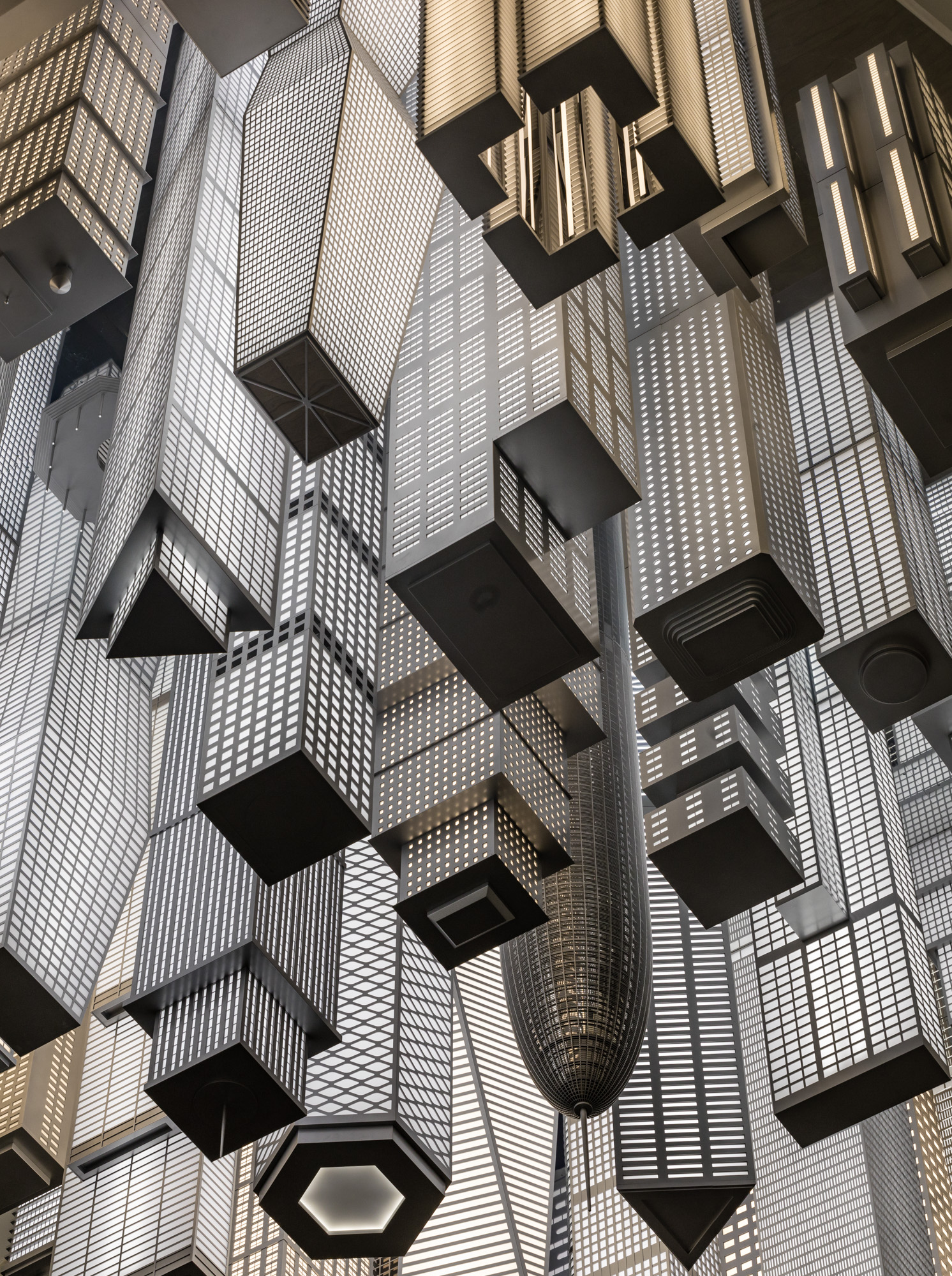
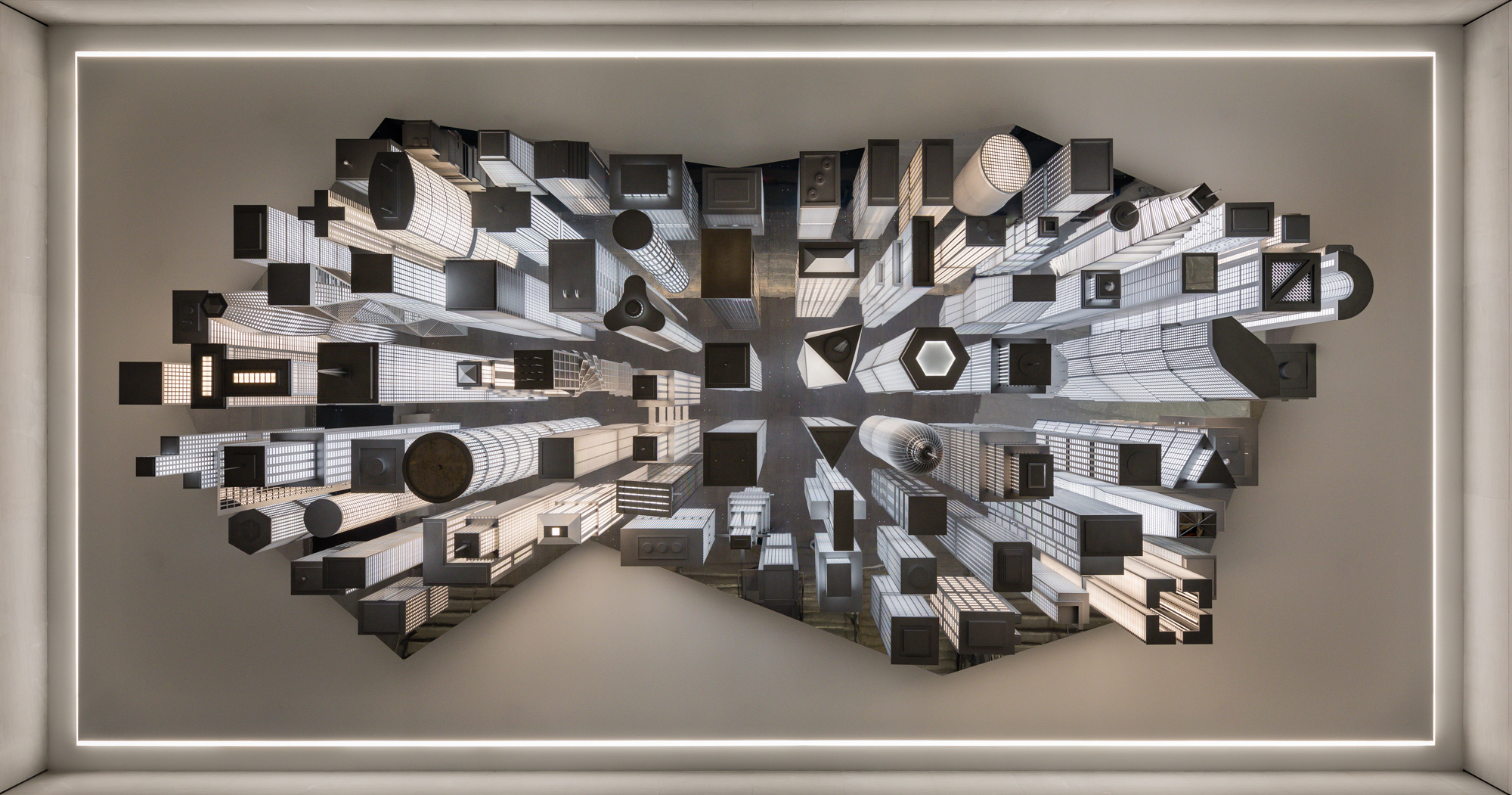
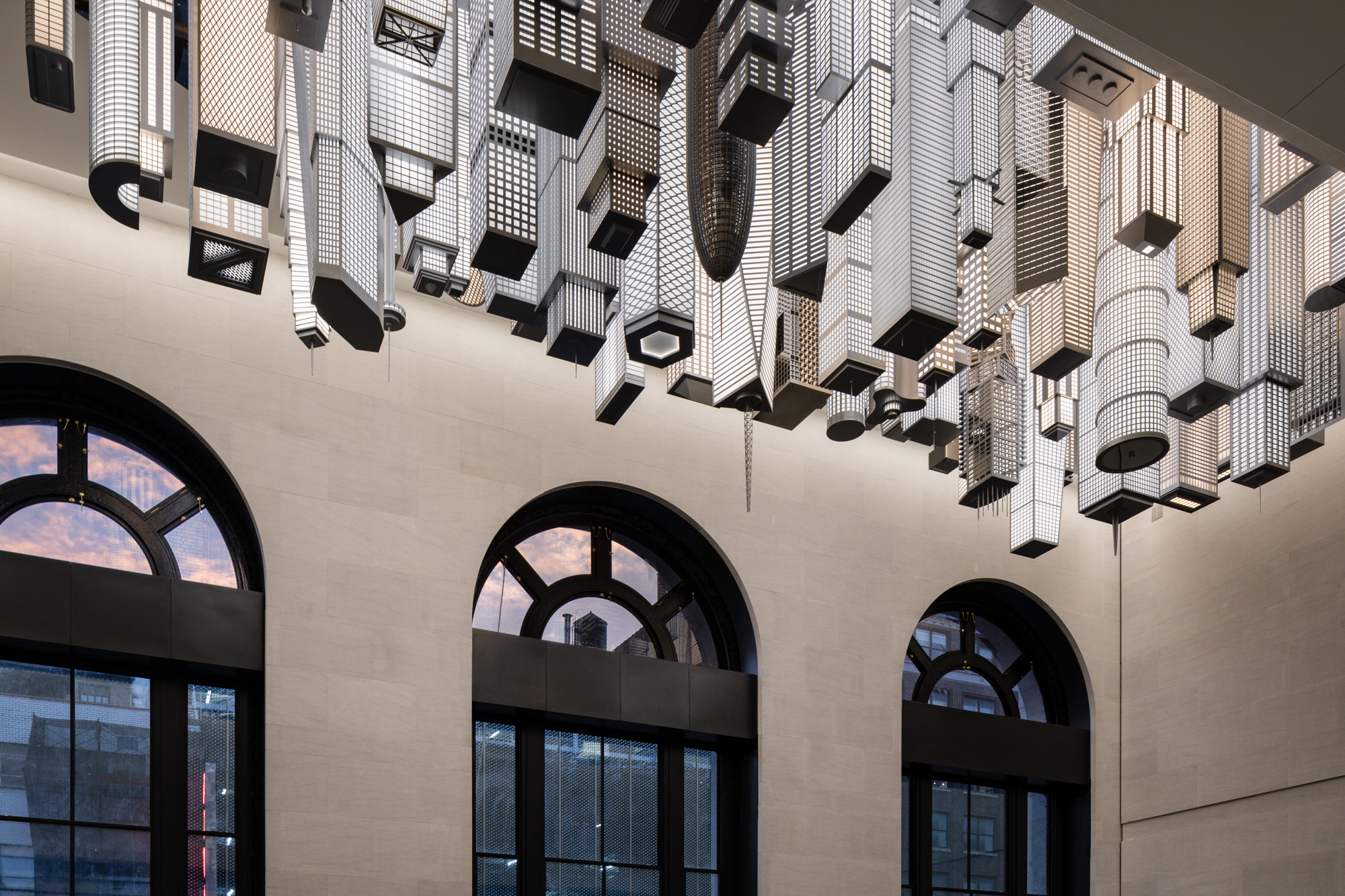
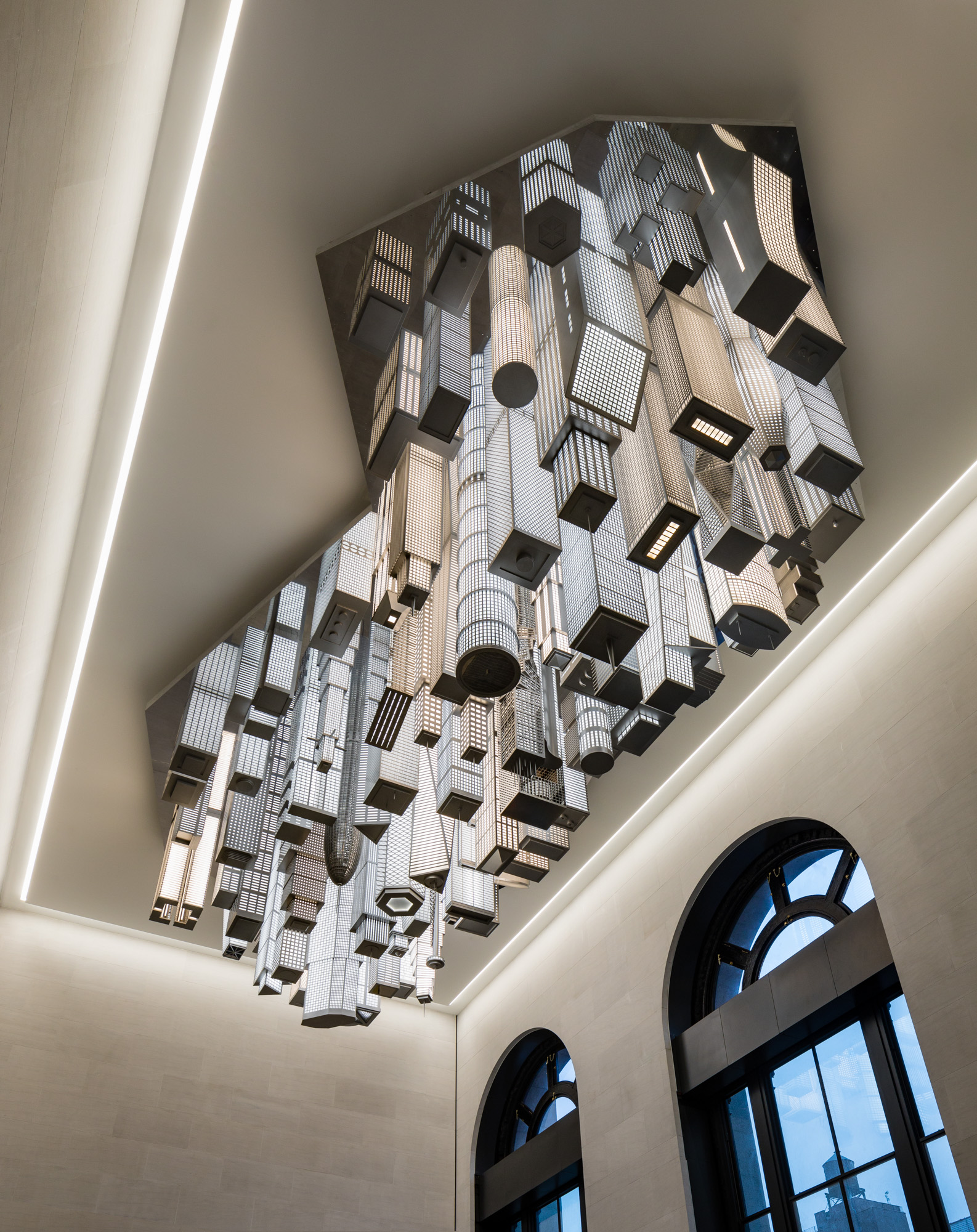
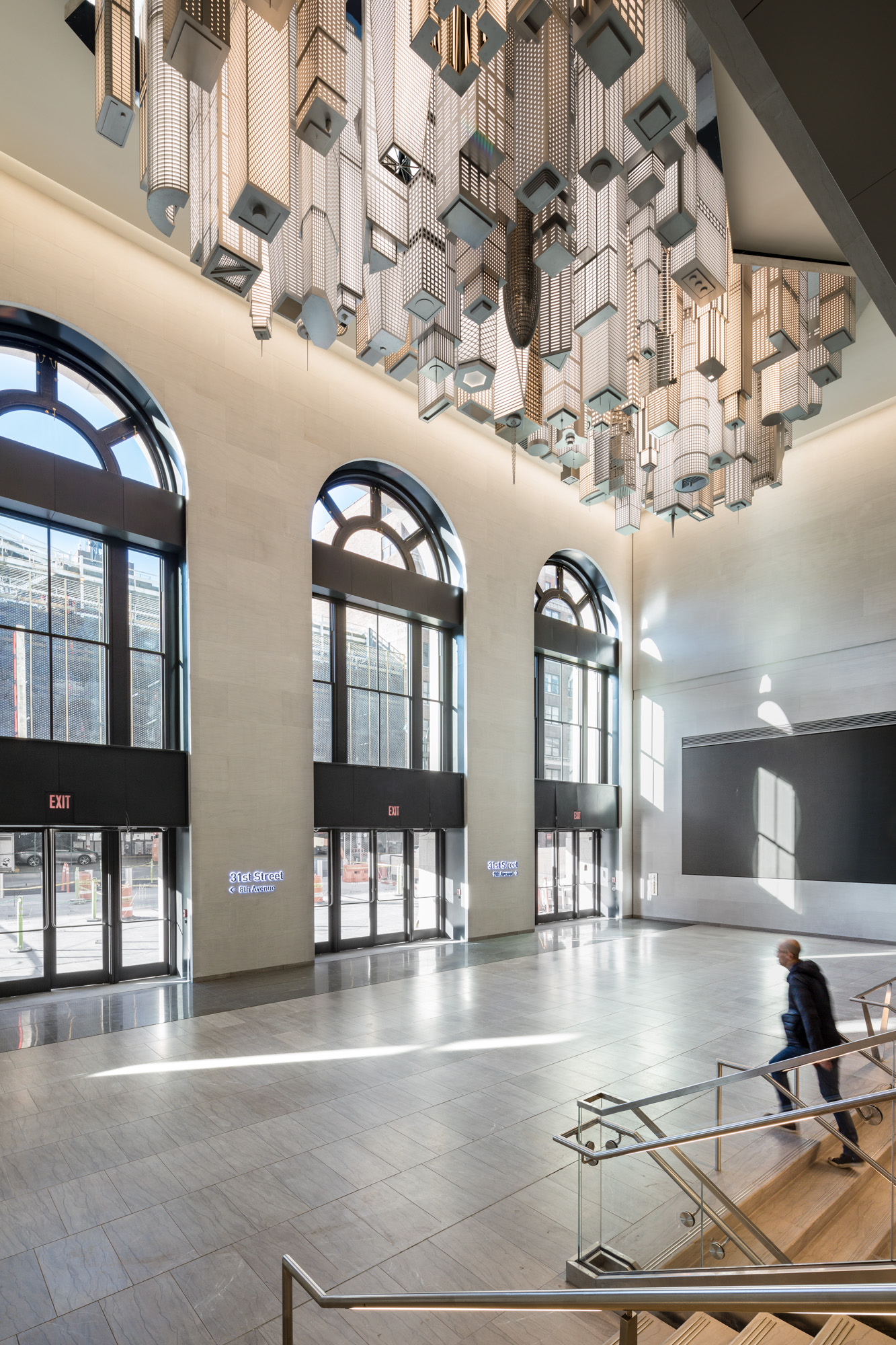
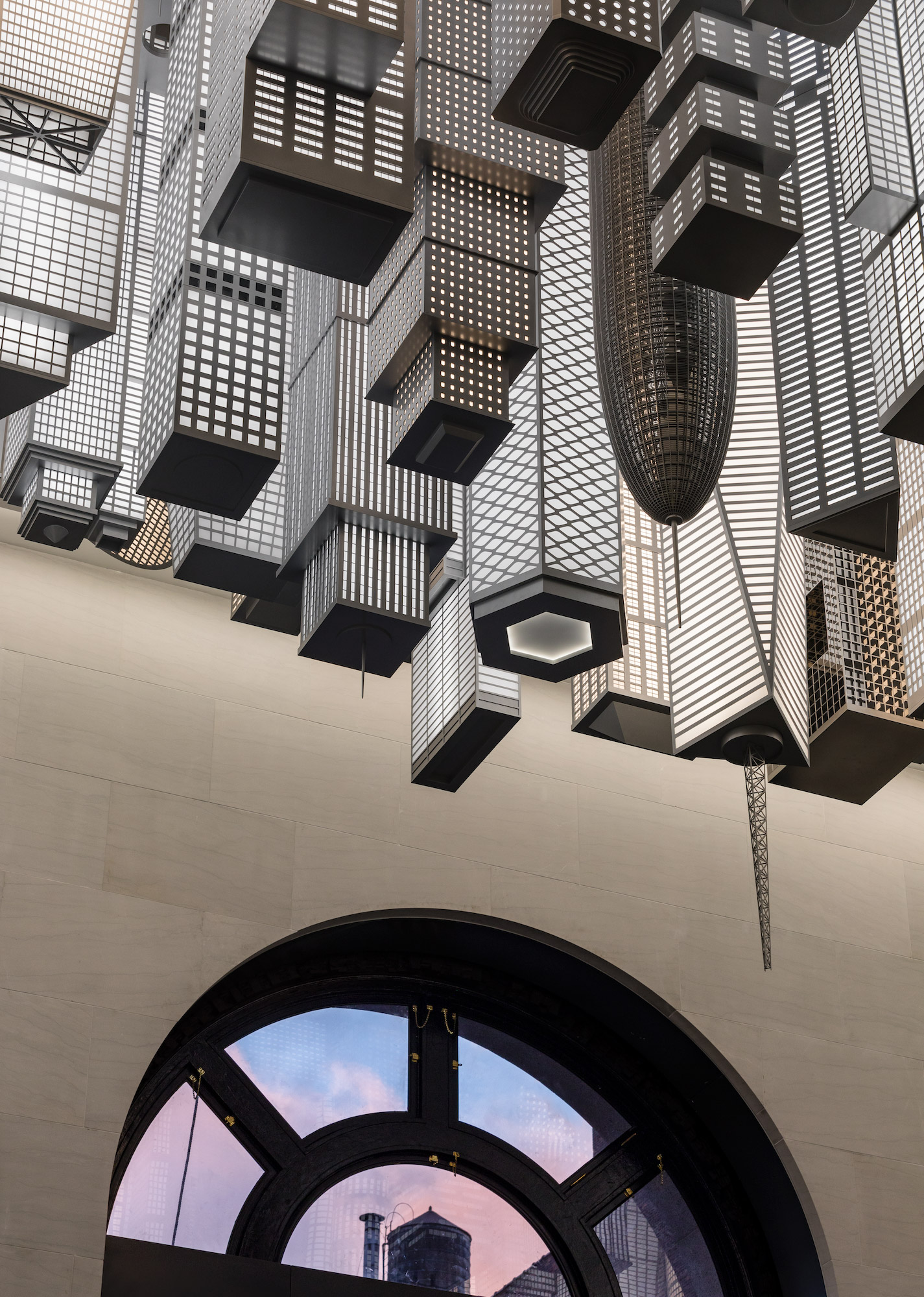
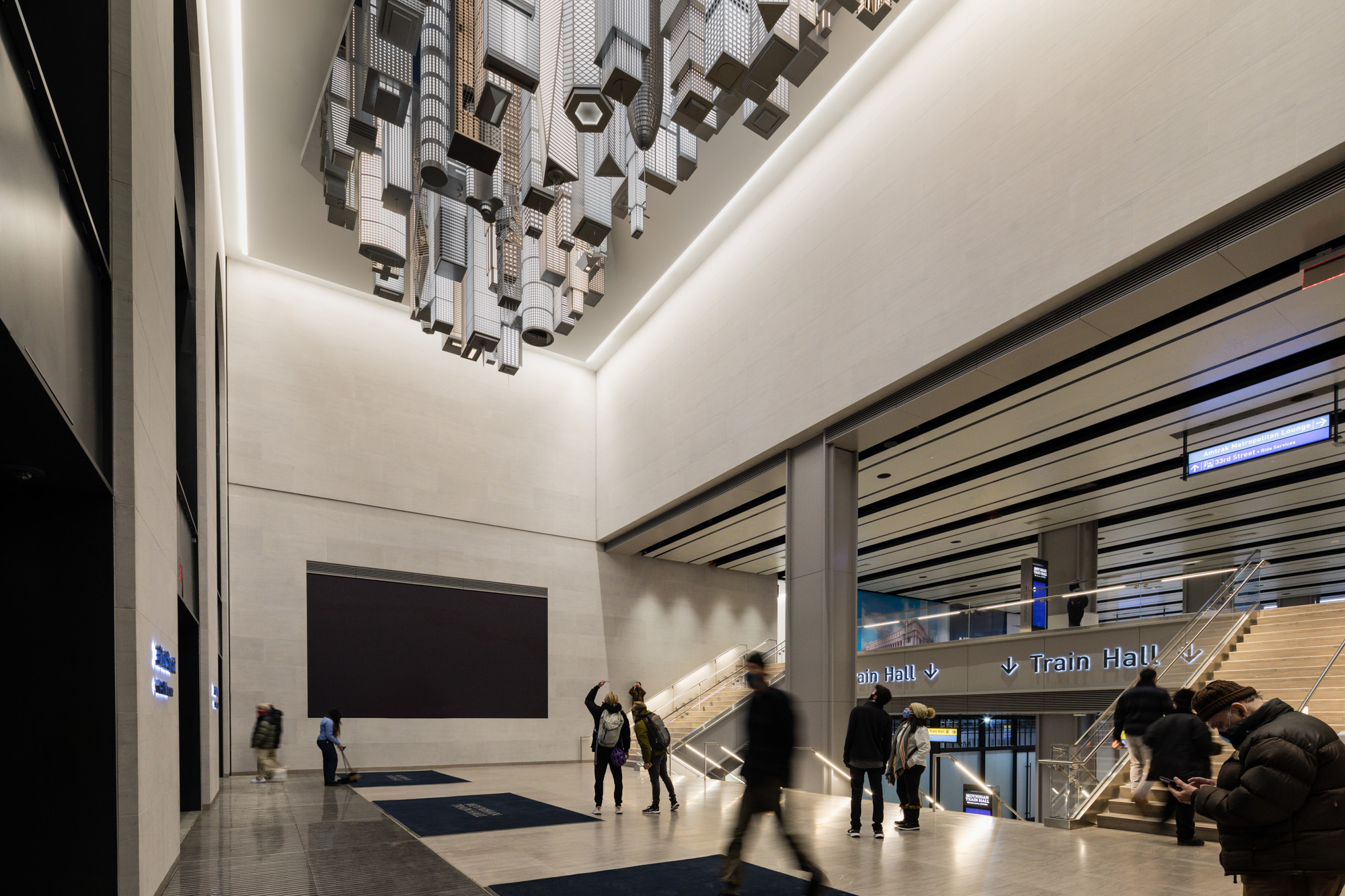
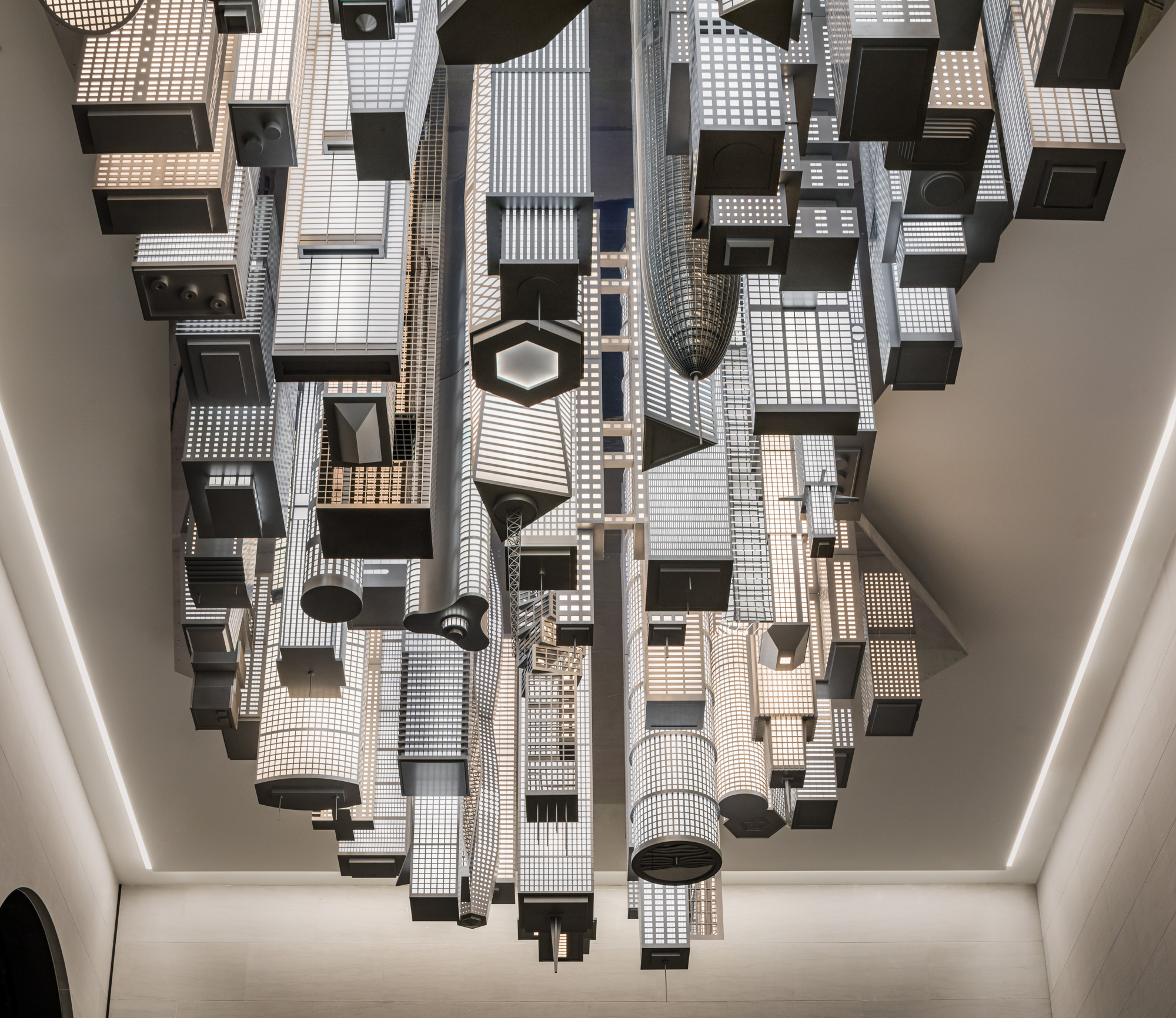
Suspended from the ceiling of the 31st Street Mid-block Entrance Hall, The Hive is a 1:100 scaled architectural model that offers a surreal and fantastical vision of a global metropolis. Dozens of illuminated high-rise buildings descend toward visitors, their downturned orientation inviting new and varied perspectives as visitors move around the space. Artist duo Elmgreen & Dragset has combined miniaturized skyscrapers of their own invention with iconic high-rise buildings from megacities around the world, distilling these towers into their most essential forms. This fictional city combines landmarks from Chicago, Hong Kong, Kuala Lumpur, London, and Paris as well as iconic New York City silhouettes.

Titling the work The Hive, the artists suggest a link between natural and human-built structures, like the complex and evolving architecture of a beehive. They have also compared the ceiling-mounted buildings to luminous stalactites that pay tribute to the highly developed cities we live in today while reminding us of our cave-dweller origins. Familiar yet foreign, this uncanny, hybridized representation of an urban center highlights the globalization of architectural design and evokes the influence and interconnectedness of the world’s great cities. Like an inverted reflection of the cityscape just beyond the Train Hall doors, The Hive expresses the quintessential idea of New York City as a melting pot where cultures, nationalities, and ethnicities coexist to become greater than the sum of their parts.

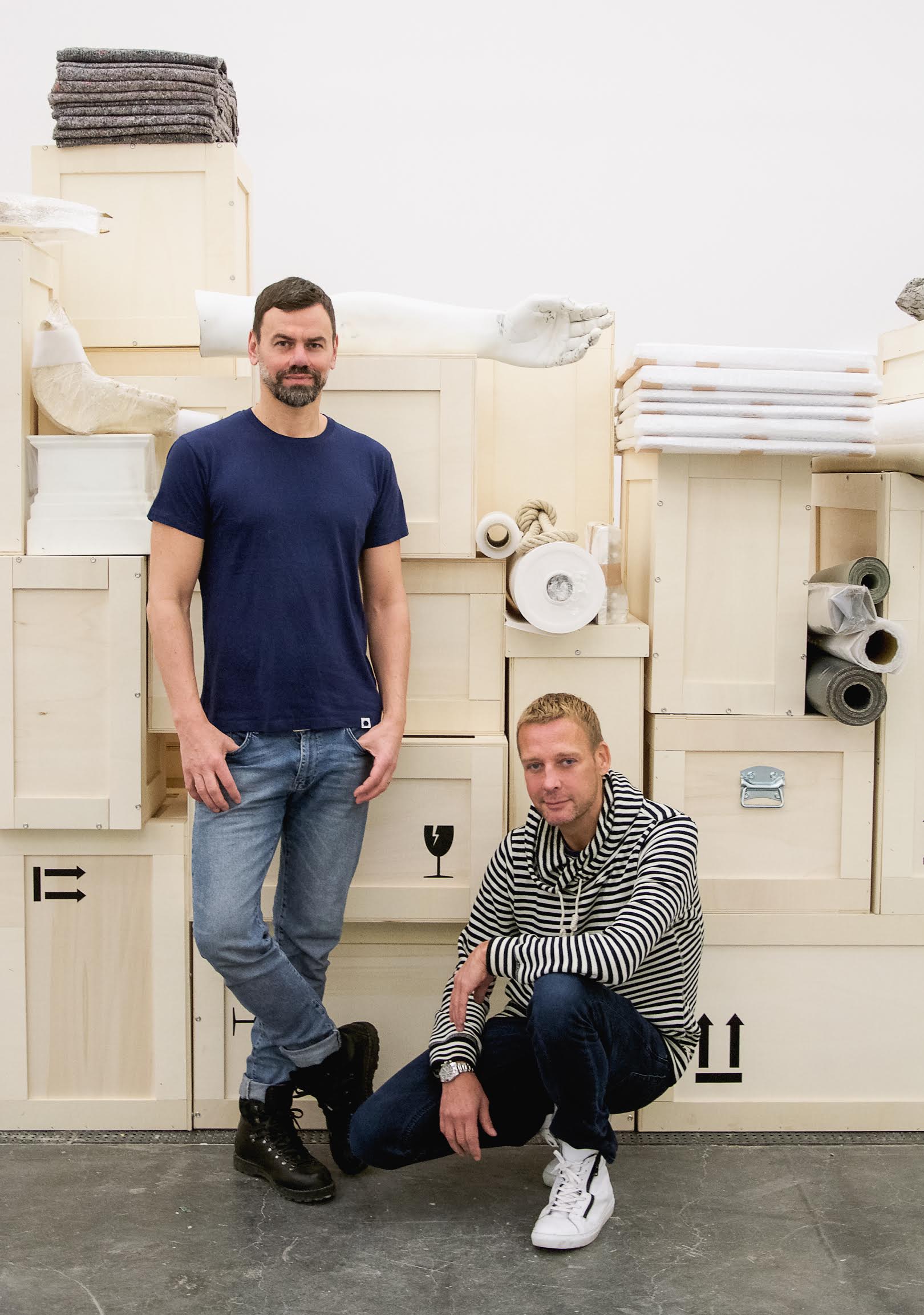
Since 1995, Elmgreen & Dragset have created sculptures and installations that encourage novel perspectives on the structures and systems that govern our lives. Their works transpose and relocate everyday objects into unexpected arrangements and settings, often with subversive humor. Through recontextualizations of the familiar, the artists transform the quotidian fixtures of our lived environment—ATM machines, sewage pipes, suburban swimming pools—inviting new narratives and activating associations with broader societal tensions. Elmgreen & Dragset’s strategy of displacement fundamentally shifts our perception of our surroundings and often resists notions of conformity within our built and sociocultural environments. In keeping with their practice and in visual dialogue with the artists’ works Magic Mushrooms (2015) and City In The Sky (2019), The Hive allows us a surprising perceptual and spatial relationship to a familiar view, the city skyline. The looming stature of the inverted skyscrapers is at once overpowering and enthralling. It evokes the magnetic draw of cities and the continual urbanization of our world. With buildings up to 9 feet tall and integrating over 0.8 miles (1.3 km) of LED strip, this is one of their most technically complex installations. The Hive is the artists’ first permanent public sculpture in New York.


Elmgreen & Dragset
Michael Elmgreen (b. 1961, Copenhagen, Denmark; lives and works in Berlin, Germany), Ingar Dragset (b. 1969, Trondheim, Norway; lives and works in Berlin, Germany)
The Hive, 2020
Stainless steel, aluminum, polycarbonate, LED lights, and lacquer
45’ 5” L x 22’ 5” W x 12’ D
Commissioned by Empire State Development in partnership with Public Art Fund

Installation Photos

A close-up shot of a crop of black and white lit up high-rise buildings descending from the ceiling.
A crop of black and white lit up high-rise buildings descending from the ceiling of the inside of a train station, with three arched windows.
A crop of black and white lit up high-rise buildings descending from the ceiling of the interior of a train station.
A crop of black and white lit up high-rise buildings descending from the ceiling of the inside of a train station, with three arched windows.
A crop of black and white lit up high-rise buildings descending from the ceiling of the interior of a train station.
A crop of black and white lit up high-rise buildings descending from the ceiling of the interior of a train station. People walk around underneath the work.
An exterior of a train station with three large arched windows and doors, with the artwork peeking through the window.
A close-up shot of a crop of black and white lit up high-rise buildings descending from the ceiling.

Elmgreen & Dragset gratefully acknowledge their studio (Niklas Schumacher, Margo Lauras, Moritz Pitrowski, Rhiannon Thayer, Darius Am Wasser, Phoebe Emerson, Leona Tobien, Sasha Mballa-Ekobena) as well as Steelworks, Studio Barthelmes, UAP, Torsilieri, and Craft Engineering.

About the Artist

Elmgreen & Dragset    View Profile

Since 1995, Elmgreen & Dragset have created sculptures and installations that encourage novel perspectives on the structures and systems that govern our lives. Their works transpose and relocate everyday objects into unexpected arrangements and settings, often with subversive humor. Through recontextualizations of the familiar, the artists transform the quotidian fixtures of our lived environment—ATM machines, sewage pipes, suburban swimming pools—inviting new narratives and activating associations with broader societal tensions. Elmgreen & Dragset’s strategy of displacement fundamentally shifts our perception of our surroundings and often resists notions of conformity within our built and sociocultural environments.

Elmgreen & Dragset have presented solo exhibitions at institutions including Musée d’Orsay, Paris (2024–25); Centre Pompidou-Metz, France (2023–24), Fondazione Prada, Milan (2022); The Nasher Sculpture Center, Dallas, (2019–20); The Whitechapel Gallery, London (2018–19); Tel Aviv Museum of Art, Tel Aviv (2016); UCCA Center for Contemporary Art, Beijing (2016); PLATEAU, Samsung Museum of Art, Seoul (2015); Victoria and Albert Museum, London (2013–14); Museum Boijmans Van Beuningen, Rotterdam (2011); and ZKM Museum of Modern Art, Karlsruhe (2010). Their work has been included in the NGV Triennial, Melbourne, Australia (2023); Bangkok biennial (2018), Istanbul biennial (2013, 2011, 2001), Liverpool biennial (2012), Singapore biennial (2011), Moscow biennial (2011, 2007), Venice biennial (2009, 2003), Gwangju biennial (2006, 2002), São Paulo biennial (2002), and Berlin biennial (1998). In 2012 Elmgreen & Dragset were selected for London’s Fourth Plinth Commission in Trafalgar Square. Their work is in the collections of the Museum of Contemporary Art, Chicago; ARKEN Museum of Contemporary Art, Ishøj, Denmark; Columbus Museum of Art, OH; Museo Jumex, Mexico City; Hamburger Bahnhof, Nationalgalerie der Gegenwart, Berlin; Leeum, Samsung Museum of Art, Seoul; Louisiana Museum of Modern Art, Humlebæk, Denmark; and Moderna Museet, Stockholm. Elmgreen & Dragset live and work in Berlin.

(as of 2020)


Kehinde Wiley, Go

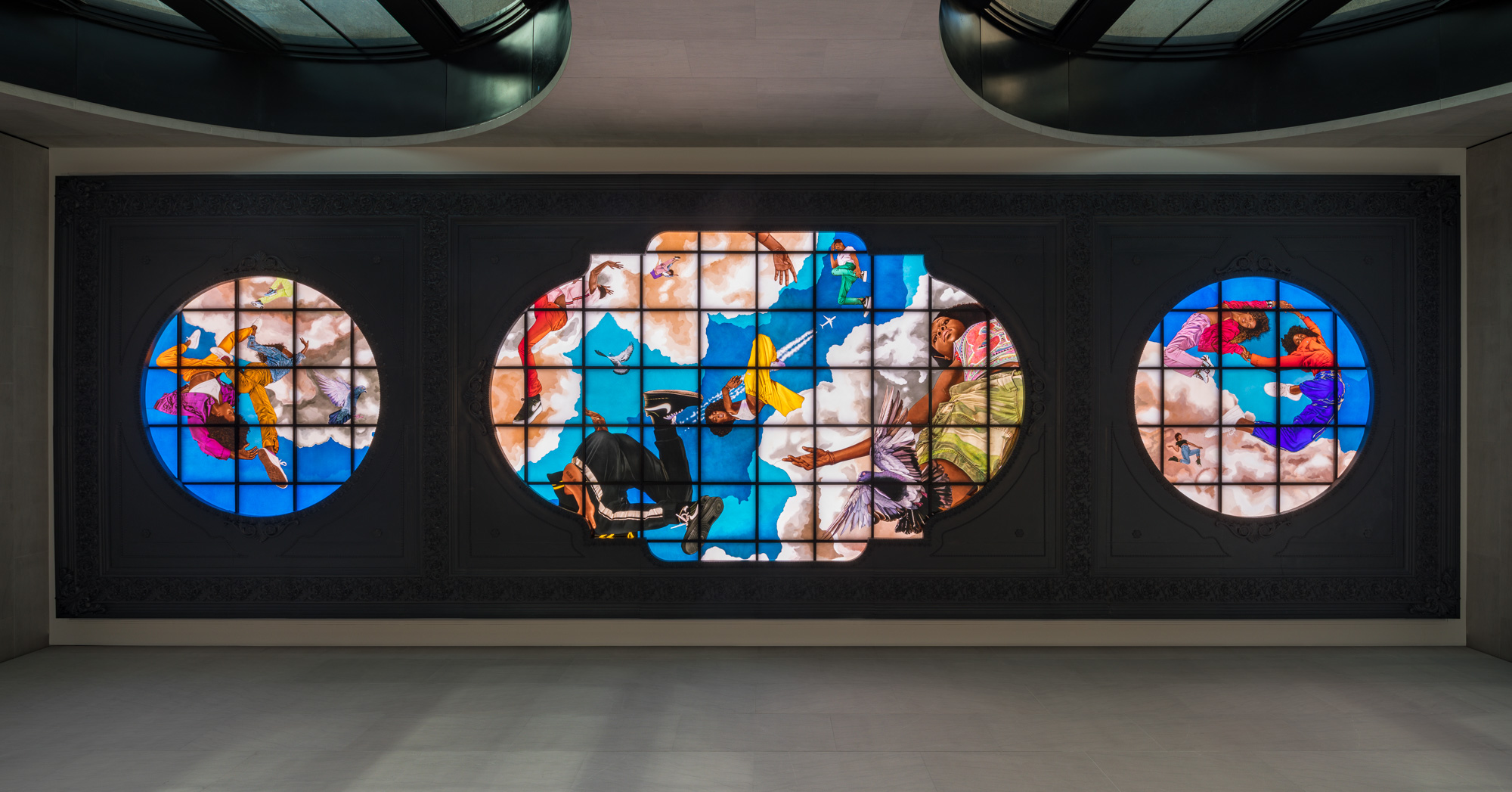
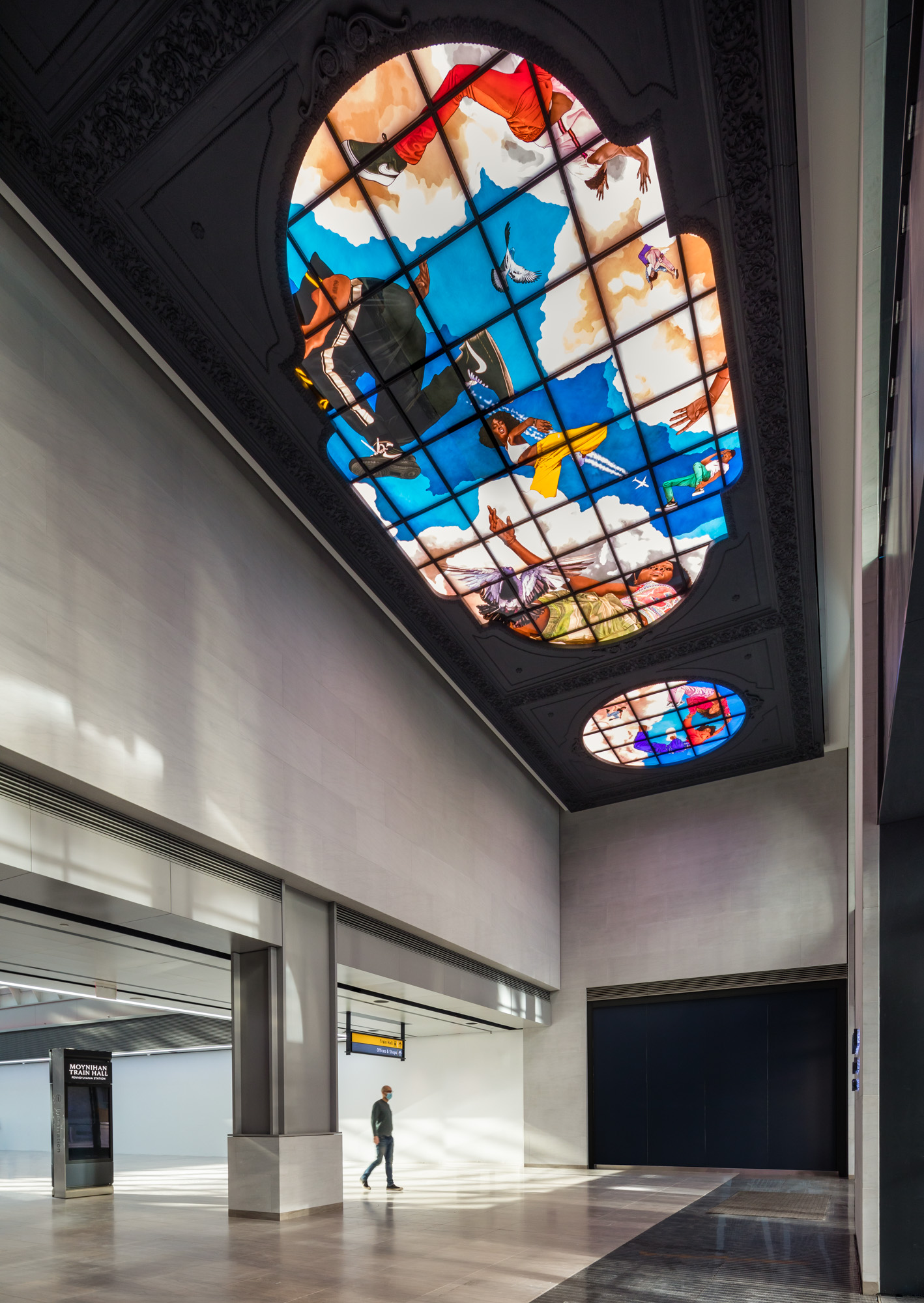
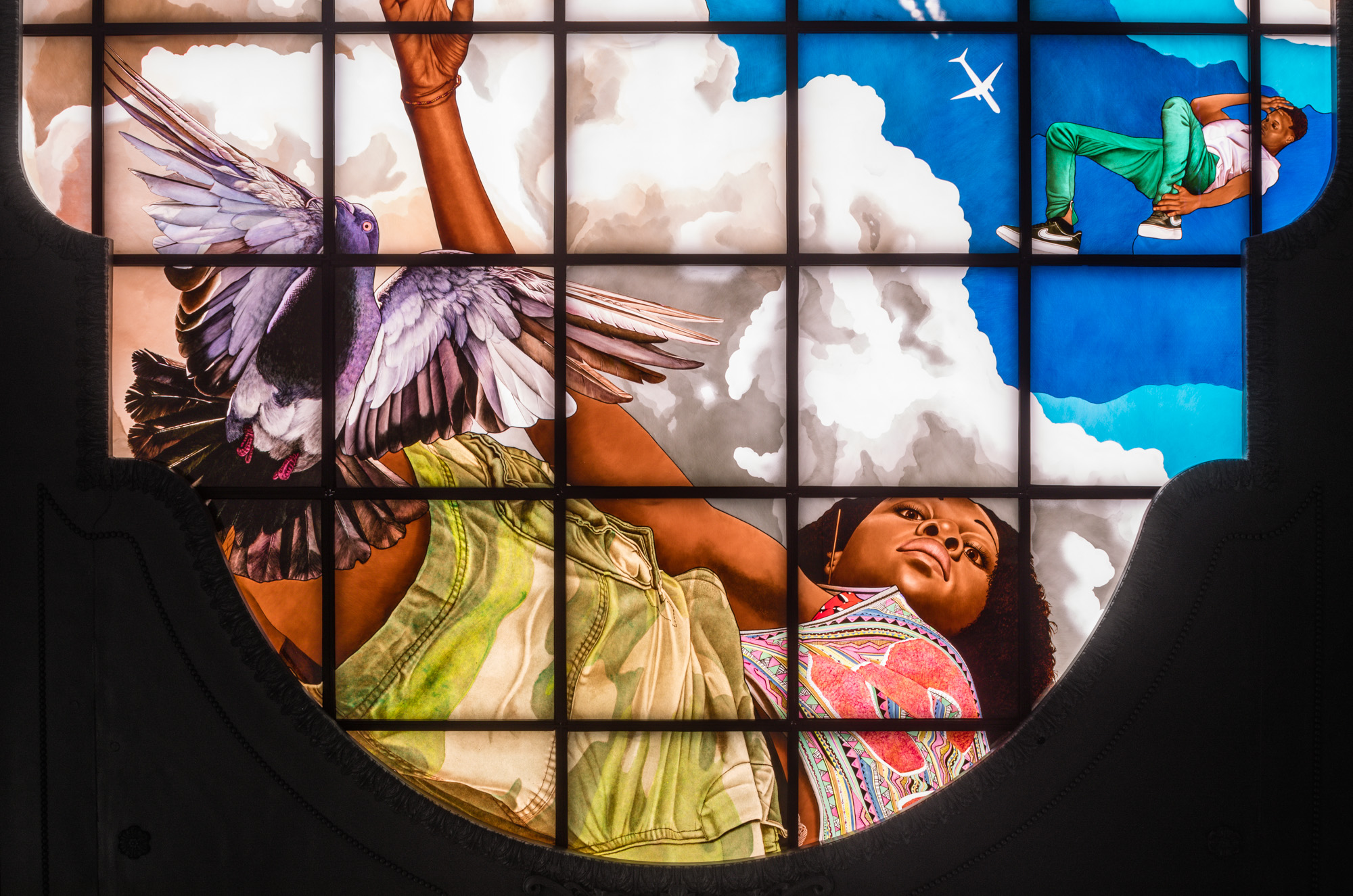
Commanding the expansive ceiling of the 33rd Street Midblock Entrance Hall, Kehinde Wiley’s hand-painted glass triptych celebrates the vibrancy and virtuosity of bodies in motion at monumental scale. Go is an exuberant depiction of young, Black New Yorkers in poses drawn from breakdance, the modern dance style, which originated on the streets of New York during the 1960s and ’70s among African American and Latino youth. Wiley draws on the classical European tradition of frescoed ceilings, using a pronounced foreshortening technique (often associated with 18th-century master Giovanni Battista Tiepolo) to create the impression of figures ascending to the heavens above. He captures them mid-gesture, against billowing clouds in a brilliant blue sky, lunging and twisting in poses that embody the combination of precision, athleticism, and expression inherent to this acrobatic style of performance. Wiley casts his subjects in roles traditionally reserved for saints and angels, depicting them instead as unique individuals attired in their regular streetwear. These contemporary avatars of the sublime are awesome in their gravity-defying abilities, yet familiar to any subway rider; an image of joy at the intersection of the epic and the intimate. Go extends the metaphorical language of light and divinity to reveal the talent, beauty, and power of Black bodies. Translating the urban environment into a celestial dreamscape, Wiley communicates an optimistic spirit of buoyancy, possibility, and survival.

Over the last two decades, Wiley has gained recognition for his highly naturalistic paintings of Black and Brown people in poses and formats drawn from the Western art historical canon. He has often invited young people he encounters in urban centers around the world to embody a pose of their choosing from the portraits of European old masters, underscoring complicated and enduring sociopolitical histories that have determined the exclusion of people of color from much of art history. In recent years, Wiley has expanded his practice to the genres of statuary and public monument as well as the medium of stained glass. The three-part, backlit work responds astutely to its architectural context, echoing Moynihan Train Hall’s skylights and incorporating details of the ornamental ironwork from the building’s facade into the elaborate molding that frames the composition. Go is his first permanent, site-specific installation in glass.


Kehinde Wiley (b. 1977 in Los Angeles, CA; lives and works in New York City and Dakar, Senegal)
Go, 2020
Stained glass with aluminum frame, gypsum molding, steel structure, and LED light panel
17’6” L x 55’8” W x 10” D
Commissioned by Empire State Development in partnership with Public Art Fund

Installation Photos

A brightly painted stained glass triptych depicting young Black people in poses drawn from breakdance, set against billowing clouds in a brilliant blue sky.
detail of a brightly painted stained glass triptych depicting ya young Black woman in a pose drawn from breakdance, set against billowing clouds in a brilliant...

Kehinde Wiley gratefully acknowledges Brad Ogbonna, Chelsea GuerdatDavid Muller of DCM Fabrication, Dee and Ricky Jackson, Dominick Conetta of DUN-RITE Specialized CarriersGabriella WilksJanine CirincioneJesenia PinedaJey Yaro, Jitka and Richard Kanta of SKLO, John Fedoroff, John Thomas, Kylie CorwinLya PouleyyMalak LunsfordRosey Selig-AddissSable BoykinSarina MartinezSasha BoykinSean Kelly, and Taquane Butler.

About the Artist

Kehinde Wiley    View Profile

Kehinde Wiley (b. 1977, Los Angeles) is best known for his vibrant portrayals of contemporary African-American and African-Diasporic individuals that subvert the hierarchies and conventions of European and American portraiture. He has often invited young people he encounters in urban centers around the world to embody a pose of their choosing from the portraits of European old masters, underscoring complicated and enduring sociopolitical histories that have determined the exclusion of people of color from much of art history. In recent years, Wiley has expanded his practice to the genres of statuary and public monument as well as the medium of stained glass. Working in the mediums of painting, sculpture, and video, Wiley’s portraits challenge and reorient art-historical narratives, awakening complex issues that many would prefer remain muted. In 2018 Wiley became the first Black artist to paint an official US Presidential portrait for the Smithsonian National Portrait Gallery; former US President Barack Obama selected Wiley for this honor. In 2019, the artist debuted his first large-scale public sculpture in Times Square, New York, a bronze equestrian monument honoring the heroism of young black men in America. In 2020, Wiley received France’s distinction of Knight of the Order of Arts and Letters.  

Wiley has presented solo exhibitions at Museum of Black Civilizations, Dakar, Senegal (2024); de Young Museum, San Francisco (2023); National Gallery. London (2021); Brooklyn Museum, New York City (2020, 2015); Seattle Art Museum, WA (2016); Petit Palais, Musée des Beaux-Arts de la Ville de Paris, Paris (2016); and The Jewish Museum, New York City (2012). Notable group exhibitions include Entangled Pasts: 1768–Now, Royal Academy of Arts, London (2024); Giants: Art from the Dean Collection of Swizz Beatz and Alicia Keys, Brooklyn Museum, New York City (2024); Fictions of Masculinities: Carpeaux Recast, The Metropolitan Museum of Art, New York City (2022); The Obama Portraits Tours, Art Institute of Chicago (2021, travelled to Brooklyn Museum, New York City, and LACMA, Los Angeles); and Black American Portraits, LACMA, Los Angeles (2021). His work is in the collections of National Portrait Gallery, Washington, DC; Los Angeles County Museum of Art, CA; Hammer Museum, Los Angeles; the Museum of Contemporary Art, Los Angeles; The Metropolitan Museum of Art, New York City; Studio Museum in Harlem, New York City; Jewish Museum, New York City; Victoria and Albert Museum, London; and the Brooklyn Museum, New York City. He is the Founder and President of Black Rock Senegal. Wiley lives and works in New York City and Dakar, Senegal.

(as of 2024)

About Creative Partnerships

Extending our core mission to present dynamic exhibitions by the world’s most compelling artists and make culture accessible to all, Public Art Fund: Creative Partnerships brings strategic planning, curatorial, project management, and communications expertise to leading cultural institutions, corporations, and civic organizations across the globe. Through these collaborations, Public Art Fund commissions permanent installations and temporary exhibitions in line with the unique vision of our partners and the specific parameters of each site, resulting in new artworks that activate public spaces, create engaged constituencies, and amplify the impact of our partners’ own initiatives through the power of public art.


Related Exhibitions