Julian Opie Animals, Buildings, Cars, and People
About the Exhibition
Lower Manhattan is transformed by Animals, Buildings, Cars, and People, an exhibition of sculptures by British artist Julian Opie (b. 1958, London, England). This is the artist’s most comprehensive US solo show to date, featuring new commissions alongside some of his best-known works. Opie’s cool, graphics depictions of modern life are on view in all areas of the historic 19th-century park—on its lawns and sidewalks, even on the steps of the Tweed Courthouse. Julian Opie: Animals, Buildings, Cars, and People is sponsored by Forest City Ratner Companies. Mayor Michael R. Bloomberg said, “We are honored to host Julian Opie’s first major exhibition in the United States and welcome the Public Art Fund’s third show to City Hall Park. We have had a tremendous response to the first two shows and expect that our latest collaboration will complement our City’s thriving public art program throughout the five boroughs. I encourage everyone to come visit us in Lower Manhattan as Julian Opie’s works are sure to inspire New Yorkers and visitors to New York City from around the globe.”
Animals, Buildings, Cars, and People is Julian Opie’s first US sculpture survey, featuring 14 works from 9 different series made between 1997 and 2004. Succinct, colorful, and seductive, Opie’s iconic imagery portrays the familiar physical world, from fashion models to farm animals, from skyscrapers to village churches. His work has been seen all over the world, in museums, galleries, corporate atriums, shops, airports, and even in a parking garage and a hospital cafeteria. He has rarely shown his sculptures in the United States, though his singular graphic sensibility, as seen on his album cover design for The Best of Blur, is familiar to many.
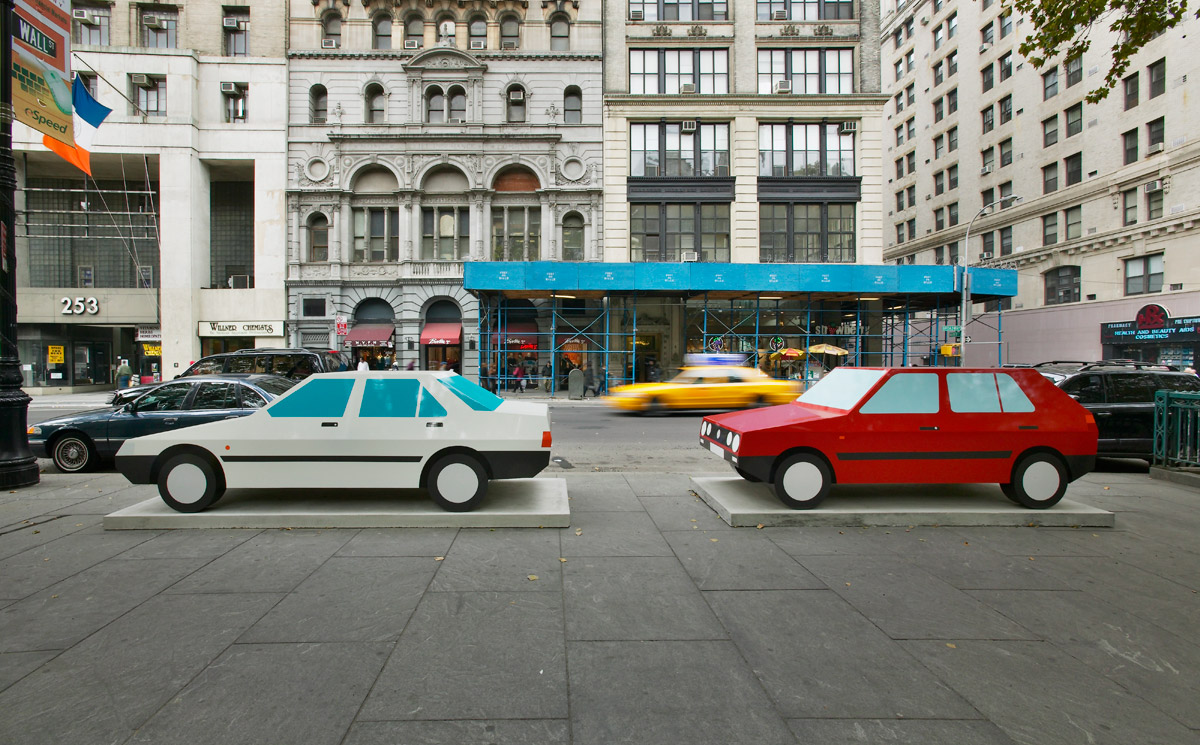
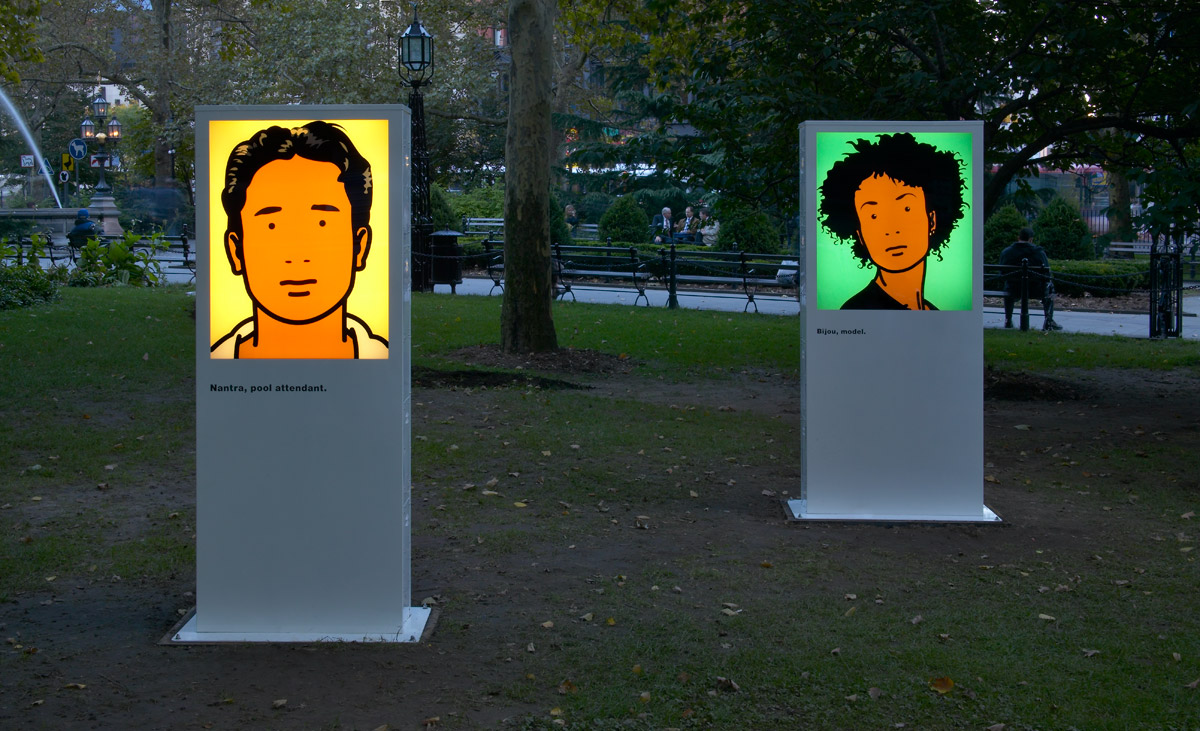
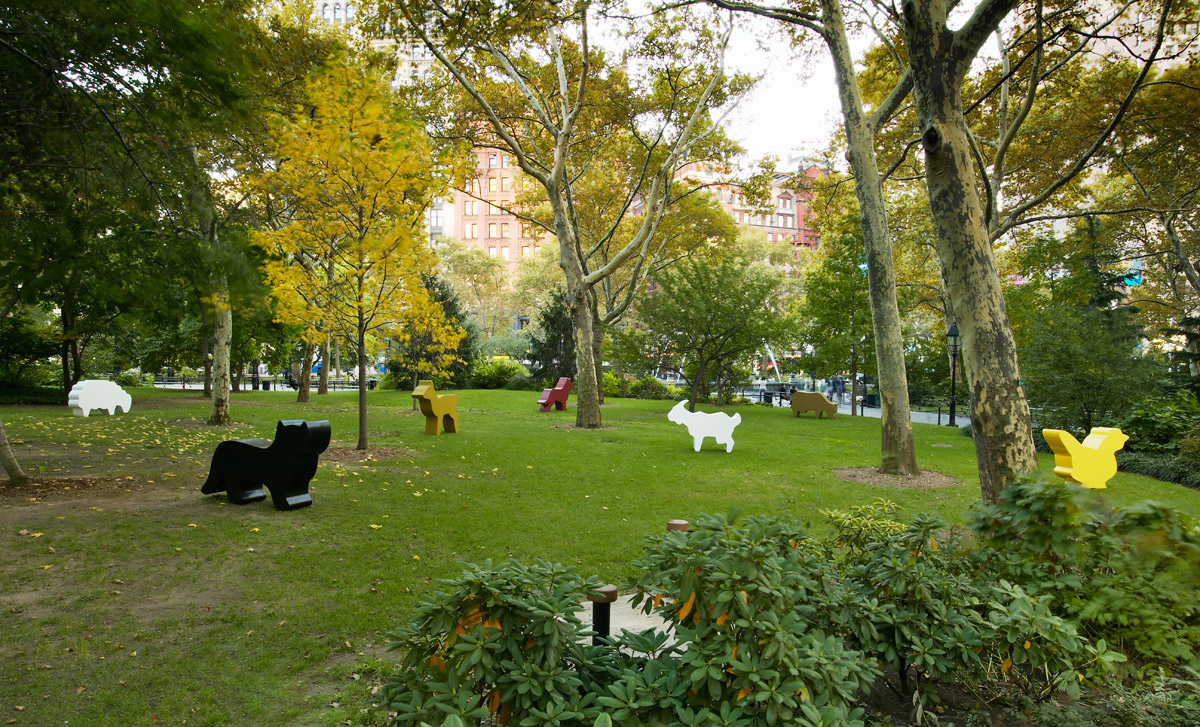
Opie, who has said that he sees his sculptures functioning like objects in an IKEA catalogue, mixes and matches icons of the city, small town, and countryside in City Hall Park. At the northern end of the exhibition are two LED sculptures, Bruce Walking (2004) and Sara Walking (2003), installed on the steps of the Department of Education’s headquarters at the Tweed Courthouse on Chambers Street. These two full-length portraits depict two figures in constant motion as they appear to walk forward. Around the corner on Broadway, along the western side of City Hall Park, are two life-size, 3D sculptures of cars: Imagine you are driving a red Volkswagen and Imagine you are driving a white Honda (both 2004). They portray, respectively, a hatchback and a four-door sedan. Nearby is a trio of enamel-on-glass sculptures—This is Kiera, This is Monique, and This is Bijou (all 2004)—each depicting a glamorous female figure. Also along Broadway, near the southern end of the park, is a group of painted wooden animals called Sheep Cow Deer Dog Chicken Cat Goat (1997) and two light-box sculptures, Nantra, pool attendant (2003) and Bijou, model (2004), which feature close-up portraits of two individuals.
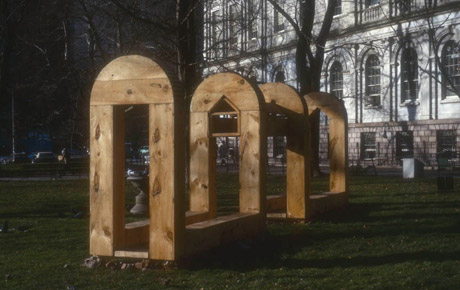
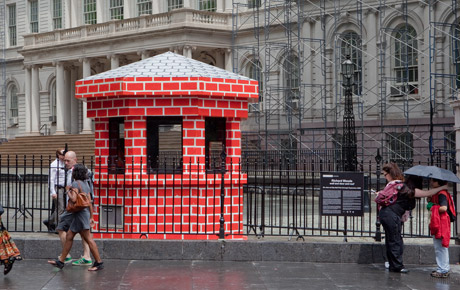
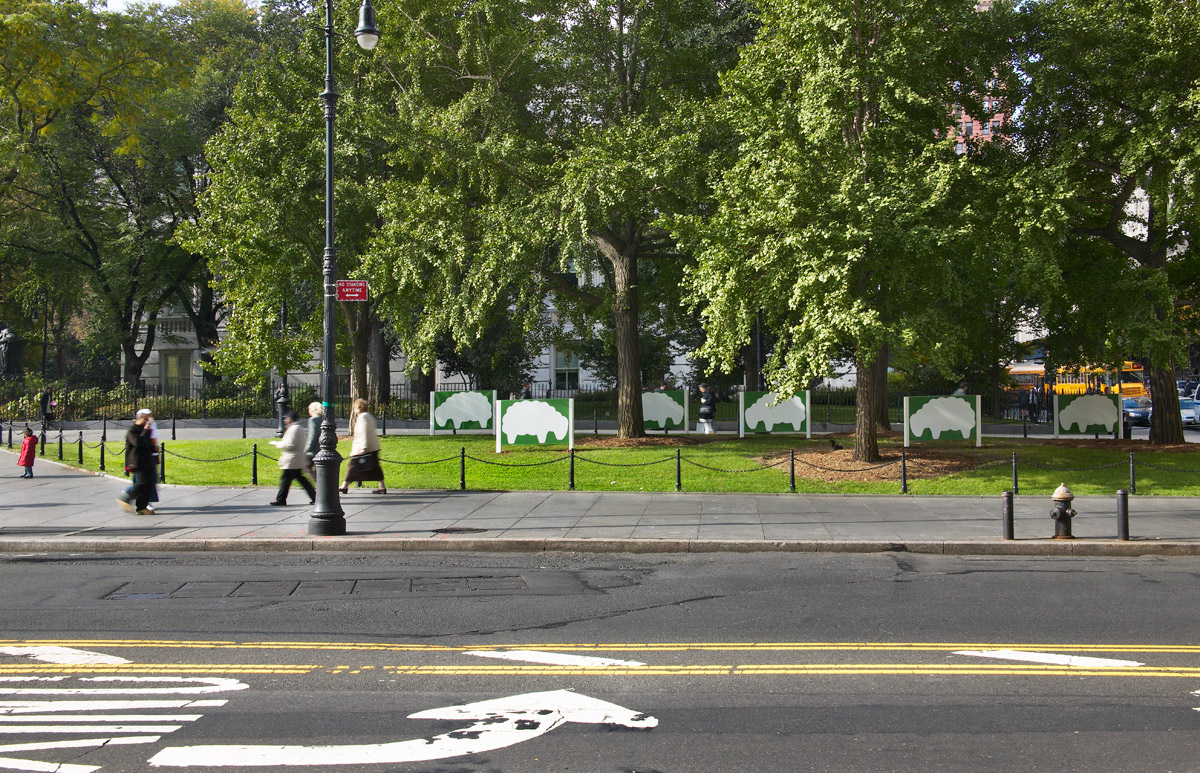
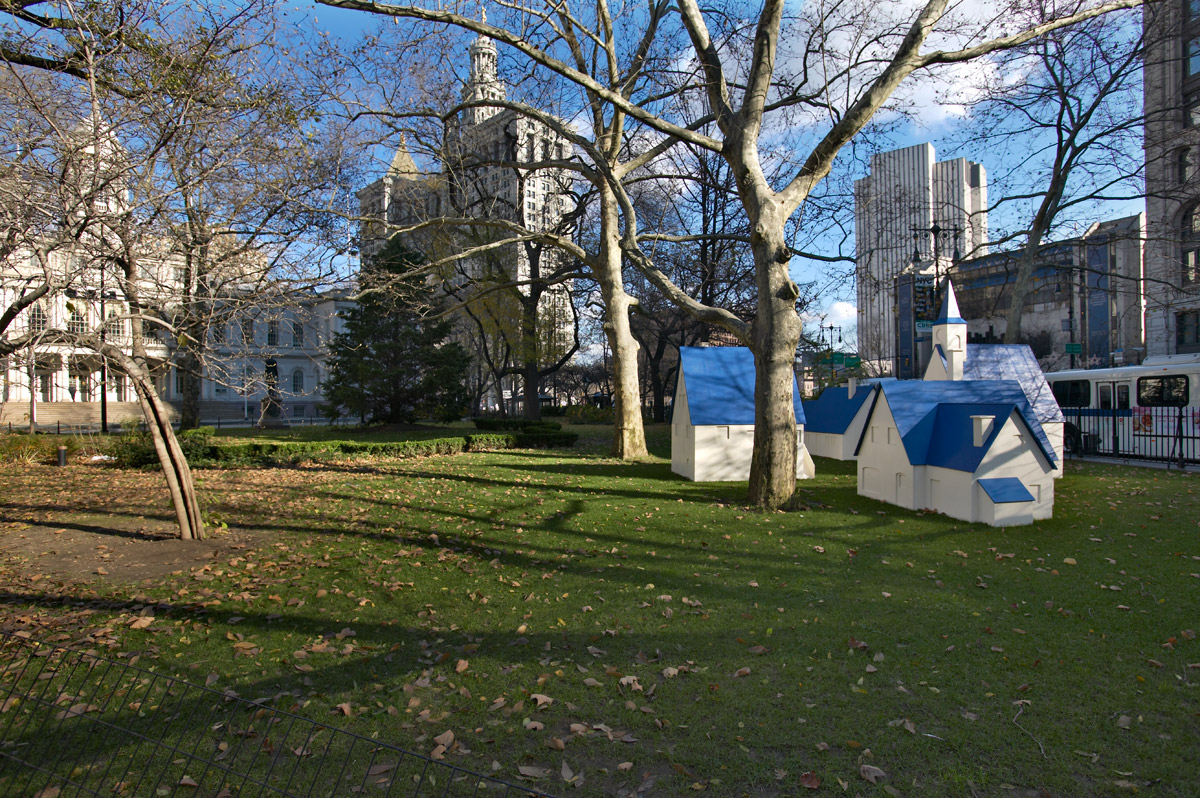
On the other side of the park, along Centre Street and Park Row, are four more groups of sculpture. My Aunt’s Sheep (1997) is an installation of six enamel-painted aluminum signs of white sheep, which graze on a small grassy area at the northern end of the park. City? (2004), a cluster of 3D aluminum Modernist skyscrapers, stands near the subway entrance, facing the Brooklyn Bridge. Village? (2004), a group of plywood buildings, stands near 6 escaped animals (2001), an installation of street signs with animals painted on them.
Opie distills his images from the world around him, rendering them in the universally recognizable style of commercial graphics. He reduces the thing at hand to its most essential lines and color planes, flattening surfaces, and omitting all idiosyncratic details like dents on a car or spots on a cow. The resulting images—straightforward pictograms with bold lines, clean edges, and bright surfaces—read as clearly as traffic signs. “I am always referring to the world, to things that seem poignant to me,” he has said, “and then I try to synthesize or make my own version of these things.” Scale is important in Opie’s work, and many of the things he depicts are made at nearly a one-to-one scale with their real counterparts, like My Aunt’s Sheep or the compact cars of Imagine you are driving a red Volkswagen and Imagine you are driving a white Honda. No matter what the subject, however, the objects he creates always relate to human proportions. City? is diminutive compared to actual skyscrapers, but at almost ten feet tall is still taller than any person.
Photo Gallery


This exhibition is made possible through the cooperation of the City of New York, Michael R. Bloomberg, Mayor; City of New York Department of Parks & Recreation, Adrian Benepe, Commissioner; City of New York Department of Education, Joel I. Klein, Chancellor; and City of New York Department of Cultural Affairs, Kate D. Levin, Commissioner.
Special thanks to Lisson Gallery, London, and BEYER, New York City.
Related Exhibitions
Originally on view at City Hall Park, Manhattan
Originally presented at West Broadway & Grand Street