Ai Weiwei: Good Fences Make Good Neighbors - Public Art Fund
বাংলা (Bengali) 简体中文 (Chinese Simplified) 繁體中文 (Chinese Traditional) Nederlands (Dutch) English Français (French) Deutsch (German) Italiano (Italian) 日本語 (Japanese) 한국어 (Korean) Português (Portuguese - Brazil) Español (Spanish) Tiếng Việt (Vietnamese)
I am looking for…
Suggested searches:
Ai Weiwei
Talks
53. GoodFences_GildedCage_TimothySchenck

Ai Weiwei Good Fences Make Good Neighbors

October 12, 2017 - February 11, 2018

About

As the culmination of its 40th anniversary year, Public Art Fund presents the citywide exhibition Good Fences Make Good Neighbors by world renowned artist and human rights activist Ai Weiwei. Inspired by the international migration crisis and current global geopolitical landscape, the exhibition transforms the security fence into a powerful social and artistic symbol with interventions across the city. Large-scale, site-specific are installed at Doris C. Freedman Plaza at Central Park, the Washington Square Arch in Greenwich Village, and the Unisphere at Flushing Meadows Corona Park in Queens, in partnership with NYC Parks. These are joined by site-specific interventions on top of and in between private buildings located at 48 East 7th Street, 189 Chrystie Street, 248 Bowery, and The Cooper Union for the Advancement of Science and Art at Astor Place; a series of new flagpole-mounted works for the New York City Economic Development Corporation–managed Essex Street Market; and sculptural interventions around ten JCDecaux bus shelters in partnership with the New York City Department of Transportation. In addition to these site-specific works, Ai has created a new series of 200 unique two-dimensional banners that will appear in all five boroughs on lampposts. The artist uses spaces that traditionally feature advertising to showcase a new series of 98 documentary images from his research at refugee camps and national borders on JCDecaux bus shelters as well as Intersection’s LinkNYC kiosks citywide. A graphic work depicting the many forms of the global refugee crisis appears on five JCDecaux newsstands in Manhattan. Each of the works grows out of the existing urban infrastructure, using the fabric of the city as its base and drawing attention to the role of the fence in dividing people. In doing so, the artist highlights how this form, ubiquitous yet also potent, can alter how we perceive and relate to our environment.

Ai has particular empathy with displaced people. Growing up amid the upheavals of China’s Cultural Revolution, Ai and his family were exiled to Shihezi, Xinjiang Province, where his father, a renowned poet who had been branded an enemy of the state, was made to clean the village’s communal toilets. Later Ai moved to New York City as an art student in the 1980s and experienced life as an immigrant in the US, where he pursued an interest in Western modern and contemporary art. Returning to China in 1993, Ai gained artistic success but also notoriety for his presence on social media and for using his art and public platform to engage with pressing political issues, eventually resulting in his 2011 arrest and detention by the Chinese government. Since the reinstatement of his passport in 2015, Ai has traveled to refugee camps across the globe and has dedicated much of his practice to bringing attention to the plight of displaced people, many of whom are victims of war or acts of terror. This global issue has gained a different relevance in the US in the wake of new policies on immigration and border control, making the fence a particularly charged symbol of division and isolationism in this country.

“Ai Weiwei is unique in having combined the roles of preeminent contemporary artist, political dissident, and human rights activist in such a prominent and powerful way,” said Public Art Fund Director & Chief Curator Nicholas Baume. “In many ways, Good Fences Make Good Neighbors is the culmination of his work to date. It grows out of his personal experience of ‘otherness,’ his distinguished practice as both artist and architect, as well as his intensive research on the international refugee crisis and global rise of nationalism. At the same time, his long and formative history with New York has been deeply influential in the development of this exhibition.”

Since the late 1960s, experimental artists have used New York City as a canvas for their practice, intervening with public plazas, buildings, the city’s infrastructure, unused and abandoned spaces and more, to explore new ideas in public space and demonstrate the potential of the urban landscape to act as a platform for artistic expression. Public Art Fund grew out of this impulse, 40 years ago. Working in this tradition and inspired by minimal and conceptual artists of the 1960s and ’70s like Richard Serra, Gordon Matta-Clark, and Trisha Brown, Ai creates variations on the fence—from metal chain-link to synthetic netting—to form interventions that adapt to their sites, as if growing out of urban space and changing how we relate to the fence and our environment. They are installed in key locations around the city, encouraging the public to engage with the city through the eyes of the artist.

With both local and global resonances, Good Fences Make Good Neighbors utilizes diverse sites across the city—in locations both iconic and community-oriented—that connect Ai’s personal story as an artist, activist, and immigrant, to the broader history of immigration in New York City. These locations also highlight the city as a site for artistic intervention, and the charged socio-political moment reverberating around the world.

Good Fences Make Good Neighbors is Ai Weiwei’s largest and most ambitious public art exhibition to date and will be on view October 12, 2017–February 11, 2018, at more than 300 sites across New York City.

Ai Weiwei: Good Fences Make Good Neighbors is curated by Public Art Fund Director & Chief Curator Nicholas Baume with the assistance of Associate Curator Daniel S. Palmer.

About the Artist

Ai Weiwei    View Profile

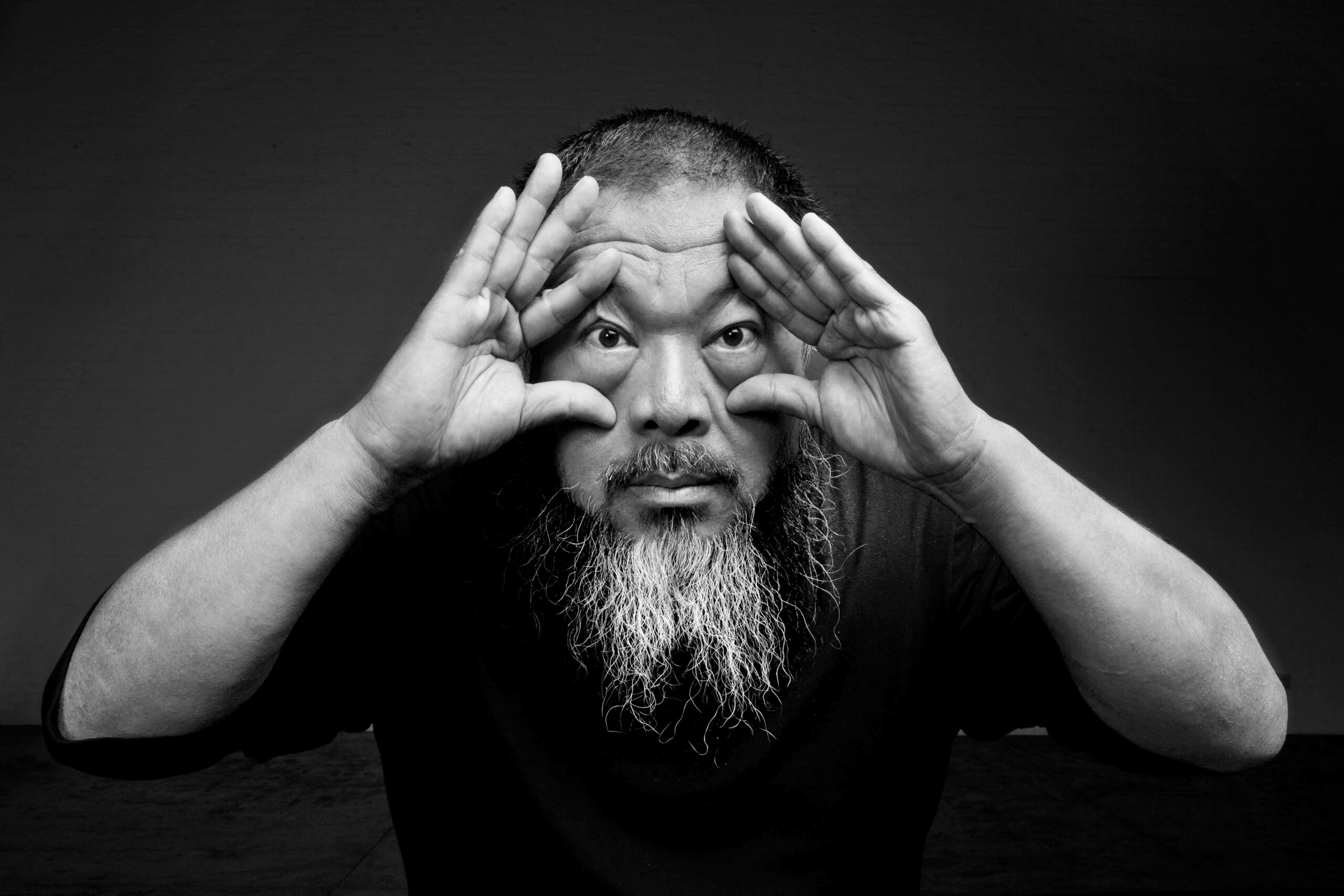
Ai Weiwei (b. 1957, Beijing) attended the Beijing Film Academy and later, moved to New York City (1983–93) to continue his studies at the Parsons School of Design. One of the most influential contemporary artists, Ai has redefined what contemporary art can do politically, socially, and ethically. He places real political risk at the center of his practice—resulting in censorship, surveillance, imprisonment, and exile. He is important not only for his artworks, but for how he uses art as a tool for investigation, exposure, and civil resistance. Merging conceptual practice, activism, architecture, social media, and documentary strategies, his work challenges not only political systems, but also museums, viewers, and artists themselves—asking what it means to speak, to see, and to act under conditions of power.

Major solo exhibitions include the National Gallery in Prague, Czech Republic (2017); Palazzo Strozzi, Florence, Italy (2016); 21er Haus Museum of Contemporary Art, Vienna (2016); Helsinki Art Museum, Finland (2016); Royal Academy of Art, London (2015); Martin-Gropius-Bau, Berlin (2014); Hirshhorn Museum and Sculpture Garden, Washington, DC (2012); Taipei Fine Arts Museum, Taiwan (2011); Tate Modern, London (2010); and Haus der Kunst, Munich (2009). Architectural collaborations include the 2012 Serpentine Pavilion and the 2008 Beijing National Stadium, with Herzog and de Meuron. Among numerous awards and honors, he was granted the lifetime achievement award from the Chinese Contemporary Art Awards in 2008 and the Václav Havel Prize for Creative Dissent from the Human Rights Foundation, New York City, in 2012; he was made Honorary Academician at the Royal Academy of Arts, London, in 2011. He was given the Ambassador of Conscience Award by Amnesty International, London in 2015. He lives and works in Berlin and Beijing.

(as of 2017)

Site and Interventions

Sculptural Installations

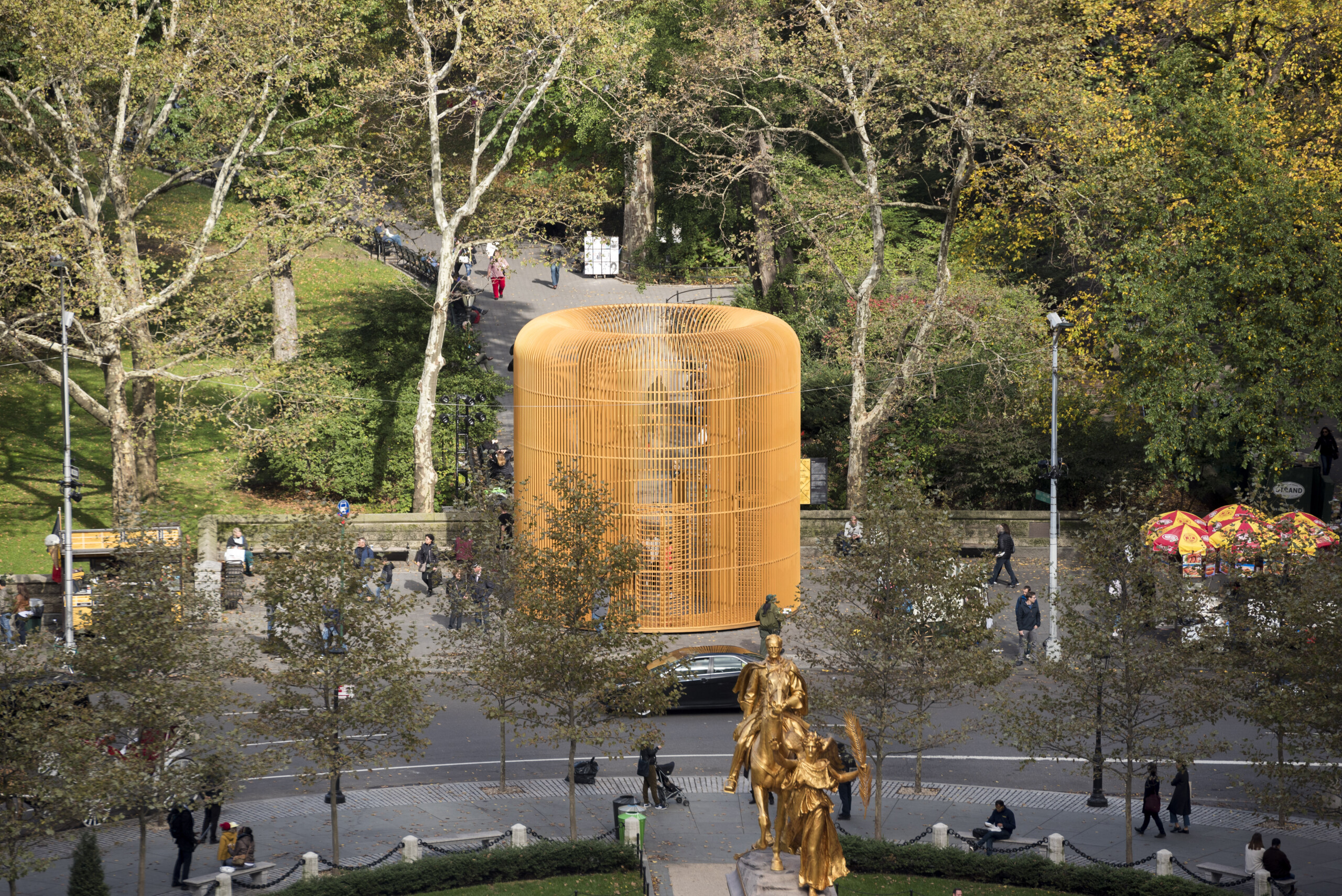
Gilded Cage, Doris C. Freedman Plaza, Central Park, Manhattan
Located at the southeast entrance to Central Park, at Doris C. Freedman Plaza, this large-scale, freestanding installation transforms the fence into an abstract, golden cage-like sculpture. While retaining references often associated with structures of division, like bars and turnstiles, the installation juxtaposes against one of the most visited urban public parks in the US. Designed as a democratic oasis and vision of utopia, Central Park has vast open areas, lush forests, and monuments of heroes and explorers, creating a powerful contrast with Ai’s work. The installation allows viewers to walk into and around the sculpture, inviting them not only to interact with the work, but also consider the inherent dualities of the world we live in.

Arch, Washington Square Arch, Washington Square Park, Manhattan
Similarly, Washington Square Park in Greenwich Village has long been a popular site for tourists and residents alike. Bordered by New York University, the iconic park lies at the heart of culture and politics in New York City, often acting as a site for celebrations, performances, and protests. The location has deep ties to New York City’s early history; originally used as farmland by Native Americans, the land was claimed by European settlers in the mid-17th century and later used as a home for freed slaves; in the late 18th century the site was turned into a burial ground before becoming a public space in 1826. Ai’s nearly 40-foot tall cage structure is located within the triumphal Washington Square Arch, which was created in 1892 to celebrate the centennial of George Washington’s inauguration as president of the United States. The artist’s sculpture features a polished mirror passageway in the form of two united human silhouettes, evoking the entrance that Marcel Duchamp (who frequented and also played chess in Washington Square Park) designed for André Breton’s Gradiva gallery in 1937.

“When I lived in New York in the 80s, I spent much of my time in Washington Square Park. This area was one of New York’s most vibrant and diverse neighborhoods—a home to immigrants of all backgrounds,” said Ai Weiwei. “The triumphal arch has been a symbol of victory after war since antiquity. The basic form of a fence or cage suggests that it might inhibit movement through the arch, but instead a passageway cuts through this barrier—a door obstructed, through which another door opens.”

Circle Fence, Unisphere, Flushing Meadows Corona Park, Queens
Home to the iconic Unisphere and host to the World’s Fair in 1939 and 1964, Flushing Meadows Corona Park is situated between several of the most diverse neighborhoods in New York City, reflecting more recent waves of immigration. Located at the Unisphere, Circle Fence creates a low perimeter around the symbolic structure. Rather than impeding views of the historical site, the installation emphasizes the Unisphere’s form and symbolic meaning, engaging with the steel representation of the Earth by surrounding it with mesh netting strung around metal stanchion barriers.

Site-Specific Installations on Buildings (Manhattan)
7th Street Fence, 48 East 7th Street, East Village
Chrystie Street Fence, 189 Chrystie Street, Lower East Side
Bowery Fence, 248 Bowery, Lower East Side
Five Fences, The Cooper Union for the Advancement of Science and Art
Exodus, Essex Street Market

The Lower East Side has a rich and documented history of immigration, and as the neighborhood changes, it continues to be a hub for diverse and international communities. Ai Weiwei’s subtle interventions in Lower Manhattan grow out of the existing urban landscape, highlighting both the personal and historical stories of these neighborhoods, as well as their continuing evolving identities. At 48 East 7th Street, the street where Ai lived in a basement apartment as a student and immigrant in the 1980s, his intervention occupies the interstitial space between two buildings. Two additional rooftop fence installations appear on buildings at 189 Chrystie Street, a sign factory in the 1920s that is now home to a nightclub, and 248 Bowery, a historic building dating back to before 1830. At the New York City Economic Development Corporation–managed Essex Street Market, which opened in the 1940s and has long been at the heart of the community, a narrative scene of banners spanning the market’s façade’s flagpoles depicts the perilous journeys of refugees, driven by threats to their survival and also by hope. These site-specific works draw attention upward to the architecture of these lower-lying buildings on the vibrant Lower East Side, a neighborhood that has been home to many immigrant groups since the 19th century.

Farther north at Astor Place, Ai installs another sculptural variation on the fence at The Cooper Union for the Advancement of Science and Art’s iconic Foundation Building, which  has served as a beacon of democracy, free speech, equality, and educational rigor in New York City for more than 150 years. Five Fences fills the open arched spaces on the north portico facade of the building, simultaneously covering these open spaces but remaining porous.

Brooklyn Shelter 1–4, Harlem Shelter 1–4, Bronx Shelter 1–2
JCDecaux bus shelters: Downtown Brooklyn, Harlem, and the Bronx
Transportation is a key component in the conversation about immigrants and refugees today; the forced emigration from their homes and subsequent restrictions of their free movement are central to this debate. In New York City, the construction of transportation infrastructure has played a central role in the American immigrant story. The workforce to construct the city’s roads, bridges, and tunnels were made up of immigrants, and that infrastructure continues to be vital to the flow of millions of people each day. Interventions at ten JCDecaux bus shelters in Downtown Brooklyn, along Fulton Street and other major roadways; in Harlem along 125th Street and Adam Clayton Powell Jr Boulevard; and in the Bronx at 163rd Street and 3rd Avenue, highlight the importance of access and movement in a thriving city, as well as the city’s easily-navigated grid system, city infrastructure, and public transportation. The installations incorporate additional seating, effectively functioning as both sculpture and urban amenity.

Interventions on Advertising Platforms

Banner Portrait 1–200, Lamppost Banners (Citywide)
For Ai, the grid of New York City reflects the ideal of a democratic and accessible society, which defines how people engage with the city both physically and psychologically. The citywide components of the exhibition include 200 unique banners for lampposts featuring portraits of immigrants from different periods, among them historic images from Ellis Island by Augustus Sherman, photographs of notable refugees, portraits by Ai Weiwei’s studio from the Shariya camp in Iraq, and cell phone shots taken by the artist at refugee camps around the world.

Good Neighbor 1–98, Documentary Images (Citywide)
• JCDecaux bus shelters
• Intersection’s LinkNYC kiosks
In 2016, Ai and his team traveled to 23 countries and more than 40 refugee camps while filming his documentary Human Flow. This new series of 98 documentary images features images from these experiences, where fences are used to divide people and define them as different. The imagery is paired with information and quotes from poets, writers, and organizations about global displacement, thematically connecting the very real experiences of today’s immigrants and refugees with the exhibition’s sculptural components. Deployed across advertising platforms on JCDecaux bus shelters and LinkNYC kiosks, they are located at prominent sites with significant pedestrian traffic, at major transportation hubs, and near other site-specific installations in order to create arteries that connect clusters of sites across the city.

Odyssey 1–5, JCDecaux newsstand kiosks (Manhattan)
Co-opting spaces that are generally reserved for advertising on newsstands, Ai displays a series of five illustrated classical Greek-style friezes. Depicting the many forms of the global refugee crisis, its stylized imagery evokes black-figure vase painting to show the imagery of disaster, displacement, perilous migration, and restrictive fencing. This compelling imagery further calls our attention to the plight and humanity of the millions of displaced people across the globe.
Partnering Sponsor: Frahm & Frahm

Lead support is provided by Jill & Peter Kraus, Jennifer & Matthew Harris, and Anonymous.

Major support is provided by The Horace W. Goldsmith Foundation, the Charina Endowment Fund/Richard & Ronay Menschel, Kathleen McDonough & Edward Berman, Glenn & Amanda Fuhrman, and Stavros Niarchos Foundation.

Generous support is provided by Elizabeth Fearon Pepperman & Richard C. Pepperman II, Susan & Jonathan Bram, Jeffrey Deitch, Jennifer & Jason New, neugerriemschneider, Berlin, Red Crane Foundation, Marcia Dunn & Jonathan Sobel, Robert Soros, Sheryl & Dan Tishman, Patricia & Howard Silverstein, Lisson Gallery, Espolòn Tequila, Shari & Jeff Aronson, Elise & Andrew Brownstein, Meg & Bennett Goodman, Holly & Jonathan Lipton, Linda Lennon & Stuart Baskin, Anne & Joel Ehrenkranz, and Bridgitt & Bruce Evans.

Public Art Fund gratefully acknowledges the partnership of JCDecaux, UAP, Intersection, Thornton Tomasetti, AECOM Tishman, and FXFOWLE.

Public Art Fund gratefully acknowledges the generosity of its 40th Anniversary Leadership Circle:

Jill & Peter Kraus, Jennifer & Matthew Harris, the Charina Endowment Fund, Elizabeth Fearon Pepperman & Richard C. Pepperman II, Jennifer & Jason New, Oliver’s Realty Group/RAL Development Services, Elise & Andrew Brownstein, Holly & Jonathan Lipton, Marcia Dunn & Jonathan Sobel, Stavros Niarchos Foundation, Patricia & Howard Silverstein, The Silverweed Foundation, Katherine Farley & Jerry Speyer, The Marc Haas Foundation, and Sydney & Stanley S. Shuman

With special thanks to the Office of the Mayor, Office of the Manhattan Borough President, Office of the Brooklyn Borough President, Office of the Queens Borough President, Office of the Bronx Borough President, Office of the Staten Island Borough President, Council Member Margaret Chin, Council Member Julissa Ferreras-Copeland, Council Member Daniel Garodnick, Council Member Corey Johnson, Council Member Mark Levine, Council Member Jimmy Van Bramer, NYC Parks, Department of Cultural Affairs, New York City Department of Transportation and DOT ART, NYC Department of Buildings, Mayor’s Office of Citywide Event Coordination and Management, NYC Department of Citywide Administrative Services, Mayor’s Office of Immigrant Affairs, New York City Economic Development Corporation, New York City Department of Environmental Protection, Landmarks Preservation Commission, FDNY, NYC & Company, Central Park Conservancy, The Cooper Union for the Advancement of Science and Art, Lower Eastside Partnerships, and Essex Street Market Vendors Association


Related Exhibitions