Cristian Andersen
(b. 1974, Zurich, Switzerland)
inverse reverse obverse, 2013
Bronze, stainless steel
Courtesy private collection
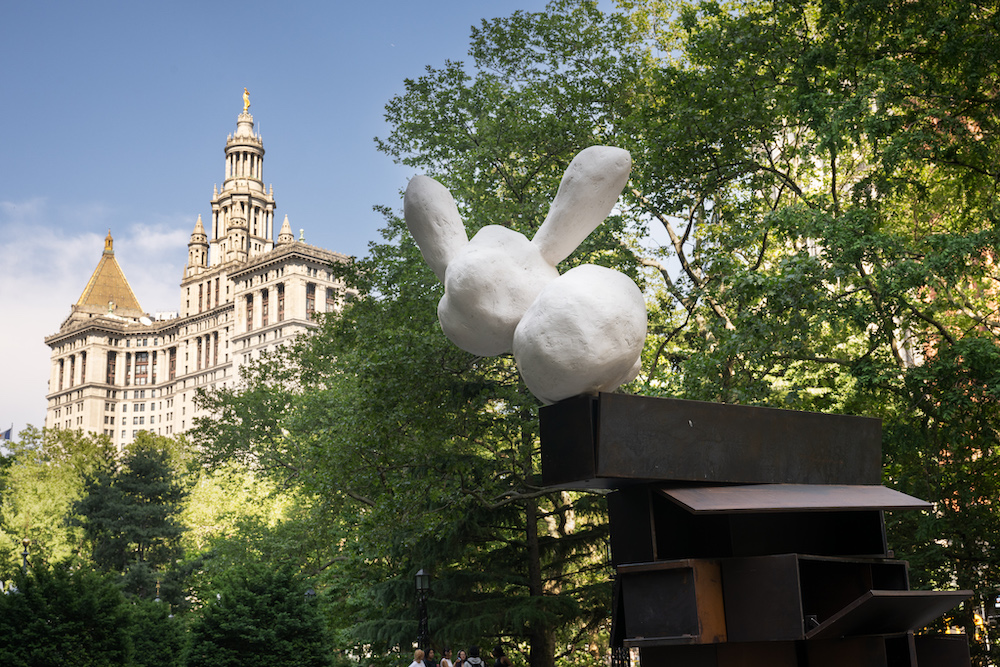
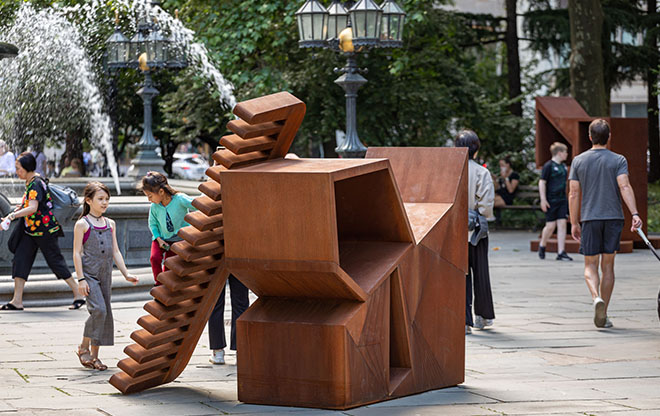
Cristian Andersen’s playful sculptures combine found objects recast in new materials and stacked in precarious totems. The final form piles one object atop another defying gravity with astonishing balance. From construction materials to cowboy hats, each object is absorbed into a new sculptural assemblage, creating whimsical moments of discovery as we move around the sculpture.
James Angus
(b. 1970, Perth, Australia)
John Deere Model D, 2013
Painted steel, painted cast iron
Courtesy of the artist and Gavin Brown’s Enterprise
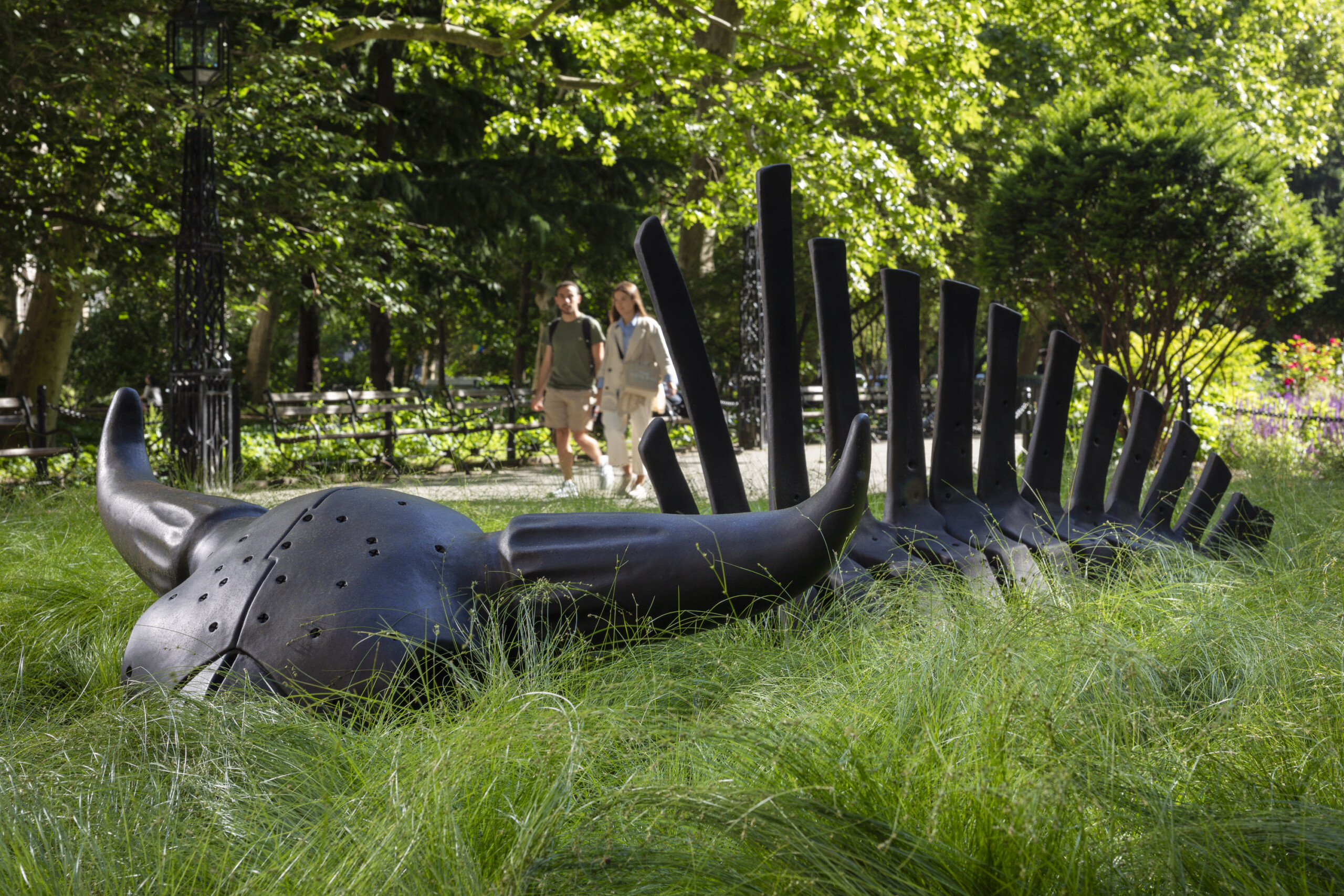
James Angus’s replicas of everyday objects include a 1920s Bugatti racing car, a gorilla’s skull, and a manta ray. In this sculpture, Angus has created an extraordinarily detailed reproduction of a John Deere tractor. However, the artist’s copy is not faithful; he has used digital technologies to meticulously alter the scale and proportions of the original tractor so they appear slightly distorted. As if playing a trick on us, Angus blurs visual fact with fiction, transforming expectations and calling attention to the object’s scale, volume, and form.
Olaf Breuning
(b. 1970, Schaffhausen, Switzerland)
The Humans, 2007
Marble, bronze
Courtesy of the artist and Metro Pictures
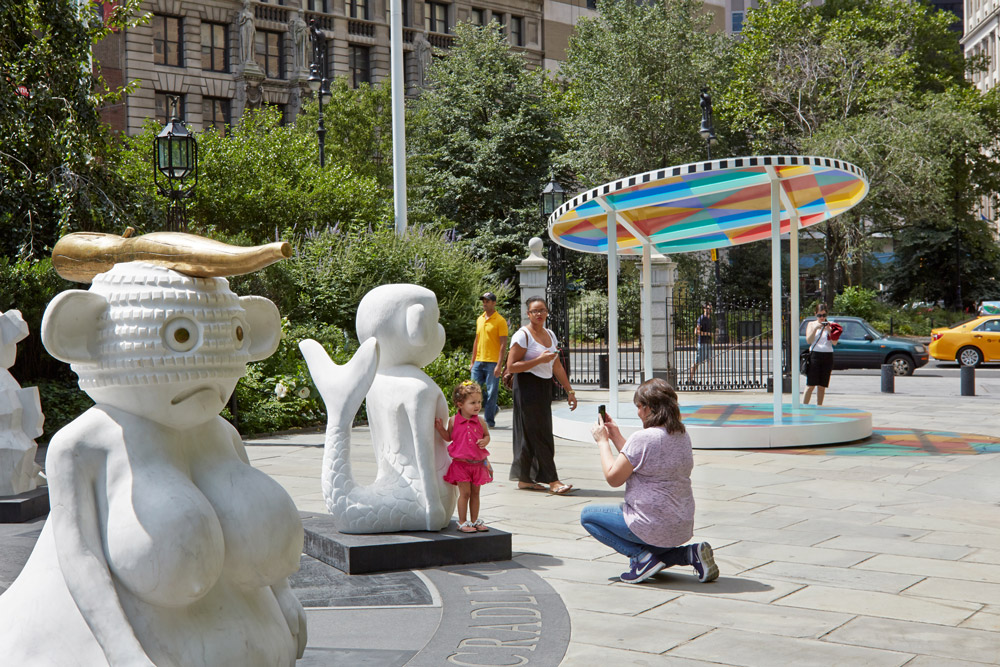
Olaf Breuning’s eclectic art practice incorporates film, staged photography, sculptures, and drawings. Carved in marble with bronze details, the six whimsical characters in Breuning’s The Humans are part animal, part fairy-tale figurine and bring a playful attitude to the tradition of figurative sculpture. With their comically expressive faces and rounded bodies, these endearing creatures parody the cycle of human evolution from fish to fisher king, here installed in an endless loop.
Daniel Buren
(b. 1938, Paris, France)
Suncatcher, 2013
Powder-coated steel, glass, vinyl
Courtesy of the artist and Bortolami Gallery, NY
Since the 1960s, Conceptual artist Daniel Buren has explored the nature of painting and its relationship to space through the use of simple patterns such as contrasting stripes and color grids. For City Hall Park, Buren has taken the idea of a pergola—a garden trellis traditionally used for hanging flowers—and transformed it into a pavilion of light. When sunny, the colored glass panels bathe visitors in vivid color, expanding the field of painting to the glow of light itself.
Evan Holloway
(b. 1967, La Mirada, CA)
Willendorf Wheel, 2013
Bronze
Courtesy of the artist and Harris Lieberman Gallery
Evan Holloway’s idiosyncratic use of material and subject matter often makes satirical reference to the history of sculpture. For Willendorf Wheel, he has cast repeating molds of a reproduction of the Venus of Willendorf statuette—an iconic fertility symbol estimated to have been carved between 24,000 and 22,000 BCE. Forming a bronze circular hoop of figurines, Holloway allows us to see the interior of the mold, literally turning the Venus inside out and on her head.
Alicja Kwade
(b. 1979, Katowice, Poland)
Journey without arrival (Raleigh), 2012/2013
Stainless steel, aluminum, rubber, plastic components
Courtesy of the artist
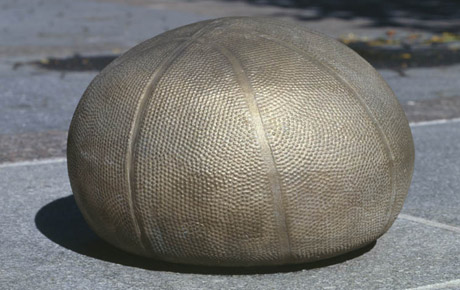
Alicja Kwade’s sculptures liquefy, upturn, twin, and mirror found materials and everyday objects. With familiar forms gone awry, her poetic works transform materials in ways that suggest time and space are malleable ideas. To create Journey without Arrival (Raleigh), Kwade dismantled and reassembled a bicycle, bending each element to form a perfect circle. As if caught between dimensions, the new object is at once surreal and surprising, calling attention to its seemingly impossible form.
Sarah Lucas
(b. 1962, London, England)
Florian and Kevin, 2013
Cast concrete
Courtesy of the Artist and Gladstone Gallery, New York, and Brussels and Sadie Coles, London
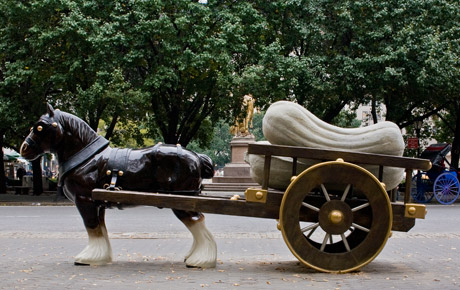
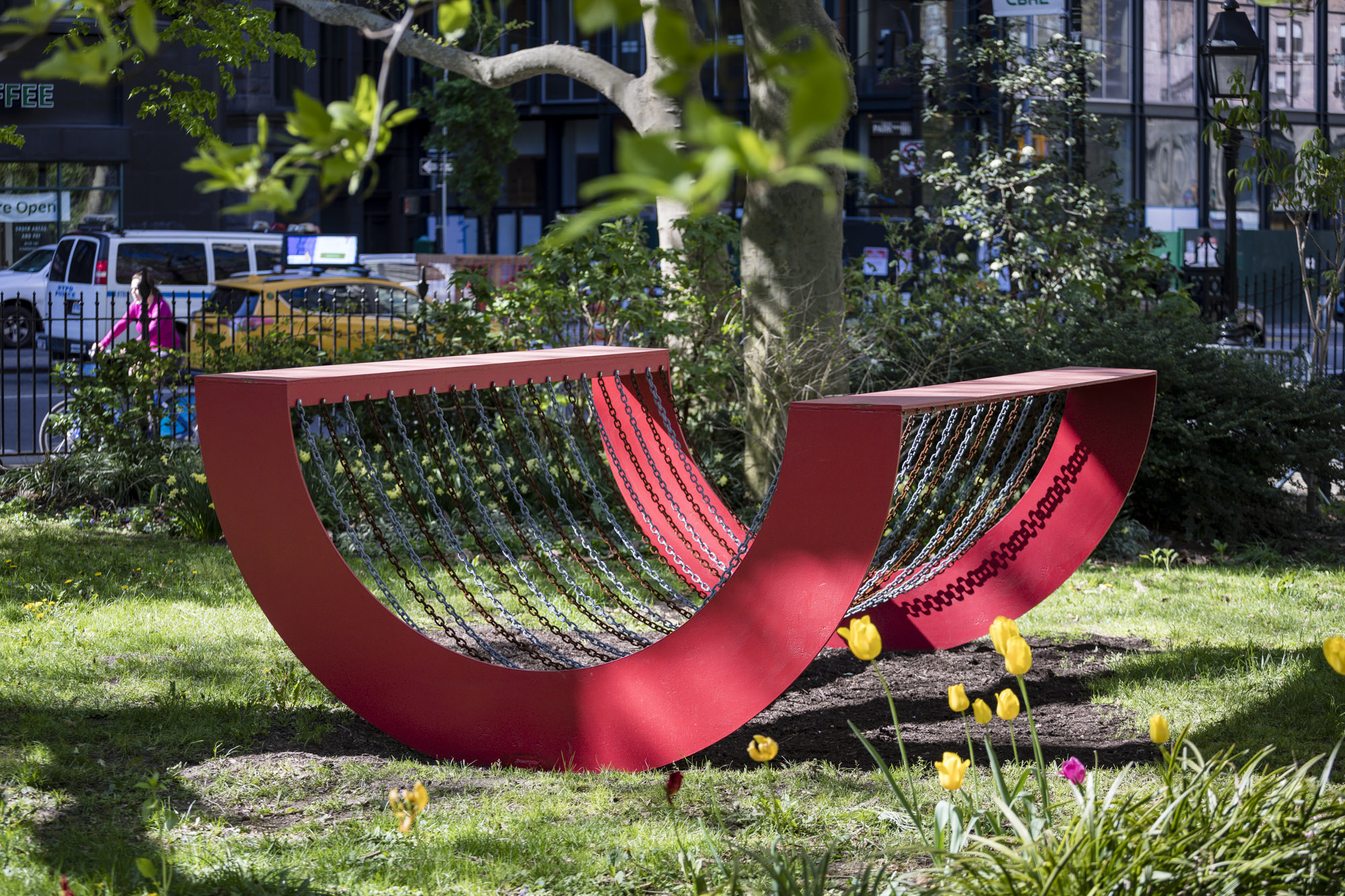
Sarah Lucas transforms commonplace objects including oranges, hosiery, boots, and buckets, into playful, symbolic forms. Florian and Kevin are enormous cast concrete vegetables that sit in the gardens of City Hall Park as if they’ve grown from Alice’s Wonderland overnight. Like benches made for giants, these two oversized “brothers” call to mind the prize-winning squash of the state fair, just waiting to be pinned.
Ugo Rondinone
(b. 1964, Brunnen, Switzerland)
dog days are over, 1996/2013
Performance
Courtesy of the artist and Gladstone Gallery, New York
Ugo Rondinone has used the figure of a classic clown since the early 1990s in performance art, video, and sculpture. Continuing the exploration of that theme, dog days are over features a big-bellied clown with a larger-than-life presence as a stand-in for a modern day shaman. In the context of City Hall Park, Rondinone has collaborated with fashion designer Victoria Bartlett to create this contemplative alter ego.
Presented at different locations around the fountain, Fridays 11:00 am–5:00 pm, weather permitting
David Shrigley
(b. 1968, Macclesfield, England)
Metal Flip Flops, 2001
Steel
Private Collection, USA. Courtesy of the artist, Stephen Friedman Gallery and Anton Kern Gallery, New York
Both deadpan and slapstick in his approach to art making, David Shrigley is best known for his humorous drawings that reflect sardonic observations on everyday life with acerbic wit. Shrigley’s Metal Flip Flops are steel reproductions of the artist’s own size 13 flip-flops, installed on the pavement by the fountain as if left behind by a visitor. No longer functional footwear, these flips-flops are neither useable nor disposable. Instead, they ironically assert their presence as a monument to the mundane.
Gary Webb
(b. 1973, Hampshire, England)
Buzzing it Down, 2012
Cast aluminum, paint
Courtesy of the artist and Bortolami Gallery, NY
Incorporating pop art references, synthetic materials, and an exuberant use of color, Gary Webb’s enigmatic sculptures often explore the formal interplay between abstraction and figuration. Buzzing it Down is a large-scale cast aluminum sculpture painted in brilliant and reflective chrome hues. Like round, stacked Lego blocks, each form playfully whips liquid color around the minimalist totem.
Franz West
(1947–2012, b. Vienna, Austria)
Untitled, 2012 (finished posthumously)
Epoxy resin, metal, lacquer
Franz West Foundation, courtesy Gagosian Gallery
From the 1960s until his death in 2012, Franz West explored the interplay between art and audiences with a diverse array of sculptures, performances, and installations. Premiering at City Hall Park, Untitled is one of the final works conceived by the artist. In keeping with many of his sculptures, these irregular forms have a strong sense of physicality and surface texture. Like bulbous, inverted pears, they populate the landscape in dialogue with the surrounding trees and the park’s urban context. Their pastel colors and eccentric, top-heavy shapes suggest an unlikely dance, both whimsical and enchanted.